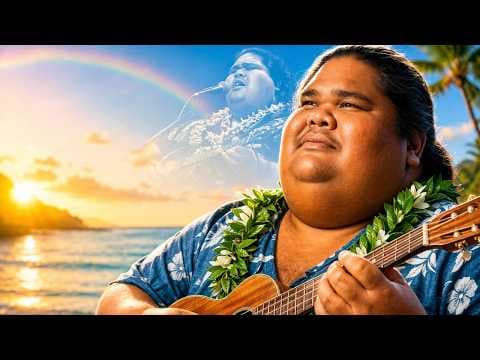
Israel Kamakawiwoʻole — Le géant doux derrière la chanson la plus réconfortante du monde
Audio Summary
AI Summary
Millions recognize the gentle opening of "Somewhere Over the Rainbow," a song that has resonated at weddings, in hospital rooms, during farewell ceremonies, and in quiet late-night moments of reflection. Yet, many cannot name the man behind the voice: Israel Kamakawiwoʻole. He was not destined for the typical American music industry, lacking the mainstream profile and never seeking to transform himself for wider appeal. He remained in Hawaii, a choice that profoundly shaped his path.
Born in Honolulu in 1959, Israel grew up in an Hawaii largely unseen by mainland America. While tourists flocked to beaches and sunsets, native Hawaiians grappled with issues of identity, sovereignty, and the erosion of their language and traditions. For Israel, music was concrete, not abstract. His parents worked in a Waikiki nightclub, his father in security, his mother managing operations. Instruments were tools, not decorations, used to pay bills and fill venues. His uncle, Moe Keale, a respected figure in Hawaiian music and television, taught him that music could preserve memory, protect a language, and carry history within a melody.
Israel experimented with various instruments—piano, guitar, flute—but the ukulele became his constant companion. Portable, intimate, and deeply Hawaiian, it brought people together rather than dominating a space. From an early age, Israel was physically distinct, a large child who continued to grow. While such a physique might draw spectacle elsewhere, in his community, it evoked concern and protection. His family watched over him, and music provided a space where his body wasn't the primary focus. His older brother, Skippy, shared his love for music and his struggle with weight. They were very close, singing together almost constantly.
In the 1970s, they joined other local musicians to form The Sons of Makaha. Their aim was local, not national chart success. They performed traditional Hawaiian songs, emphasizing language preservation and cultural pride on small stages across the islands. Their audience consisted of local families who connected with the lyrics, not just tourists seeking entertainment. Israel's stage presence was striking; his imposing physical size contrasted with his soft, clear, and controlled voice. It seemed to float rather than impose, disarmingly drawing listeners in.
The group gained recognition in Hawaii, selling albums consistently, and Israel became known as a voice carrying something familiar and deeply rooted. However, island success didn't guarantee stability. In 1982, Skippy died from obesity-related health complications. The loss was immediate and brutal, serving as a stark warning to Israel, who shared his brother's physical struggles. Though the band continued for a time, something had broken. Israel eventually stepped back, beginning a solo career not for greater fame, but because music was his sole remaining constant.
His early solo albums resonated deeply with Hawaiian audiences, earning local awards and circulating widely. He became a familiar voice at community events and on local radio, but outside Hawaii, he remained largely unknown. There was no indication that a simple, stripped-down recording would one day cross the Pacific to become one of American popular culture's most recognizable voices.
The moment that changed everything didn't come with a contract, but with a 3 AM phone call to producer Milan Bertosa. An impulsive request from a very large Hawaiian man who wanted to record immediately. No elaborate plans, just a ukulele and a song. Studio time was expensive, and improvised sessions rarely yielded memorable results. Bertosa hesitated but accepted. When Israel Kamakawiwoʻole entered the studio, he literally filled the doorway. With only a microphone in a quiet room, they kept it simple—no band, no layered production. Israel adjusted his position, held his ukulele close, and began to play.
The first notes were soft, almost hesitant, compelling the room to slow down. Without rushing or trying to impress, he sang "Somewhere Over the Rainbow." His interpretation was controlled and restrained, letting the melody exist without embellishment. Mid-song, he seamlessly transitioned into "What a Wonderful World," an instinctive blend that felt natural. Slight breaths between phrases, small imperfections—nothing was corrected or smoothed. They didn't record a second take. What they captured that night wasn't powerful or radio-calibrated; it felt deeply personal.
The recording didn't immediately explode. It was included on his 1993 album, *Facing Future*, a project rooted in Hawaiian themes and local identity. In Hawaii, the album found its audience, selling steadily and spreading by word-of-mouth. Visitors heard it and took copies home. But there was no national marketing campaign, no sudden television appearances. The song moved quietly. Music supervisors began using it for reflective closing scenes, followed by television producers. Gradually, the recording appeared in contexts far removed from its island origins. Radio stations that never played Hawaiian music began integrating it, and an unusual phenomenon occurred: people formed an emotional connection with the voice before knowing the man. They heard comfort, calm, and stability, without seeing the physical reality behind the voice.
As the mid-1990s approached, its dissemination accelerated, appearing in films, commercials, and TV series nationwide. Meanwhile, Israel's body endured increasing strain. Tours were physically grueling, requiring special arrangements for travel and accommodations. Even short walks left him breathless, and he sometimes needed oxygen between concerts. Doctors warned of critical pressure on his heart and lungs. Despite the risks, he continued to sing. On stage, his controlled voice and stable breath belied the immense physical burden. Off stage, constant fatigue plagued him. At his heaviest, he exceeded 750 pounds, making movement an unimaginable effort. Medical monitoring was daily. Loved ones described his constant exhaustion even amidst success.
Yet, the recording continued its journey, reaching more listeners in intimate moments across the country. The song grew faster than his body could keep pace. Invitations from the mainland multiplied, and media attention grew. His version of "Somewhere Over the Rainbow" transcended regional success to become a cultural presence. Still, he never left Hawaii, remaining loyal to the place that shaped his voice and identity. As the world discovered his song, the physical toll silently escalated.
By 1997, the warnings were no longer distant. Doctors had explained the extreme pressure on his heart and lungs for years. Breathing was an effort, sleep monitored, medical visits routine. In public, he remained warm, accessible, with an easy smile and quick laugh, greeting people by name. Privately, each day was physically exhausting. There was no scandal or public breakdown, just a body reaching its limits. On June 26, 1997, Israel Kamakawiwoʻole died at 38 from respiratory failure. At an age when most artists plan their next decade, his passing went largely unnoticed on the American mainland. The song continued to circulate, some listeners still unaware of the face behind the familiar voice.
In Hawaii, it was different. Over 10,000 people gathered to honor him. The state lowered its flags to half-mast, a rare honor for an artist. His body lay in state at the Capitol, with families queuing for hours, bringing flowers and leis, many standing in silent homage to one of their own, not an international star. Shortly after, his ashes were scattered in the ocean, surrounded by canoes carrying friends, family, and community representatives. The Pacific, the ocean that defined island life, received what remained of him. There was no spectacle, just tradition.
After his death, something unexpected happened. The recording traveled even further. The "Somewhere Over the Rainbow" music video, showing scenes of daily Hawaiian life and his memorial, spread widely. For many outside the islands, it was their first glimpse of the man behind the voice. Listenership soared year after year. The song appeared in more films, series, and commercials, becoming a go-to choice for weddings, farewells, and moments when words failed. His version slowly embedded itself in American culture.
The silent reality is that his global recognition truly exploded after his death. He never fully witnessed how far his recording would go, how many families it would comfort in hospital rooms, how many couples would walk down the aisle to his music, or how many lonely people would press replay in the night. He stayed in Hawaii, but the song never stopped. Decades later, as the first notes of his ukulele resonate, most people don't think of charts or the industry. They think of a memory, a person, a moment they try to hold onto. And without knowing his full story, they let his voice fill the space. Israel Kamakawiwoʻole didn't live long, didn't overcome his health issues, and never became a classic pop star. But he left something that continues to gently circulate in people's lives. And when the first phrase begins, "Somewhere over the rainbow," it continues to do exactly that.