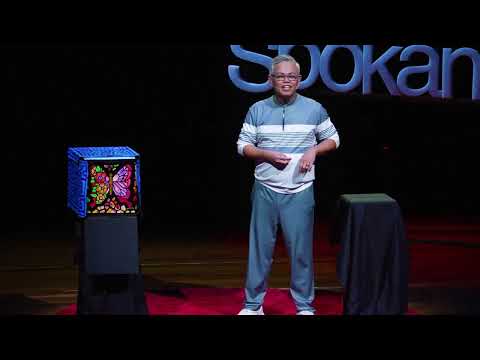
What happens when you stay in the box? | Gatieh Nacario | TEDxSpokane
Audio Summary
AI Summary
Growing up in the Philippines, the speaker was taught that success meant studying hard, earning a degree, securing a stable career, and supporting family. They followed this path, achieving a doctorate in education, becoming a university leader, and serving as vice president for academics, overseeing numerous programs and guiding deans. By all conventional measures, they were successful, which they visualized as a "blue box" – blue representing education degrees and the many people they helped become educators. This box, however, was never their true dream.
As a child, the speaker yearned to be a painter, dancer, singer, actor, and performer. Their artistic inclinations were often discouraged due to financial constraints, with parents reminding them of the cost of art supplies and costumes. The prevailing message was that art was not a "real career" and should only be pursued as a side hobby after securing a stable job. Consequently, they chose a safer, more affordable dream: an education degree, believing teaching would provide stability and allow them to support their family. Despite their professional success, they felt an emptiness, as the artist within continued to "knock from the inside."
They tried to integrate art into their life wherever possible, winning poster-making contests, joining drama productions, competing in dance sports, and choreographing cultural dances. For a time, they believed this was sufficient. However, as their leadership responsibilities in academia grew, the "blue box" closed in, filled with strategic planning, curriculum revisions, and faculty training, leading to "less joy." They observed a lack of support for artists in their upbringing environment, with limited theater spaces, access to musical instruments, or art organizations. They postponed their artistic ambitions, thinking, "maybe someday."
In 2019, at the age of 45, the speaker immigrated to the United States. Arriving with education and experience but no guarantees, they found themselves in a new place where no one knew them. This anonymity offered a unique opportunity to give themselves "permission to create, permission to explore, permission to just be." The buried dream resurfaced, making them feel "born again." While awaiting work authorization, they immersed themselves in local arts and theater communities.
Less than a year after arriving, they painted their first mural and were later nominated for an arts award. They continued to create murals, driven by courage rather than qualifications, volunteering and introducing themselves. This revived their childhood dream of being a painter and artist, undeterred by their lack of a fine arts degree. Another transformative moment occurred when a stranger at a karaoke bar encouraged them to pursue theater. Despite having no acting training or theater degree, they auditioned, leading to 15 theater productions in less than six years, including a nomination for a Broadway World Seattle Award. An article celebrating their work in painting and acting highlighted the opportunities that emerged outside their "blue box."
Through these artistic endeavors, they found a sense of belonging in their new home, realizing it was courage, not academic degrees, that facilitated this connection. They noted that the message about art being secondary to a "real job" was consistent across different countries and cultures. However, they refused to let age, accent, race, or sexuality hinder them, believing in the universal power of courage to utilize one's talents.
The speaker emphasizes that courage is the "paintbrush" that allows individuals to create the life they desire, rather than conforming to external expectations or circumstances. They encourage listeners to imagine their own "box," assess their contentment, and find the courage to open it, stressing that it's never too late to start. They reveal their "box of courage," with each side representing a moment from their journey, such as a butterfly, sun, roots, star, paintbrush, palette, and phoenix, all symbolizing courage in motion. They conclude by asking listeners to consider what is inside their own current box.