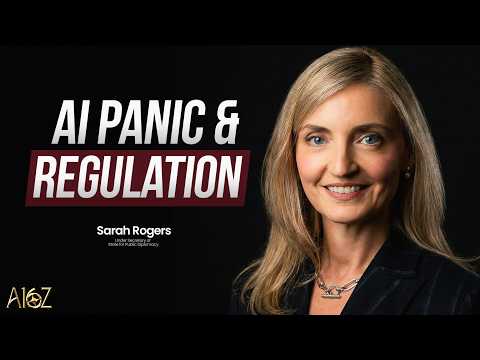
Digital Freedom, AI Regulation, and the Fight for the Western Internet | The a16z Show
AI Summary
AI's increasing importance necessitates the proliferation of a Western AI stack, a top priority for those valuing freedom. The rapidly changing AI regulatory landscape, particularly abroad, is influencing lobbying efforts in America to adopt similar digital safety and misinformation regulations. It's crucial that policy signals in this domain align with free speech principles. The concept of "AI with a Western soul," as coined by economist Tyler Cowan, represents a powerful soft power tool for the US. This kind of AI, reasoning individualistically, rules-based, and prioritizing user consent, embodies Western values and will underpin global communication and commerce.
Under Secretary Rogers, a vocal proponent of free speech and digital freedom, explained public diplomacy as the relationship between the American government and foreign publics, encompassing educational exchanges, global public affairs, and engagement with the information environment. Historically, this included censorship efforts, such as the Global Engagement Center contacting social media platforms to remove content deemed disinformation. However, under Rogers's tenure, the digital freedom office has shifted focus, pursuing transparency and freedom of expression as a primary prong of public diplomacy, effectively reversing prior censorship practices.
While the internet mostly works freely in America, many countries lack such freedom. The US stance on internet freedom abroad has evolved. Initially, during the Arab Spring, the foreign policy establishment saw internet freedom as a positive force, enabling disintermediated conversations and challenging entrenched authorities. However, anxieties arose after the Arab Spring and events like Trump's election and Brexit, leading to efforts to transform internet freedom initiatives into "disinformation curation" and suppression of "adverse narratives." Rogers acknowledges that many involved in these efforts had pro-social intentions, aiming for an ecosystem with more access to true information and less misinformation from adversaries. Yet, she believes they "went overboard," echoing historical anxieties about new communication technologies like the telegraph and printing press. She argues that fettering technology is inconsistent with American values and interests; instead, it should be used to empower people.
Digital freedom is a national security issue, especially given how easily adversarial nations can create and spread disinformation, a concern heightened by AI. The State Department has undergone reorganization, granting Rogers's office new authorities under the National Defense Authorization Act to promote internet freedom. While combating malware, spyware, and cyberattacks remains a priority, the approach to information integrity has changed. Instead of opaque, tyrannical choke points that decide what arguments users can see, the focus is now on empowering users with tools like content provenance to determine the origin and veracity of online content, including AI-generated material. Initiatives like censorship circumvention VPNs and X's community notes, which put power in the hands of users transparently, are now favored.
Regarding AI, a "Project Maven moment" for tech and American dynamism, Rogers highlights the EU and other governments' actions on free speech as a concern. Project Maven catalyzed awareness of the link between tech innovation and national security but also sparked ideological employee revolts at Google. With AI, policy makers recognize its transformative power. The idea of "AI with a Western soul" is paramount, emphasizing reasoning that is individualistic, rules-based, and prioritizes user consent. The proliferation of a Western AI stack is a top priority for the administration and anyone who cares about freedom.
Rogers notes that while the US is much harder on adversaries like Russia and China for internet censorship, the EU's approach is different and concerning. Unlike adversaries who firewall their internet, the EU purports to levy fines on American companies for allowing American citizens to engage in First Amendment-protected speech on American political issues. She cites a key moment in August 2024 when a European Commission official threatened Elon Musk with regulatory penalties if he aired an interview with then-presidential candidate Donald Trump on X, even before the interview occurred. This was coupled with an ongoing investigation into X regarding blue check authenticity and algorithm transparency, with the official implying that airing the interview would increase X's exposure to adverse findings in the other regulatory crackdown. Rogers views this as viewpoint-skewed enforcement of ostensibly content-neutral regulations, which she finds insidious and inevitable in politically charged contexts. She argues that European censorship laws, making it illegal to insult politicians or blaspheme, when transposed to a transnational internet and enforced with substantial fines on American companies, force an international conversation.
The US values alliances with Europe, aiming for safe, strong, and prosperous allies who share an interest in free expression. Rogers hopes for constructive progress in negotiations on regulatory actions, not necessarily leading to identical speech regimes, but preventing a "sweeping censorship contagion."
On AI regulation, Rogers identifies copyright as a major issue. She highlights CDA230 and the fair use doctrine as structural features of the internet, both artifacts of American law, that have facilitated its growth. Recent court rulings supporting the training of AI as fair use are positive. However, regulatory temptations in other countries, including the EU, to treat copyright differently could be devastating. Similarly, while transparency in IP is understandable, forcing companies to disclose aspects of AI that allow foreign adversaries to reverse-engineer models compromises the American and Western competitive edge.
Rogers also expresses concern about applying content regulations for "very large online platforms" to AI. These regulations often require vague "risk assessments" for hate speech or speech that could adversely affect civil discourse or well-being. She finds draft legislation imposing strict criminal liability if an LLM is even capable of generating certain content, even if not obscene under the First Amendment, to be dangerous. This kind of strict liability regime degrades CDA230 protections and disincentivizes creative model training.
Regarding contracting with the Department of Defense and the broader implications for AI, free speech, and national security, Rogers emphasizes that AI must maintain its "Western soul." Debates about autonomous weapons or data synthesis scope should occur through established constitutional processes—in courts, on state house steps, and in democratic deliberation—rather than being subject to the fiat of Silicon Valley executives or tech workers. She stresses the importance of the rule of law as a touchstone.
On how the US government can encourage free speech in the private sector, given that Elon Musk's acquisition of Twitter (now X) is not a replicable playbook, Rogers offers several suggestions. Firstly, the government should avoid creating capricious and arbitrary regulatory cudgels, like those seen in Europe's blue check investigation or some debanking cases where ostensibly viewpoint-neutral regulations were disproportionately enforced against groups with certain viewpoints. The regulatory environment should be crisp and principled, with clear compliance guidelines. Secondly, any tech regulations should favor viewpoint neutrality. Rogers notes a positive shift in the tech industry towards free speech since 2020, significantly catalyzed by Elon's purchase of X. She believes many founders are patriotic and possess a "gray tribe freedom impulse." Regulations should incentivize viewpoint neutrality, a concept from First Amendment law. This doesn't preclude founders from offering users tools to curate their information environment in other ways, such as seeing less spam or pornographic content, as these are not viewpoint-based distinctions and should be treated more favorably by regulations. Lastly, government officials must stand up for American companies and political freedoms when threatened internationally. Just as the French government would defend its platforms, the US government should not tolerate foreign threats against American companies for hosting protected speech. Policy signals in this domain must be consistent with free speech.