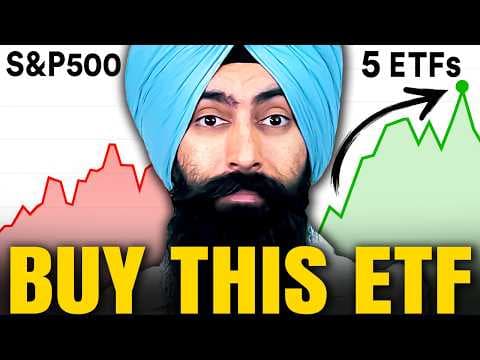
5 ETFs That Beat the S&P 500 for the Last 10 Years (Nobody Talks About Them)
Audio Summary
AI Summary
The S&P 500, averaging around 10% annual returns, serves as a benchmark for investment success. However, even slightly exceeding this average can lead to significantly greater wealth accumulation over time. For instance, a one-time $10,000 investment over 30 years would grow to $174,000 at 10% annual returns. This same investment, at 13% per year, would reach $395,000, at 15% it would grow to $662,000, and at an impressive 17%, it could reach nearly $1.1 million. These figures highlight the power of compounding and the substantial impact of even marginal improvements in returns, especially when combined with consistent additional investments.
While higher returns often correlate with increased risk, the video explores strategies and specific Exchange Traded Funds (ETFs) that have historically outperformed the S&P 500, potentially offering better returns with managed risk. It's crucial to understand that all investments carry risk, and past performance is not indicative of future results. Blindly trusting any investment advice, especially from unverified sources, is discouraged.
An ETF is a fund that can be bought on any stock brokerage, offering exposure to a basket of assets. The S&P 500 ETF, like SPY, provides exposure to the 500 largest U.S. companies, automatically rebalancing its holdings as companies' market capitalizations change. Investing in the S&P 500 is generally considered a diversified and less risky approach, representing broad exposure to the U.S. economy. Despite market crashes and recessions, the S&P 500 has averaged 10% annual returns over the long term, emphasizing the importance of a long-term investment horizon and avoiding panic selling during downturns.
The video then delves into specific ETFs that have historically outperformed the S&P 500:
1. **VUG (Vanguard S&P 500 Growth ETF):** This ETF focuses on S&P 500 companies classified as "growth" companies, excluding value and slower-growing firms. Over the last decade, VUG has averaged approximately 16% annual returns, slightly outperforming the S&P 500's average of 15.75% during the same period. While value companies can offer protection during downturns, growth-oriented funds aim for higher appreciation.
2. **XLK (Technology Select Sector SPDR Fund):** This ETF concentrates on technology companies within the S&P 500, typically comprising 65-70 companies. Due to the rapid growth of the tech sector, XLK has averaged around 21% annual returns over the past decade, significantly outpacing the S&P 500. This illustrates the potential of sector-specific investments, assuming continued growth in that sector.
3. **PPA (iShares U.S. Aerospace & Defense ETF):** This ETF invests in companies within the aerospace and defense industry, such as Lockheed Martin, RTX, and Boeing. These companies often benefit from consistent government spending, regardless of economic conditions, particularly during periods of geopolitical tension. Over the last ten years, PPA has averaged approximately 19% annual returns, outperforming the S&P 500. The video notes that a good financial investment must make financial, legal, and moral sense to the individual investor.
4. **SPMO (Invesco S&P 500 Momentum ETF):** This ETF tracks the top 100 momentum companies within the S&P 500. Momentum investing aims to capitalize on stocks that are already growing rapidly, with the expectation that this growth may continue. While this strategy can be more volatile and leans towards trading, SPMO has averaged over 18% annual returns in the last decade, outperforming the S&P 500. The underlying S&P 500 constituents provide a foundation of established companies.
5. **SMH (VanEck Semiconductor ETF):** This ETF offers exposure to the semiconductor industry, crucial for powering everything from smartphones and AI servers to automotive and medical devices. Driven by the AI boom and increasing demand for computing power, SMH has demonstrated exceptional performance, averaging a remarkable 33% annual return over the past decade, more than doubling the S&P 500's returns. The video acknowledges the potential for an AI bubble but emphasizes the fundamental need for semiconductors.
6. **QQQ (Invesco QQQ Trust):** As a bonus, the video discusses QQQ, which tracks the NASDAQ 100. This index comprises the 100 largest non-financial companies listed on the NASDAQ stock exchange, heavily weighted towards technology. QQQ has outperformed the S&P 500 for decades, averaging around 18% annually over the last ten years. However, its heavy tech concentration makes it more volatile, experiencing larger gains in bull markets and steeper declines in bear markets.
A key strategy for long-term success with ETFs, especially those with higher volatility like QQQ, is "Always Be Buying" (ABB) and "Buy the Dip" (BTD). ABB involves consistently investing a set amount regularly, regardless of market conditions. BTD emphasizes increasing investments during market downturns when assets are discounted. This approach, coupled with maintaining cash reserves for buying opportunities during crashes, helps investors capitalize on market cycles rather than succumbing to emotional selling. Market downturns, such as those in 2022, 2020, and 2008, are presented as opportunities to acquire quality investments at a discount. The core principle is to remove emotion from investing and maintain a long-term perspective, recognizing that market crashes and recessions are cyclical events.
The video also briefly touches on the importance of tax planning and working with qualified tax advisors, highlighting the potential costs associated with poor tax advice. Finally, it reiterates that while the S&P 500 provides a solid foundation, seeking slightly better returns through diversified and historically outperforming ETFs, combined with a disciplined investment strategy like ABB and BTD, can significantly accelerate wealth accumulation over the long term. The ultimate goal is to become a financially savvy investor who leverages market cycles to their advantage.