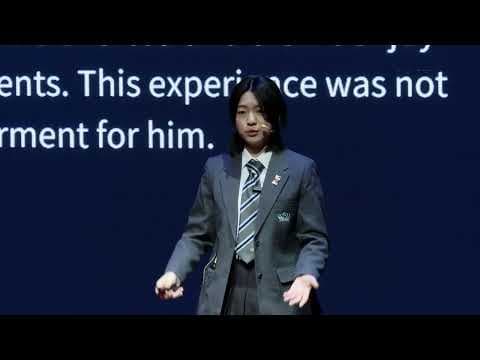
Think Again: Find Your Own Passion,Don’t Let It Go | Zhang Elsa | TEDxNACIS Shanghai Youth
Audio Summary
AI Summary
The speaker begins by asking the audience about their passions and whether their stated interests are genuine or merely for external validation, particularly when applying to universities. They observe a trend where students design hobbies to appear well-rounded for applications, rather than pursuing what genuinely excites them. For example, an engineering applicant might suddenly claim to be a robotics enthusiast without prior experience, or a biology applicant might join an environmental club despite disliking its activities, solely to include it in an essay. This leads to dishonesty with oneself, teachers, and admissions officers, resulting in time spent on activities one doesn't care about, eventually forgetting the joy of doing something purely for pleasure.
The speaker emphasizes that admissions officers seek authenticity, not a perfect list of hobbies. They are looking for what truly ignites an applicant's interest, something they would pursue even when unobserved. A genuine passion, stemming from the heart, is presented as more impactful than fabricated interests. An example is given of a friend, Lily, who loved painting since childhood. When applying to universities, she simply showcased her sketchbooks and spoke passionately about her creative process, leading to her acceptance. Her success was attributed to the authenticity of her passion, not its strategic alignment with her major.
In contrast, another individual spent a year volunteering in a hospital for medical school applications, despite disliking sick people and feeling shy. His essay about the experience lacked sincerity, leading to his rejection. He later expressed regret for wasting a year on something he didn't care about for external approval.
The speaker then asks why people engage in such self-deception, attributing it to fear that their true hobbies, like reading fantasy novels or playing video games, are not "perfect enough" or are perceived as silly or old-fashioned. They argue that all passions are valid, regardless of whether they make one appear smart or talented. Following genuine passions leads to increased focus, confidence, and vitality, and develops skills effortlessly. This authentic energy is what truly stands out in applications, job interviews, and life.
The speaker encourages the audience to stop designing their hobbies and instead embrace what genuinely feels good. They urge listeners to revisit abandoned sketchbooks, forgotten instruments, or intriguing clubs. The core message is to prevent passion from becoming a mere tool for grades, applications, or approval. Ultimately, being true to oneself, discovering and holding onto one's true passion, is presented as more important than getting into top universities. The talk concludes with a plea to find and cherish one's passion.