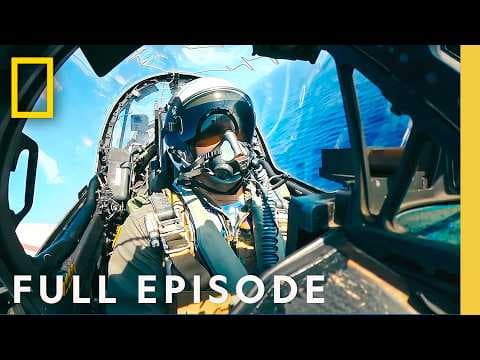
Catching the Wire (Full Episode) | Top Guns: The Next Generation | National Geographic
Audio Summary
AI Summary
The United States Navy's fighter pilot training is exceptionally challenging, requiring pilots to master landing on aircraft carriers, a feat with an incredibly small margin for error. Failure to land correctly can result in fatal consequences or necessitate a go-around. This documentary provides an unprecedented look into the advanced stages of this elite training, where pilots hone skills for frontline combat, including dogfighting, carrier landings, low-level flying, and precision bombing. The ultimate goal is to earn fighter pilot wings, a distinction achieved through the most intense training imaginable. However, not all trainees succeed, with many facing setbacks and the possibility of elimination from the program.
Carissa Meinster, initially on a path to become a military doctor, was inspired to pursue aviation after a flight with an F-18 pilot. Her husband, Ben, is already a Navy F-18 pilot, and Carissa hopes to join him in Lemoore, California, to live and work in the same location. Carissa has successfully completed the strike bombing phase but is currently struggling with the next stage: Field Carrier Landings. Due to the inherent dangers of at-sea carrier landings, students practice on a runway at Meridian, simulating the carrier's landing area. This involves aggressive, "violent" landings to ensure the tailhook engages one of the arresting wires. Missing a wire leaves less than 500 feet to become airborne again.
The training incorporates "Touch-and-Go" maneuvers, where pilots accelerate immediately after touchdown to simulate a missed wire scenario, allowing for a swift takeoff. To pass, students must demonstrate improvement over 13 flights, each with six touch-and-go landings. Carissa failed her initial carrier qualification attempt and is now repeating all 13 flights. She describes the experience of not being "enough" after immense effort as "painful." The program demands constant vigilance; any lapse can lead to failure. Self-doubt is a common companion for trainees, but execution is paramount.
Captain Stephanie Harris, another female pilot in Carissa's class, is on track to pass her carrier qualification. Harris has a unique background, having lived on a houseboat and interned at the UN before joining the Marines. She feels a strong sense of being a protector.
Carissa is nearing the end of her resit, with only two flights remaining. Failing carrier qualification a second time would result in dismissal. Carissa acknowledges the program's difficulty and the internal struggle to believe in oneself, emphasizing that the only way forward is to repeat the challenging tasks.
Commander Polson and Lieutenant MacGriff, landing signal officers, scrutinize each touch-and-go, guiding students on the "ball" – an amber light indicating the correct glide slope. The "datums," green lights on the runway, represent the touchdown point. If the ball is above the green line, the aircraft is too high; below, it's too low, risking a crash into the carrier's stern. "Roger Ball" is a communication confirming the pilot sees the ball and is cleared to continue. An improving trend in landings is crucial for progression.
Carissa's primary issue has been erratic power corrections, leading to inconsistent heights above the target touchdown point. Her trainer notes that overcoming this hurdle is very difficult. During one attempt, Carissa's power correction was insufficient, causing her to descend below the glide slope, prompting a wave-off. Had this been a real carrier landing, she would have crashed.
Stephanie Harris, in contrast, is a standout performer. While not every landing is perfect, her ability to manage corrections, even when starting too high, indicates a strong grasp of the maneuvers. Carissa fails four of her six attempts on this day, leaving her with one final attempt, which she also fails due to being too high. The instructors emphasize not relying on luck and the importance of consistent power management.
Andrew Charles Seepe, another student, has harbored a dream of being a fighter pilot since childhood, captivated by the idea of flying advanced aircraft and being compensated for it. He possesses a degree of arrogance, a trait common among fighter pilots, but which needs to be tempered. Andrew is known for his impulsive remarks and occasional trouble. His wife describes him as "gung-ho" and someone who gives 110%. He finds the roar of F-18s motivating.
During a training flight with families present, Andrew is warned not to do anything stupid. Despite acing his touch-and-gos, he attempts an excessively fast approach, exceeding 440 knots instead of the standard 350. This "riding the lightning" leads to a reprimand from his commanding officer. As a consequence, he is grounded and assigned to duty desk work, a "penance" for his misconduct. His superiors emphasize that such breaches of trust and unsafe actions will not be tolerated on an aircraft carrier. Andrew reflects on his actions, acknowledging their danger and his tendency to learn "the hard way."
The training philosophy has evolved; modern fighter pilots are not necessarily the cocky, aggressive archetypes of the past. A variety of personalities are valued. Stephanie Harris, outside of her training, leads yoga sessions, which she finds centering and beneficial for focus and decision-making. She believes yoga's values contribute to being a more careful and smart pilot. The mutual support among female pilots and trainees is highlighted as particularly helpful during struggles.
Carissa and Stephanie's final carrier landing flights are scheduled, but a hurricane threat forces a stand-down. Undeterred, Carissa utilizes a simulator to refine her landing technique, drawing on her academic background and past successes in overcoming challenges. Despite past setbacks in basic flight training, including failing a flight, she persevered. Her resilience and determination are noted by her instructors.
With clear skies, Carissa is cleared for her final carrier landing exam. This is a critical "make or break" situation for her dream of becoming a Navy fighter pilot. The pressure is immense. Stephanie also takes her final exam. Carissa's initial attempts are marred by nerves, with her first approach being too fast, followed by two more failed landings, leaving her with only two attempts to pass. The support of Steph and her husband's advice to breathe and focus helps Carissa regain composure. In her final two attempts, she demonstrates significant improvement, with her fifth and sixth passes being strong and consistent. Her instructors are satisfied, deeming her qualified to fly to the carrier. Carissa expresses pride in proving herself, both to her instructors and to herself, finally believing in her ability. Stephanie also successfully completes her qualification.
The focus then shifts to dogfighting, described as a "knife fight in the phone booth," where pilots learn fundamental combat maneuvers. Claggett is identified as having an aggressive personality, and the instructors stress that while competitiveness is present, the program cannot offer limitless chances, emphasizing a "put up or shut up" mentality.