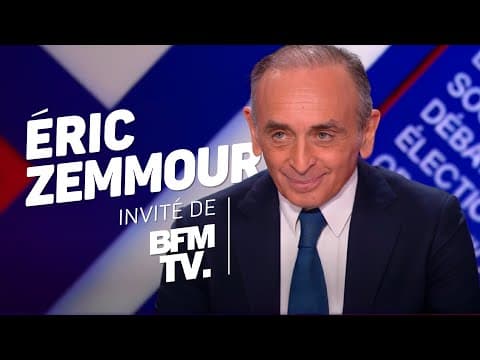
Eric Zemmour sur BFMTV : Il faut baisser les taxes sur le carburant !
AI Summary
Éric Zemmour, president of Reconquest, began by discussing the Pope's call for peace in the Middle East. While expressing respect for the Pope's moral authority, Zemmour stated his belief that peace is achieved through strength, not dialogue, citing Napoleon's view that "there is only one way to lead men, and that is to be strong." He differentiated between the Pope's moral power and a political power, noting the Vatican's diminished political influence since the Middle Ages.
Regarding Donald Trump's actions in Iran, Zemmour acknowledged concerns about potential entanglement but emphasized that success dictates whether Trump will be seen as a genius or a fool. He stated that he does not believe in international law for matters of state sovereignty, war, and peace, considering them to be governed by power dynamics.
Zemmour then distinguished between Trump's domestic and foreign policies. He supported Trump's internal policies, particularly those aimed at preserving Western identity, citing the example of 1.5 million foreigners being deported from the U.S. in one year, leading to population decreases in cities like Miami and Los Angeles. He highlighted this as proof that "remigration" can be effective.
However, Zemmour criticized Trump's foreign policy approach during his first term, believing it was hindered by inexperience and the "deep state." While acknowledging Trump's patriotism and defense of American interests, Zemmour stressed that French and American interests can diverge, recalling past instances where the U.S. was not "tender" with France. He argued that Trump's current strategy of bombing without ground troops is insufficient to overthrow a regime and that sending troops, as seen in Iraq, Libya, and Afghanistan, often leads to catastrophe.
He expressed a nuanced view on Emmanuel Macron's approach to the conflict, which he described as a mix of restraint and "agitation." Zemmour criticized Macron for inconsistency, citing his initial offer to lead a coalition to aid Israel after October 7th, followed by calling Netanyahu "barbaric" and banning U.S. planes supplying material for Israel's Iron Dome from French airspace.
On the domestic front, Zemmour condemned Trump's personal attacks on President Macron, calling them "vulgar" and "displaced." He then addressed the rising fuel prices in France, noting that the price of gasoline at €2 per liter is "unbearable," especially for people in rural areas who rely on cars. He criticized the government's handling of public finances, stating there is "no money left" for effective aid.
Zemmour rejected the government's proposed "flash fuel loan" as a cynical move, arguing it's lending people money to pay taxes already taken from their pockets. He also dismissed the left's proposal to block pump prices as "Venezuelan" and likely to cause shortages, and the National Rally's suggestion to lower VAT as too expensive and primarily benefiting consumers rather than enhancing competitiveness.
Instead, Zemmour proposed lowering the "Assise" tax on fuel, arguing it would be more effective as it's not reimbursed like VAT, thus benefiting working individuals. He estimated this would cost €12 billion, which he suggested could be financed by eliminating public development aid, an amount he claims is roughly equivalent. He argued that public development aid is no longer effective for French interests, as WTO rules prevent "tied aid" that would benefit French companies, and instead, it often serves Chinese interests or is misused for "woke" initiatives.
The discussion then turned to domestic politics, specifically a march against racism and discrimination led by the newly elected mayor of Saint-Denis, Bali Bakayoko, which was attended by Jean-Luc Mélenchon and other leaders. Zemmour refused to condemn controversial remarks made about the mayor, stating his belief in absolute freedom of expression, citing Spinoza. He reiterated his view that laws against "racist" speech are "liberticidal" and used by judges for political agendas.
Zemmour criticized Mélenchon's concept of a "New France," interpreting it as a call for a new population to replace the "French people of Greco-Roman and Christian civilization" with an "Arab-Muslim and African" population. He claimed Mélenchon is playing on words, using "generational change" to mask a demographic shift where the younger generation is increasingly Arab-Muslim, while older generations are "uniformly white and of Christian culture."
Regarding the new mayor of Saint-Denis's policies, such as banning LBDs (defense ball launchers) and considering disarming municipal police, Zemmour argued that this would effectively prevent police from controlling drug trafficking in housing estates. He suggested that such policies could be deliberate, implying a "complicity of elected officials and part of the population in drug trafficking." He even proposed a law similar to Italy's, allowing the dissolution of municipal councils infiltrated by mafias.
On the case of MEP Rima Hassan, who is being prosecuted for "apology of terrorism" for allegedly exalting a Japanese terrorist, Zemmour, while supporting free speech, said she must face the legal consequences, just as he has for his own convictions. He dismissed the controversy around drugs found in her bag, focusing instead on Jean-Luc Mélenchon's political strategy.
Zemmour asserted that Mélenchon's consistent strategy is to dominate the left by leveraging the Muslim electorate, seeing them as his "new working class," similar to how communists once dominated with the working class. He pointed to the high percentage of Muslim votes for Mélenchon in 2022 as evidence.
Finally, Zemmour addressed the upcoming presidential election. He dismissed the idea of a primary within his Reconquest party, stating that he has "all the time in the world" to announce his candidacy and is pleased with Sarah Knafo's success. He expressed skepticism about current poll numbers for Jordan Bardella, arguing that pollsters have often been wrong and tend to overestimate the National Rally. He reiterated his conviction that he can reach the second round of the presidential election, otherwise, he "wouldn't go."