Ce Business Caché et 100% Légal des Chaînes YouTube Anonymes et Automatisées
AI Summary
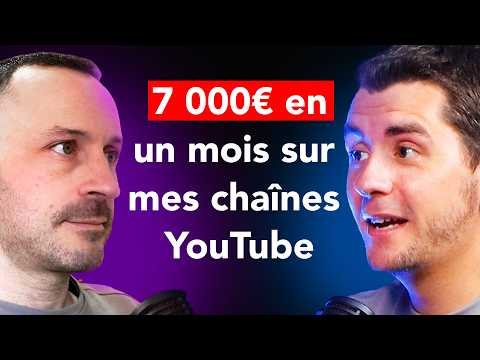
In this podcast, Romain, a 39-year-old entrepreneur originally from Brittany, France, shares his extensive journey from the physical business world to achieving a record-breaking €7,200 month through faceless YouTube channels. Having been independent since 2011, Romain spent over a decade running a window-tinting business for cars. However, after twelve years, he felt he had reached the limit of that industry and began looking toward the internet for new opportunities.
Romain’s transition to the digital space was not immediate. He first explored the "classic" online business models, starting with dropshipping in 2017. He launched three different online stores, learning the complexities of Facebook Ads and the "winner" product hunt. While he eventually managed to generate sales, he found the model exhausting and financially thin. Between high advertising costs, product costs, VAT, and customer returns, his profit margins were stuck between 10% and 15%. He then tried Amazon FBA, which offered a more passive income stream but required a significant upfront investment to source and ship inventory from China. These experiences, while not his final destination, provided him with a crucial foundation in digital marketing and persistence.
In 2020, Romain discovered the potential of "faceless" YouTube channels. His first venture into this space was a channel coupled with Amazon Affiliate links. This proved successful for three years until a compliance issue—failing to properly disclose his partnership in video descriptions—led Amazon to suspend his account for six months. This setback forced Romain to diversify and look for more stable ways to monetize YouTube, eventually leading him to discover Hervé and the "YouTube Business" program in late 2024.
Romain emphasizes that the "YouTube Business" approach changed his perspective on content creation. Instead of trying to mimic massive creators, the strategy involves identifying small, emerging niches that the algorithm is actively promoting. He highlights the importance of the mentorship aspect of the program, noting that having a professional to validate niche choices and troubleshoot technical issues is what separates successful creators from those who give up.
Today, Romain manages six YouTube channels. His workflow has evolved to incorporate significant automation; approximately 60% of his production process now involves Artificial Intelligence. He uses AI primarily for scriptwriting and voiceovers, debunking the common fear that YouTube penalizes AI-generated content. He explains that as long as the final product provides genuine value and quality to the viewer, YouTube remains a welcoming platform for these tools. To scale his operations, Romain delegates video editing—the most time-consuming task—while maintaining control over the scripts and overall strategy.
The financial results of this shift are significant. Romain recently hit a record month of approximately €7,200 in cumulative revenue across his channels. Unlike his previous experience with dropshipping, the profit margins on YouTube are exceptionally high, ranging from 70% to 80% after paying for tools and freelancers. He describes the simplicity of the model: no inventory, no shipping, and a single, reliable payment from Google every month on the 21st or 22nd.
Romain also views his channels as tangible digital assets. He recently sold one of his older channels on the marketplace Flippa. Even though the channel's performance had begun to stagnate, it still generated consistent monthly income from its back catalog of videos. Selling the channel allowed him to raise a lump sum of cash, which he immediately reinvested into his newer, high-growth channels. This "asset management" mindset is a key part of his long-term strategy.
The conversation also touches on the technical hurdles of the platform. Romain recounts a "false positive" incident where one of his main channels was suddenly demonetized for "reused content." This is a common fear for many creators, but Romain explains that with the right support, it is manageable. By following a specific appeal process and creating a video that proved his original creative work, he was able to get the channel reinstated within 48 hours. He notes that without a mentor to guide his appeal, he might have reacted with frustration or given up entirely.
The lifestyle benefits of this business model have allowed Romain to relocate to Spain, near Barcelona, where he has lived for the past five months. He is currently exploring further expatriation to Andorra, drawn by its security and favorable tax system (including a 4.5% VAT and a maximum 10% income tax). He notes that while Andorra is becoming more selective about residency, his YouTube income provides the geographic and financial freedom to pursue such moves.
Ultimately, Romain’s story serves as a roadmap for those looking to transition from traditional work to the digital economy. His main conclusion is that the most valuable thing he has gained isn't just the money, but the knowledge. He believes that even if all his channels were deleted tomorrow, he could sit down with a computer and an internet connection and rebuild his entire income from scratch in a few months. He encourages others to start for free, learn the process, and view YouTube not just as a hobby, but as a legitimate vehicle for wealth creation and geographic independence.