The winter before spring: The cultivated meat story | Ahmed Khan | TEDxLondonBusinessSchool
Audio Summary
AI Summary
The speaker introduces the concept of cell-cultivated meat, explaining that it involves producing meat directly from cells, bypassing traditional animal agriculture. This innovation aims to address future food system challenges, particularly the projected doubling of meat demand by 2050 due to a growing global population. Current livestock farming has a significant environmental footprint, consuming vast amounts of land and water, and contributing substantially to greenhouse gas emissions and deforestation.
Cellular agriculture offers potential benefits, including significantly reduced land and water usage, lower greenhouse gas emissions (with renewable energy), and improved public health by avoiding antibiotic use and zoonotic diseases. It also enhances animal welfare and could bolster food security by enabling local food production anywhere. Critically, this is distinct from plant-based alternatives; it is real meat grown from cells.
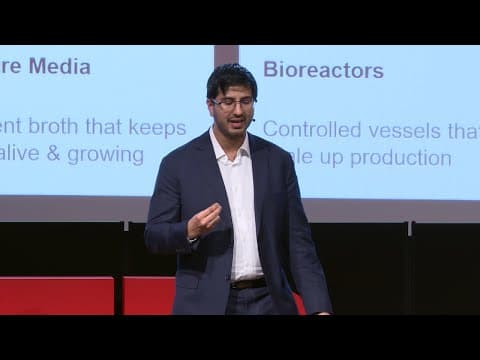
The process involves taking a small cell sample from an animal, isolating stem cells, and cultivating them in a nutrient-rich broth within bioreactors, mimicking conditions inside the animal to encourage proliferation and differentiation into meat. This technology borrows from the medical and pharmaceutical industries.
Despite its promise, the field faces significant challenges, including an "investment winter" characterized by a sharp decline in funding. This is attributed to setbacks in regulatory approval timelines and production scaling, as well as competition for capital from other booming sectors like artificial intelligence. Consequently, some companies have shut down or pivoted.
The speaker's research focuses on strategic partnerships to navigate this difficult period. A key finding is that cultivated meat startups can find opportunities in the drug and pharmaceutical industry. However, success requires repositioning their technology to address specific pain points in the pharma sector, such as faster market timelines or cheaper production. Companies must also de-risk their innovations and ensure regulatory compliance, as pharmaceutical firms are highly risk-averse. Cost reduction alone is insufficient; it must be coupled with demonstrated regulatory compliance.
Looking ahead, the speaker predicts a phased market entry for cultivated meat: limited launches in high-end restaurants within five years, more mainstream availability in premium restaurants and supermarkets in ten years, and widespread adoption at mainstream pricing in fifteen years, assuming scaling and regulatory hurdles are overcome. The ultimate goal is to shift the narrative from "can it be done" to "will consumers choose it." The speaker concludes by reiterating the potential of cell-cultivated meat, emphasizing that with the right partnerships and strategies, the field can emerge from its current challenges.