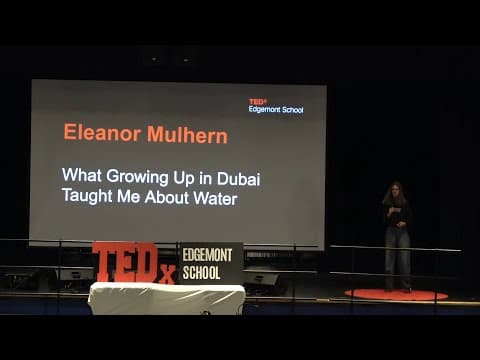
What Growing Up in Dubai Taught Me About Water | Eleanor Mulhern | TEDxEdgemont School
Audio Summary
AI Summary
The speaker reflects on spending ten years in the Middle East, first in Doha and then Dubai, living in a place called Sustainable City. This neighborhood, with its date trees, parrots, ducks, green lawns, sprinklers, and walking paths, felt lush, calm, and full of life. It was easy to forget they were in a desert, as water felt completely normal with pools, fountains, and watered fields.
However, just beyond their neighborhood was the desert—miles of sand and rocks with no natural fresh water or rivers, and very little rain. The speaker recalls a rare rainstorm after more than a year of drought, which friends and they celebrated by pretending to sail in cardboard boxes. At the time, this didn't seem unusual, but looking back, the stark contrast between abundant water in their neighborhood and the scarcity outside feels strange.
In Dubai, rain, though rare, often caused chaos rather than relief. Roads would flood, buildings leaked, underpasses filled, and cars became stranded. School often had "rain days" where students were sent home early because the city was built for heat and dryness, not for rain, lacking gutters and adequate drainage.
Over the years, it started to rain more, partly due to Dubai's use of cloud seeding, where planes release particles into clouds to encourage rainfall. This effort to create more fresh water meant the city had to deal with water in new, unprepared ways. The speaker then wondered where Dubai's water actually came from.
Most of Dubai's water doesn't come from rain or rivers but from the sea, through a process called desalination. Huge plants, miles of pipes, and enormous amounts of energy are involved in pumping, cleaning, filtering, treating, and distributing seawater across the city. These systems are invisible when they work, making water seem ordinary.
The speaker recently experienced a water main break in their current home, which abruptly made water stop feeling ordinary. This event highlighted how much daily life depends on these hidden systems, which are only noticed when they fail. The experience changed the speaker's perspective: water is not just "there" but depends on unseen systems, energy, maintenance, and decisions. This realization led to questions about what it takes to make water feel ordinary, what happens when those systems fail, and who gets to experience that sense of normalcy.