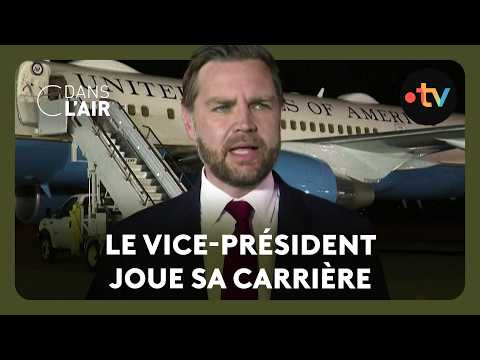
J.D. Vance à Islamabad
Audio Summary
AI Summary
Donald Trump has assigned his vice president, JD Vance, to lead negotiations with Iran, a move that is seen by some as a test or even a trap. Vance, who has historically been discreet and opposed to the war, now finds himself at the forefront of the conflict. Trump publicly joked about the situation, stating that if the agreement works, he gets all the credit, and if it fails, Vance is to blame, highlighting the pressure on his vice president.
Vance, a former Marine who served in the Iraq War in 2003, joined the MAGA camp in July 2024 with a vision of non-interventionism, believing that American youth should remain at home rather than be sent overseas. Despite publicly supporting the war's initiation, behind the scenes, Vance was reportedly the most vocal opponent of the war within Trump's advisory circle. He warned Trump that a conflict with Iran could lead to regional chaos, numerous casualties, and potentially fracture Trump's coalition.
The choice of Vance to lead the negotiations is interpreted in several ways. The Iranians specifically requested Vance, trusting him more than previous negotiators like Steve Witkoff, whose past efforts led to interventions. This suggests a strategic move to engage with a figure known for his opposition to military action.
Beyond the immediate goal of ending the war, these negotiations hold significant implications for Vance's political future. As a Republican favorite for the next presidential election, his handling of this crisis could significantly impact his chances for the White House. Some speculate that Trump enjoys pitting his protégés against each other, with Vance being one of three men vying for prominence. Marco Rubio gained recognition during the Venezuela operation, while Pete Hegseth, described as an "illuminated madman" eager for conflict, immediately took to the front lines. Vance, however, has played a more nuanced role, expressing hostility to the war while also aligning with the administration's direction. If he succeeds, it could pave a clear path for his presidential bid; if not, he might remain in the shadows, potentially serving as a scapegoat.
Reports from the Wall Street Journal suggest that Vance is leaving his "fingerprints everywhere," indicating an independent approach to the negotiations. Vance himself claims he wanted to undertake this mission, seeing it as politically beneficial. He needs to maintain the unity of the MAGA coalition, which includes right-wing and far-right figures like Tucker Carlson and Marjorie Taylor Greene, who have criticized the offensive in Iran, alleging it's orchestrated by Israel and fueled by antisemitism. Vance aims to include these groups in his coalition by demonstrating an effort towards peace, but his success remains uncertain.
While there were initial divergences between Trump and Vance regarding the war, functional convergences have emerged. Trump's decision to send a dissenting voice to the front lines is a strategic positioning. The Iranians' request for Vance is notable, as they recognized his opposition to military options and gave him credit for it. Vance is overseeing a team that includes Witkoff and Kushner. Traditionally, the vice president's role is largely ceremonial, but Trump has given Vance a crucial role in leading this process.
Doubts remain about the possibility of a "good agreement." Critics question what success would entail, fearing a "bad agreement" that might allow Iran to continue its nuclear program and lift sanctions, leading to a fragile peace that could quickly unravel with future Israeli interventions. Furthermore, concerns are raised about negotiating with a regime that has not changed but has radicalized, with the Revolutionary Guards now holding significant power. The ongoing extreme violence and the weakened state of Iran militarily also complicate the negotiations, as the future actions of Iranian opposition groups are uncertain.
Overall, there is a consensus that a truly "good agreement" is unlikely, and the mere fact that these negotiations are occurring signifies a failure for Donald Trump, suggesting that the current situation is worse than before the war. For the Iranian population, seeing the regime institutionalized through these talks is a profound disappointment, as Trump had initially hinted at coming to their aid, only to engage with a regime that has regenerated with even crueler leaders.