The Rise and Fall of NFTs
Audio Summary
AI Summary
In 2021, the world witnessed an unprecedented surge in the value of Non-Fungible Tokens (NFTs), digital assets that represent ownership of unique items, often digital art. This phenomenon, characterized by astronomical sales like a digital image by the artist Beeple fetching $69.3 million and the first tweet from Jack Dorsey selling for $2.9 million, quickly became known as the great NFT bubble. Celebrities, major brands, and institutions, including Jimmy Fallon, Snoop Dogg, Paris Hilton, Louis Vuitton, and the University of California, Berkeley, were drawn into the NFT craze, contributing to a trading volume that ballooned from $82 million in 2020 to approximately $17.6 billion by the end of 2021, a staggering 21,000% increase.
However, this explosive growth was short-lived. The NFT bubble burst, leading to a catastrophic collapse in value. The Beeple JPEG, once valued at $69 million, reportedly dropped to around $2,300, and Jack Dorsey's tweet, sold for $2.9 million, was last valued at $280, representing a 99.9% loss. Viral Board Ape NFTs, for which celebrities paid hundreds of thousands of dollars, saw their values plummet. NFT platforms began shutting down, auction houses dissolved their NFT departments, and some celebrities faced lawsuits. Studies suggested that as much as 95% of NFT art had no intrinsic value.
Despite the disaster, some proponents maintained that the underlying technology of NFTs still held potential for important uses, hoping for a resurgence. The rise and fall of NFTs offered a compelling case study in human psychology, market fundamentals, and the determination of value, serving as a cautionary tale of a period when the world seemed to go mad over digital images.
The concept of NFTs originated with a desire to empower artists in the digital realm. In 2014, Kevin McCoy and Anil Dash, at a New York City hackathon, conceived of digitizing artworks to ensure artists could profit from and control their creations. While traditional paintings are inherently unique, digital files are easily copied. NFTs provided a technological solution to this problem, acting as a digital certificate of authenticity recorded on a blockchain, essentially a digital deed to an asset. This offered artists a lifeline, enabling them to monetize their digital work in ways previously impossible.
The period between 2018 and 2021 saw a meteoric rise in NFTs. Artists like Tyler Hobbs saw their work generate significant income, with secondary royalties pushing his earnings to $9 million. An 18-year-old designer sold a cartoon that cleared his family's debts, and a UCLA graduate quit his job after his first NFT sales. Even conceptual artist Damien Hurst participated by burning the originals of his paintings after minting them as NFTs, declaring he was transforming his art.
As the hype grew, driven by celebrity endorsements and promotions, the focus shifted from art to profit. Celebrities like Paris Hilton, Snoop Dogg, and Justin Bieber publicly showcased their expensive NFT purchases, normalizing the idea of paying hundreds of thousands of dollars for digital collectibles. The Board Ape Yacht Club, launched in April 2021, exemplified this trend, selling 10,000 algorithmically generated cartoon apes for substantial sums. These NFTs served not just as images but as membership tokens to exclusive clubs, private events, and a signal of social status. Global brands like Nike and Adidas entered the market, acquiring virtual sneaker companies and launching their own collections, further inflating the market.
The rapid growth from $82 million to $17.6 billion in trading volume signaled a massive bubble. Anil Dash, one of the original proponents of NFTs, expressed dismay, noting that the movement had deviated significantly from its intended purpose. The belief in the technology and the demand appeared robust, but several factors led to the downfall.
One significant issue was the nature of the sale that kicked off the frenzy. The buyer of the $69.3 million Beeple NFT, a crypto investor known as Metakovven, himself acknowledged it was a bubble, comparing it to the early days of the internet. Beyond this, rampant wash trading, where individuals artificially inflate prices by selling NFTs to themselves across multiple wallets, distorted the market. On platforms like LooksRare, wash trading reportedly accounted for $18 billion, approximately 95% of its reported volume, meaning a substantial portion of the market's apparent size was fabricated.
Critics questioned the true value of an NFT, which essentially provided a receipt for ownership rather than the asset itself or copyright. While one could view a copied image for free, the NFT offered verifiable ownership on the blockchain. However, the integrity of this ownership was also questioned. In 2018, an individual demonstrated how easily blockchain ownership could be manipulated by listing himself as the owner of the Mona Lisa on the blockchain, highlighting that ownership was only meaningful if widely accepted.
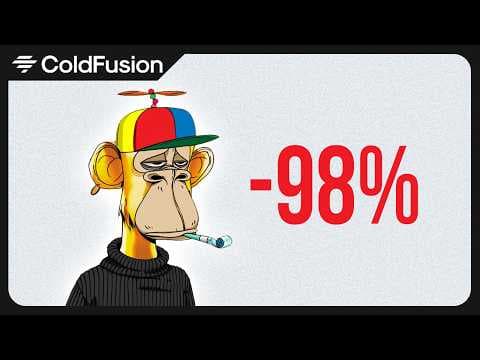
As the NFT hype cycle progressed, the value of blockchain ownership for art proved to be nearly zero. Buyers eventually stopped agreeing on the perceived value, and the market began its inevitable deflation. By May 2022, daily NFT sales had plummeted by 92% from their peak, and active wallets had fallen by 88%. Collections that once commanded hundreds of thousands of dollars sat unsold. Justin Bieber's $1.3 million Board Ape NFT was worth around $12,000 by early 2026, and the Board Ape Yacht Club's floor price dropped from $429,000 to approximately $27,000, an almost 93% loss.
The broader market data was equally grim, with NFT trading volumes collapsing by 93% and 96% of NFT projects failing within just over a year. Institutions began to withdraw, with Christie's closing its digital arts department and other marketplaces like Nifty Gateway shutting down. Lawsuits followed, with buyers suing companies like Nike for allegedly hyping projects and then abandoning them, leaving buyers with assets worth a fraction of their purchase price. While cryptocurrencies like Bitcoin and Ethereum recovered, NFTs did not.
In retrospect, the NFT boom was a clear illustration of a fatal flaw in financial markets: an object's value is determined by what a buyer is willing to pay. A shared delusion among a majority of buyers can artificially inflate prices, creating a speculative bubble. The NFT market demonstrated how human greed, amplified by celebrity influence and the allure of quick riches, can lead to such overenthusiasm. While many NFT companies failed, some established brands like Louis Vuitton, Disney, and the NBA maintained NFTs that have remained stable and continue to sell well.
The underlying technology of NFTs, however, did not disappear with the speculation. There is a growing focus on real-world asset tokenization, applying the technology to tangible assets like property, private credit, and commodities. Web3 gaming also shows promise, with NFTs potentially offering real in-game utility. The ultimate lesson from the NFT boom is that while the technology itself was real, the speculative frenzy that created a $17 billion market in a single year was driven by human greed, not the inherent value of the technology. The story of NFTs serves as a stark reminder of how easily markets can be swayed by hype and the "greater fool theory," leaving many investors with losses. The current enthusiasm around Large Language Models (LLMs) also raises questions about whether history might be repeating itself with similar overexaggeration of value.