Iran : l'enfer de la prison d'Evin
Audio Summary
AI Summary
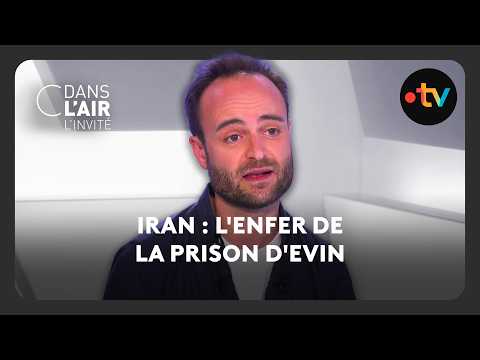
This program discusses the experience of Louis Arnaud, who spent 623 days as a political prisoner in Iran's Evin prison. He was arrested in the streets of Tehran and has since written a book titled "The Révolution Intérieur" (The Inner Revolution), published in Ecuador. The program also touches upon the release of Jacques Paris and Cécile Collaire, who were held hostage by the Iranian regime for four years.
Arnaud describes his experience in Evin prison as one of immense violence and singularity. He expresses happiness at seeing Paris and Collaire smiling, noting that their demeanor was very different during their captivity. He recounts the moment his plane landed in Greece after his release, feeling pulverized by suffering and believing he might die from the relief. He frames his own experience not just as that of a hostage, but as a story of humanity and a fight for freedom. The liberation, he explains, was bittersweet, feeling like an abandonment of the people he left behind in Iran.
The families of Jacques Paris and Cécile Collaire sent a message to the program, expressing pride and shock at finding them safe and sound. They acknowledged the immense courage and strength shown by Paris and Collaire, stating that their ordeal did not manage to break them. The families expressed gratitude to everyone who mobilized and to the state services that worked for their liberation, while also remembering other victims of the Iranian regime and calling for respect for their rights and their freedom.
Arnaud explains how he helped the families of Paris and Collaire by speaking out during manifestations and in the media, aiming to mobilize public opinion. Although he never saw them directly in prison, he knew they were there, and he was held in section 209 of Evin, described as the harshest part of the prison. He recounts a poignant moment on his last night before liberation, finding an inscription in French on a wall – a poem by Nerval. He connected this inscription to Cécile, feeling as though a door opened and he joined her in spirit, finding solace in this connection.
The program delves into why Evin prison is referred to as "the hell of Evin." Arnaud’s book describes the prisoners being reduced to an animalistic state after meals, sleeping and even defecating on the ground, subjected to the constant glare of lights. He calls the place an abattoir designed to break individuals, forcing them into fantasies and despair. He recounts witnessing interrogations and hearing the cries of women subjected to assault and violence, experiences that never leave him and serve as a form of torture. This psychological torment leads prisoners to torture themselves, creating invisible monsters and turning each moment into a massacre against each other. The constant anticipation of the next interrogation, promenade, or a brief moment of animation in the corridor offers only fleeting comfort, leading to frustration and a hollow satiety. The end, he notes, is a form of torture in itself, reducing people to a primitive state of survival, leading them to fight for basic necessities like a piece of paper.
Despite the grim conditions, Arnaud highlights the presence of humanity within the prison. He speaks of groups of people who federate, who value compassion, and who save him from darkness by opening a path towards humanity. He emphasizes that by becoming one with them, their faces becoming his own, he was not alone.
Arnaud reflects on the time it takes to realize one is free and to regain serenity. He attributes his internal freedom to a metamorphosis and an initiative where Iranian prisoners were the "maîtres" (masters). He explains that in prison, with only walls and fields, the key was to understand that it’s not just the events themselves but the interpretation of those events that matters. He achieved a clear lightness by recognizing that his perception of prison, injustice, and violence stemmed from his own inherited judgments, culture, and values. By understanding this, he realized he could create a different mental universe, give meaning to his experience, and grow from it, transcending his physical confinement.
He acknowledges that he did not provide information to the Iranians during his detention and expresses doubts about certain aspects of his experience as detailed in his book. He states that he doesn't care about these doubts because adopting the cause of Iranian freedom means not giving concessions to the Islamic Republic, a betrayal he still carries the weight of. He explains that while he wanted to be free from prison, staying there felt like a lack of loyalty to the Iranian cause he had adopted.
The Iranians, he says, asked for their voice to be heard, which has become his mission. The final word of his book, "Femme, Vie, Liberté" (Woman, Life, Freedom), encapsulates his current purpose. He aims to share universal lessons from his experience, acknowledging that everyone faces injustice, loss, and disease. He also works with entrepreneurs who are prisoners of their own constraints, helping them to find freedom.
Arnaud admits that he has not managed to fully rebuild his life in the traditional sense and does not desire a return to normalcy. The suffering remains strong, particularly being far from the Iranians and those he has come to love. While his family here understands his relief at being free, they also comprehend the duality of his experience. The metamorphosis has brought a radical change in his perception of suffering, allowing him to accept it and grow from it. The program concludes by mentioning the publication of "The Révolution Intérieur" and briefly touching upon other news topics.