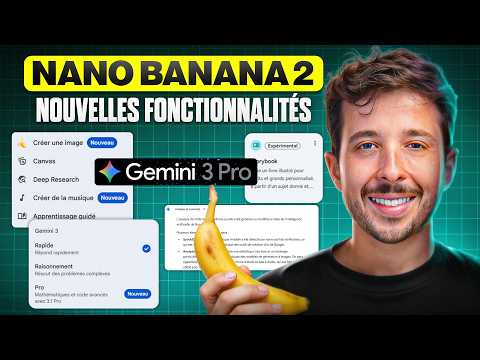
J'ai testé NANO BANANA 2 : révolution ou arnaque ?
AI Summary
In this detailed presentation, we explore the launch and capabilities of Google’s latest image generation model, Nano Banana 2. This new iteration represents a significant evolution in the Gemini ecosystem, following the initial release of the first Nano Banana model in early 2025 and the subsequent Pro version released in November of that year. The primary promise of Nano Banana 2—powered by the Gemini 3.1 Flash architecture—is that it is faster, more performant, and significantly more affordable than its predecessors.
The exploration begins by testing the model’s ability to understand real-world environments. By feeding the AI a simple screenshot from Google Maps of the Trocadéro area in Paris, the narrator challenges Nano Banana 2 to transform the 2D map into a high-detail, cinematic aerial photograph as if captured by a professional drone. The results arrive in approximately 15 seconds. While the model successfully recognizes and renders key landmarks like the Eiffel Tower and the Champ de Mars, it struggles slightly with spatial accuracy, placing the La Défense district in an incorrect location and duplicating bridges over the Seine. Despite these minor geographical errors, the speed and detail represent a notable step forward from the previous Pro model.
A major focus of the video is the model’s utility for business and marketing. To test this, a scenario is created for a candle brand called "Lueur d’Automne." The narrator asks the AI to generate an Instagram advertisement that includes specific text: the brand name, the collection name, and a website URL. Nano Banana 2 excels here, producing a high-quality visual with perfectly rendered text, including small details like "Handmade in Bordeaux." This is a significant achievement, as text generation has historically been a weak point for many image-generation AIs.
The video then moves into a comprehensive head-to-head comparison between Nano Banana 2, the older Nano Banana Pro, and ChatGPT’s image generation (DALL-E). Three distinct prompts are used: a realistic portrait of a woman in a Parisian cafe, a professional jazz festival poster, and a realistic crowd scene at the Sacré-Cœur.
In terms of speed, Nano Banana 2 and the Pro version are neck-and-neck, both completing the tasks in about 20 seconds. ChatGPT, however, lags significantly, taking one minute and 40 seconds to produce results. When analyzing the quality, Nano Banana 2 is praised for its creative lighting and its ability to handle complex details, such as rendering text in reverse on a cafe window. While the Pro model is occasionally more "realistic," it is described as less creative. ChatGPT’s images are noted for their high aesthetic value but are criticized for looking more "fictional" or "AI-generated" compared to the photographic realism of Google’s models.
A particularly innovative use case discussed is the creation of User-Generated Content (UGC) for platforms like TikTok. The narrator demonstrates how a business owner can take a simple smartphone photo of a product—in this case, a moisturizer—and use Nano Banana 2 to generate a "screenshot" of a person holding that product in a natural setting, such as a bathroom. This process can save businesses hundreds of euros typically spent on hiring content creators. Furthermore, by utilizing the broader Google ecosystem, these generated images can be fed back into Gemini to produce short, 8-second videos, providing a complete marketing pipeline from a single prompt.
The model’s "cultural intelligence" is also put to the test. The AI is asked to generate images of supermarket aisles in four different countries: Japan, Mexico, France, and the United States. Nano Banana 2 proves it understands more than just aesthetics; it correctly adapts the signage, product types, and even the specific lighting styles typical of those regions. This capability is further demonstrated by "localizing" the French candle advertisement for a Japanese audience. Instead of just translating the words, the AI redesigns the entire environment—changing the furniture and the overall "vibe"—to appeal to Japanese consumer sensibilities.
However, the model is not without its flaws. When challenged to create a consistent eight-panel comic strip featuring a character named Leo, Nano Banana 2 maintains visual consistency (the character’s red hair and green shirt remain the same), but it fails significantly with complex dialogue bubbles, producing garbled text. Interestingly, when the same prompt is run through the older Nano Banana Pro model, the text is rendered correctly, though the overall artistic quality of the panels is lower. This suggests that while the new model is more creative, the Pro version remains more "stable" for specific technical tasks involving heavy text integration in complex scenes.
One of the most important takeaways from the video is the economic shift Nano Banana 2 represents. Through the API, the 3.1 Flash model is roughly ten times cheaper than the Pro version, costing only $0.25 per million input tokens. This price drop democratizes high-end image generation for mass production and business scaling.
The final test involves "identity consistency." The narrator uploads a personal photo and asks the AI to place his likeness in five world locations, including the Great Wall of China and Machu Picchu. While the results are fast and creative, the narrator notes that the facial resemblance isn't perfect—it is close enough for casual use, but friends and family would likely recognize it as an AI-generated image.
In conclusion, Nano Banana 2 is presented as a powerful, cost-effective tool that excels in speed, marketing utility, and cultural adaptation. While it still faces hurdles with complex text in illustrations and perfect facial mapping, its low cost and rapid output make it a game-changer for professional and business applications.