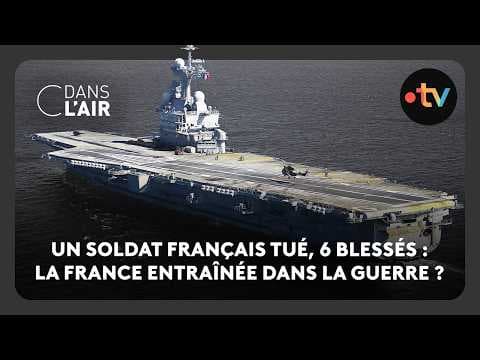
Un soldat français tué, 6 blessés : la France entraînée dans la guerre ? - C dans l’air - 13.03.2026
Audio Summary
AI Summary
The discussion centers on France's involvement in the Middle East conflict, following the death of Warrant Officer A. Frion and the injury of six other French soldiers in an attack in Iraqi Kurdistan. This marks France's first casualty in the 14-day-old conflict.
Warrant Officer A. Frion, 42, was described as an exceptional soldier with a distinguished career, having risen through the ranks and served in commando mountain groups, earning multiple citations for actions in Afghanistan. His death underscores the risks faced by French soldiers deployed to maintain peace and protect French citizens by keeping conflicts abroad. The soldiers were part of Operation Inherent Resolve, an international resolution from 2014 aimed at securing the region from ISIS and assisting Iraqi forces.
The attack, which has not been directly claimed, is attributed to a pro-Iranian Iraqi militia. This militia had previously issued a statement targeting French interests due to the deployment of the aircraft carrier Charles de Gaulle. Such attacks on Western bases (American, Italian) have occurred in the region since 2019, with Iran mobilizing proxy groups to create instability beyond its borders, aiming to draw French troops into the wider conflict, despite France's stated defensive mission.
Patricia Allémonière noted that pro-Iranian militias, some formed as early as 2003, operate with a degree of autonomy but generally follow Tehran's directives. These directives historically included targeting American interests, circumventing sanctions, and securing logistics for the Tehran-Beirut axis, as well as combating ISIS. Iran considers any country defending Gulf states as co-belligerents, a stance articulated early in the conflict. The recent activation of these militias is also linked to a message from Iran's new Supreme Leader calling on them to fight against "us."
General D. Trinquand clarified that French soldiers in Iraq are primarily instructors, training Iraqi and Kurdish forces in counter-terrorism. The attack, therefore, targeted forces engaged in defensive, anti-terrorist operations, highlighting the evolving nature of terrorism in the region. The goal of these attacks is to spread fear and impact societies.
Laurence Menget emphasized the importance of monitoring the Iraqi government's response. While dependent on Iran, the Iraqi government has no interest in seeing Western troops, particularly French, attacked. It is expected to issue warnings to these militias. The creation of some of these militias in 2014 by Ayatollah A. al-Sistani to fight ISIS demonstrates the complex relationship between Iraqi authorities and these groups. French forces will likely enhance their protection measures, but there are no plans to halt Operation Chammal.
Regarding potential French retaliation, the consensus is against immediate reprisal attacks, which could escalate into an unending cycle of vengeance. Emmanuel Macron has stated, "We are not at war," which implies ruling out direct retaliation. Protecting bases from drone attacks, possibly Shahed drones, is challenging due to their nature and the cost-effectiveness of defense systems.
The economic consequences of the conflict are also significant, impacting global oil and gas prices. The report highlights the struggles of individuals like a liberal nurse and a transport company owner in France, facing increased fuel costs. This economic disruption, which benefits Russia by alleviating oil sanctions, is seen as a deliberate strategy by Tehran to create chaos and pressure Western governments, particularly the US.
The discussion also touched upon the internal divisions within the Iranian diaspora, between those supporting Reza Pahlavi, son of the last Shah, and those advocating for a democratic, secular republic without the Shah or the current clerical regime. The role of Israel in the current conflict is a major point of contention, with some Iranians reluctant to accept liberation facilitated by a historical enemy. The current Iranian regime, despite external opposition, remains resilient, relying on a core loyalist base and internal repression.
The disappearance of Iran's new Supreme Leader and the rise of figures like Ali Larijani, a powerful negotiator within the Iranian system, suggest internal shifts. Larijani is seen as a potential figure for transition, given his influence and past interactions with Western officials.
The panel also addressed the potential for increased terrorist threats in France and other Western countries. General Trinquand warned that dormant jihadist and Iran-linked cells could be activated, targeting civilian populations to sow panic and pressure governments. While French counter-terrorism services are actively working to prevent such attacks, the threat is real and a potential consequence of distant conflicts.
The US intelligence report about a potential Iranian drone attack off American coasts in 2026 is considered credible, highlighting the vulnerability of even highly secured nations. The panel concluded that the war's objectives remain unclear, particularly for the US, fluctuating between targeting Iran's nuclear program, its military capabilities, or regime change. Netanyahu's strategy of regime change in Iran is seen as influencing Trump's decisions, but the long-term effectiveness of this approach is questioned, given the resilience of the Iranian regime and the potential for continued escalation. The 400 kg of 60% enriched uranium in Iran remains a critical concern for Israel and the US.