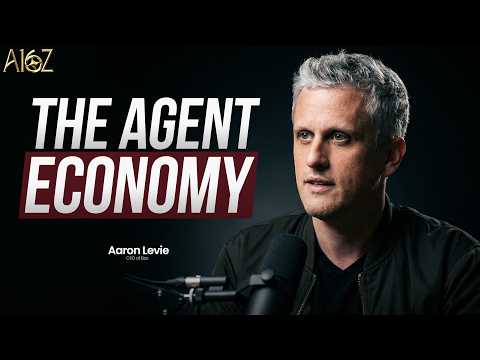
The Era of AI Agents | Aaron Levie on The a16z Show
AI Summary
The discussion centers on the evolving landscape of AI capabilities and their integration into software and workflows, highlighting potential challenges and future trajectories. A key point is that the widespread diffusion of AI will likely take longer than anticipated by those in Silicon Valley, particularly concerning complex enterprise systems like SAP, which contain significant domain knowledge not easily captured in structured data.
A major area of focus is the impending conversation around engineering compute budgets, which is expected to become increasingly significant. The economics of AI are currently being underestimated, with a fundamental misunderstanding of the scale of the opportunity. The emergence of a thousand-fold increase in AI agents compared to humans necessitates a shift in software design, moving from human interfaces to agent interfaces. This means software must be built to accommodate agents interacting through APIs, CLIs, or other programmatic methods. The paradigm of giving coding agents access to SaaS tools and knowledge workflows is proving effective, creating a "superpower" where agents can not only process information but also code and use APIs to achieve tasks, a trend exemplified by co-working tools and AI platforms.
However, a practical challenge arises: algorithmic thinking, the ability to break down tasks into logical steps, is difficult for most people. This limitation means that even with AI tools, users may struggle to effectively instruct agents, leading to a bottleneck in explaining desired actions. While this could lead to new abstraction layers for human-computer interaction, historically, developing such layers has required highly skilled individuals. The core idea remains that jobs will evolve, requiring new skill sets, with AI providing significant leverage. The example of a growth marketer using AI to automate tasks previously done by multiple individuals underscores the need for systems thinking.
The conversation then shifts to the notion of agents becoming increasingly capable of automating complex tasks, drawing parallels to how spreadsheets transformed work. The initial phase might involve agents assisting humans, but over time, the abstraction layer will move up, requiring new skills and potentially leading to a consolidation of roles into more agent-like capabilities. The ability of agents to write code on the fly for specific use cases is highlighted as a powerful property, though the majority of tasks may still involve using existing tools.
A significant debate emerges regarding how agents will interact with systems and the implications for security and control. The analogy of humans using computers is extended to agents, with a progression from code generation to terminal use, and now to computer use. However, the constraints on humans, such as cognitive bandwidth, do not apply to agents, raising questions about the proliferation of tools and interfaces.
The discussion delves into the practicalities of enterprise adoption, contrasting the agility of startups with the caution of large corporations. While startups can build systems from the ground up without legacy constraints, enterprises face challenges integrating AI into existing, complex systems. The concept of "integration on demand" by agents is seen as a powerful capability, but it also raises concerns among CFOs and CIOs about the potential for breaking systems of record. A potential solution is a read-only phase for AI integration before full write capabilities are implemented.
Security and privacy concerns are paramount, especially in an enterprise context. The idea of treating agents like human employees is questioned, as humans have privacy rights and accountability that agents may not, and direct oversight is often necessary for undoing mistakes. The risk of agents inadvertently leaking information or being social-engineered is a significant challenge. This leads to the idea of agents being treated as extensions of their users, rather than fully independent entities.
The analogy of open-source development is used to illustrate how new technologies evolve. Just as open-source faced licensing and quality issues, AI will likely develop its own norms and standards over time. The current real-time debate about AI's direction is seen as a natural part of this development process.
A key tension is identified between the desire for agents to have direct access to data and systems and the business models of current SaaS vendors, who often monetize intelligence and domain expertise rather than raw data access. This creates a conflict where agents might demand unlimited data access, challenging existing revenue streams.
The future of software development is expected to revolve around building high-quality APIs, managing agent identities and access controls, and finding new monetization models. While some businesses might see reduced revenue, others, particularly those involving file interactions, could experience significant growth.
A contrarian view is presented, suggesting that focusing on agent interfaces might be the wrong approach. Instead, the semantics and the underlying quality of systems will be more important, as agents will prioritize cost, durability, and other meaningful parameters when choosing backend systems. This implies that the push will be towards building better systems rather than optimizing for agent interfaces.
The potential for agents to fragment systems of record and create new, de facto systems is a significant risk. Companies are wary of uncontrolled agent behavior, drawing parallels to past security breaches caused by unmanaged external websites. This leads to a cautious approach from enterprises, while startups, unburdened by legacy issues, can move faster.
The discussion touches upon the compute budget as a major concern, with the potential for significant costs associated with AI. The analogy of internet bandwidth and the evolution of computing power suggests that costs will likely decrease over time, but the immediate challenge for CFOs is to budget for this unknown. The idea of local compute engines as a release valve for AI processing is also considered.
Ultimately, the conversation highlights a transition phase where the true economic potential of AI is still being discovered. The analogy of PCs and cloud computing suggests that new business models will emerge, vastly expanding the market beyond current linear growth projections. The current focus on tokens and GPUs is seen as a short-term perspective, failing to account for the transformative impact of widespread AI adoption. The challenge lies in understanding how to price and monetize AI services in a world where agents can access resources on demand, potentially opening up new avenues for business models.