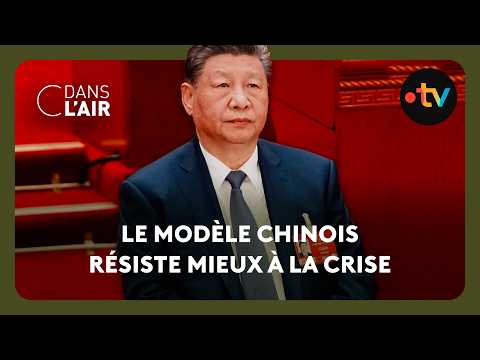
La Chine est-elle la grande gagnante ?
Audio Summary
AI Summary
Chinese state television has been actively criticizing the United States' struggles in Iran, suggesting that the veneer of American hegemony has been damaged. The conflict has reportedly had the opposite effect of what the US intended, leading to unprecedented gasoline price surges in the US, comparable to the oil shocks of the 1970s.
While Xi Jinping has remained silent on the conflict, China's economy is described as faring better than anticipated. China has been able to secure oil shipments through the Strait of Hormuz, with three Chinese ships reportedly traversing it recently. Beijing has also proactively managed the consequences of potential oil disruptions by significantly increasing its oil reserves, stocking the equivalent of four months of imports. Furthermore, China continues to receive oil from Russia under long-term contracts, ensuring a stable and reliable energy supply.
Despite some unrest related to the Strait of Hormuz, China's state-controlled economy has managed to absorb fuel price increases, with only modest hikes at the pump. Beyond oil, China has diversified its energy sources, with 30% of its energy consumption now coming from electricity, a result of substantial investments in nuclear, oil, and solar power. The vast deserts and abundant sunshine in some Chinese regions are seen as ideal for renewable energy development. The report even suggests that global warming could benefit Chinese companies, such as electric car manufacturers, potentially increasing their global market share.
However, the crisis in the Middle East is not entirely without negative consequences for China. The closure of the Strait of Hormuz also impedes Chinese exports to the region, making regional stability crucial for its commerce. This issue is expected to be a topic of discussion during Donald Trump's upcoming visit to China.
The report poses the question of whether China and Russia are benefiting from the conflict, with some suggesting that China, having taken energy precautions, appears more stable than the US, which is perceived as creating chaos. However, it's noted that Iran is an ally of China, and the weakening of its regime is not necessarily good news. The reliance of Iran on Russian and Chinese arms is also mentioned, though the impact of potential losses is considered minor.
The BRICS bloc, envisioned as a rival to existing global powers, is seen as potentially facing difficulties in emerging as a significant actor. While China has strong relations with Pakistan, a potential supporter in its rivalry with India, its overall influence in negotiations remains to be seen. Beijing claims to have made efforts to achieve a ceasefire, a claim supported by Donald Trump and subtly acknowledged by Chinese press, though China prefers to remain in the background. The report suggests China is observing the situation, with an espionage vessel near the Strait of Hormuz monitoring US actions and potentially sharing information with Russia.
The report concludes that both China and Russia are profiting from the situation, particularly on a geopolitical level. While Donald Trump is described as a source of disorder detrimental to the global economy and modernization, China is portrayed as stable, respectful of multilateralism, and gaining international points through its image. The upcoming visit of Donald Trump to China in mid-May is highlighted as significant.
The episode is seen as a valuable learning experience for China, providing insights into military, commercial, and geopolitical strategies, as well as reinforcing its image of stability. The report references an Economist article advising not to stop an enemy when they are making mistakes, suggesting Xi Jinping's strategy of allowing Donald Trump to engage in the conflict. The article also points to an evolution in British elite opinion, with a growing critique of US foreign policy, illustrated by the current war.
A question is raised about the possibility of the Lebanese and Israeli armies cooperating against Hezbollah. The report dismisses this, stating that the Lebanese army is incapable due to regional recruitment divisions, with soldiers having allegiances to groups like Hezbollah. The country's internal divisions among Shia, Sunni, and various Christian factions further complicate any potential for effective military cooperation.