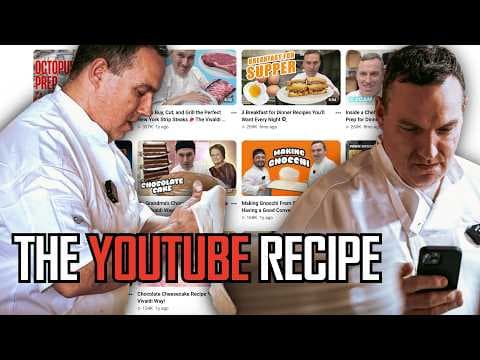
He Didn’t Know He Had a YouTube Channel — Now He Has 1 Million Subscribers and a Packed Dining Room
Audio Summary
AI Summary
Stephen Drulis, co-owner of Vivaldi Restaurant in Montreal, shared his journey of becoming a successful content creator with nearly a million YouTube subscribers, over 200,000 on TikTok, and a quarter-million on Instagram. His story exemplifies the power of storytelling in the restaurant industry and the new creator economy.
Drulis's venture into content creation began inadvertently during COVID-19. Initially, he focused on basic Facebook and Instagram posts to promote the restaurant during lockdowns. After reopening, the restaurant was busier than ever, and social media efforts dwindled to recycling old photos. A year later, tired of the static images, Drulis decided to invest in video content, specifically "reels," despite his initial skepticism about the financial return. He hired a team for filming and editing, and made the bold decision to put himself in front of the camera, a novel approach in Montreal at the time. His rationale was that if they were going to lose money, they might as well build his personal brand as the owner, rather than just the food brand.
His initial goal was simply to remind his local community of his restaurant's presence and potentially attract younger cooks. He started with TikTok, unaware that his team had also launched a YouTube channel for him. After filming about 30-40 videos over two days, focusing on well-loved recipes from his menu, the content quickly gained traction. Drulis recounts being astonished when his editor informed him that his first YouTube video had already garnered 1.3 million views, and the second reached 20 million within a month. This rapid success was unexpected, as he was unfamiliar with YouTube's features, including "shorts," and the concept of creators being paid for content.
The unexpected viral success forced Drulis to confront a new reality: was he merely creating reels for his restaurant, or was he becoming a full-fledged content creator? This led to a rapid self-education on the intricacies of content creation. He has since released hundreds of videos, constantly adapting to the demands of a global audience. Drulis notes the differences in monetization between Canada and the US, highlighting that TikTok is not monetized in Canada, making much of his early work on that platform essentially free. He also expressed the challenge of navigating the nascent creator economy without a clear roadmap or peers in Canada to consult for advice on offers and opportunities.
Drulis emphasized the immense work involved in content creation, comparing it to the physical demands of running a restaurant. He noted that while the restaurant remains his primary business, the media side has opened up new opportunities and a different kind of engagement with customers.
A key aspect of Drulis's content strategy is authenticity and relatability. He moved away from overly produced videos and focused on sharing family-style, approachable recipes that people can easily attempt at home. He deliberately avoids complex dishes like Beef Wellington, which are expensive to recreate for a home cook. This approach not only resonates with viewers but also benefits his restaurant by fostering a deeper connection with his audience.
Drulis directly addressed other restaurant owners who might be hesitant about social media due to concerns about ROI or fear of looking "stupid." He asserted that social media, when done properly, offers an unparalleled return on investment compared to traditional advertising methods like newspaper ads, which had no measurable ROI. He highlighted that while platforms like TikTok might not offer direct financial monetization in Canada, they bring in younger clientele, diversifying his customer base beyond his traditional "boomer clientele."
Beyond financial returns, Drulis stressed the intangible benefits, such as heightened customer experience. Guests who feel connected to him through his videos arrive at the restaurant with a sense of excitement, enhancing their overall visit. He also pointed out that content creation doesn't always require constant on-camera appearances; a good team and plan can involve showcasing staff, behind-the-scenes glimpses, or menu items.
Drulis shared personal anecdotes of customers traveling significant distances to visit Vivaldi Restaurant specifically because of his online presence. He recounted stories of people from Rochester, New York, visiting for a Lady Gaga concert and making a point to eat at his restaurant, or Keith Urban's band driving to the suburbs of Montreal to dine there. He even described a customer from Tampa, Florida, who rerouted a business trip to Calgary to include a stop at Vivaldi. These "oh shit moments" reinforced the profound impact of his storytelling.
When asked about his future plans, Drulis acknowledged the difficulty in choosing between growing his media presence or expanding his restaurant business. The restaurant remains his "bread and butter," but he is excited about the potential of the media side. He is exploring all options cautiously, considering his young children and the balance between seizing opportunities and being present for his family. He envisions the media aspect potentially offering more travel and experiences, aligning with his passion for meeting other restaurant professionals and exploring different culinary scenes.
Drulis admitted to still learning about the full scope of opportunities in the creator economy, such as brand deals. He shared an experience of doing one brand deal as a "test run" to understand the process, but expressed reluctance to attach his name to too many brands without a genuine connection, fearing it could turn off his audience. He referenced Mark Zuckerberg's initial resistance to monetizing Facebook, wanting to avoid becoming a "walking commercial."
The interviewer offered advice on brand deals, suggesting that business owners leverage their existing expenses and partnerships. If they already believe in and use a product in their restaurants, reaching out to those companies for collaborations becomes a natural and authentic fit, avoiding forced endorsements.
Regarding his personal tech stack, Drulis is an iPhone user (about two to three years old) and uses Rogers as his carrier in Canada. He prefers phone calls for personal communication but texts for work to maintain a record. He doesn't leave many voicemails, nor does he receive or listen to many. He gets around a hundred emails daily but enjoys only about five percent of them. He prefers taking photos over videos when he's the one behind the camera. Google Maps is his navigation app of choice, and he has recently started using Google Meets more. He has not yet explored AI tools like ChatGPT but is researching recipe apps with AI integration. His current recipe repository is a "scruffy notebook," which the interviewer suggested could be digitized using AI tools. He primarily uses Spotify for music but listens to more podcasts and audiobooks while working.
For visitors to Vivaldi, Drulis recommends fried zucchinis, grilled octopus, and gnocchi. He also suggests trying a Montreal-style pizza for out-of-towners. He is not yet active on LinkedIn but plans to be. Drulis noted that Montreal's restaurant industry, particularly with suppliers, is slower to adopt technology, with many still relying on phone orders. He uses OpenTable for reservations but finds ordering processes to be less advanced compared to the US. The interviewer recommended "Meez" (m-e-e-z) as a recipe costing software.
The interview concluded with both Drulis and the host expressing gratitude for the conversation and the community of digital hospitality leaders. They emphasized the importance of subscribing, sharing, and connecting to support the mission of empowering restaurant owners through storytelling.