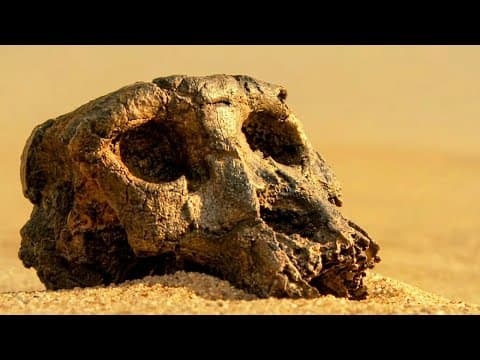
Toumaï, the New Ancestor
Audio Summary
AI Summary
This is the story of Toumaï, a 7-million-year-old hominid fossil, and its significance to understanding human origins. Toumaï recounts its past, having been hidden in the sand for millions of years, and the process by which scientists are reconstructing its identity and place in history.
Toumaï describes living with its group, constantly facing danger from predators like the sabretooth. In an attempt to protect others, Toumaï distracted a beast and was swallowed by the ground, becoming a fossil. For nearly 7 million years, Toumaï was forgotten until its discovery in 2001.
For 30 years, scientists believed mankind originated in East Africa. However, Toumaï was found in the Djurab Desert of northern Chad, west of the Great Rift Valley, challenging existing theories. Professor Michel Brunet and his team, paleontologists from Chad and France, discovered Toumaï. Brunet had long suspected that theories about human origins were incorrect and had been exploring west of the African Rift Valley for 20 years. His team had previously discovered Abel, a 3.5-million-year-old australopithecine jaw, in Central Africa. Toumaï, at nearly 7 million years old, would be the oldest known ancestor of mankind.
Ahounta Djimdoumalbaye, a Chadian scientist on Michel's team, was the first human to see Toumaï. He initially didn't recognize what he had found until he turned the skull to reveal two eye sockets and a nasal cavity, confirming it was a hominid. Toumaï was named after the local Gorane language word for "hope of life." Its discovery pushed back the origin of mankind twice as far in time, leading to skepticism from some scientists.
Michel Brunet set out to prove Toumaï's hominid status. The first step involved using a Synchrotron, an extraordinary machine that generates powerful X-ray beams, to produce precise images of the skull. Toumaï's skull was almost complete but was missing its lower jaw, squashed on one side, and had bits of ground stuck to it. The Synchrotron helped restore its true shape and differentiate between the fossil and surrounding material. Engineers identified features like Toumaï's canine, two premolars, and three molars. The two premolars having three root canals was noted as a primitive feature shared by chimpanzees and humans.
Next, specialists created a virtual reconstruction of Toumaï using 500 pictures, correcting distortions to build a 3D image. Two scientists independently created four models, which showed striking similarities. These models allowed them to precisely determine the backward inclination of the nuchal plane at the back of the cranium, a key difference between hominids and great apes. Comparing Toumaï to great apes, the analysis supported its identification as a hominid. The computer image was then transformed into a solid resin cast using a laser stereolithograph, creating a physical representation of Toumaï's reconstructed face.
The next stage involved Élisabeth Daynès's workshop, where forensic science techniques were used to add muscles and skin to the resin cast. Professor Brunet closely monitored the process to ensure scientific accuracy, focusing on details like a more pointed canine. The eyes brought the sculpture to life, presenting an image of Toumaï that paleontologists and anthropologists consider close to reality, though aspects like hair, eye color, and nose shape remain unknown.
To further validate the findings, Michel sought the opinion of Professor David Pilbeam, an anthropology professor at Harvard University. Pilbeam, upon seeing the 3D resin model, was impressed, noting the "enormous brow ridges" and confirming it as a "good biped" and "clearly a male." He called it "the earliest face of humanity."
Toumaï then pondered its life, body, and the world it inhabited. It questioned what a hominid truly is, and what differentiates it from an ape. Hominids are characterized by small canines and bipedalism (walking upright on two feet). The position of the foramen magnum (the hole where the spine meets the head) in Toumaï's skull indicates it was a biped, as its eyes would look forward when placed on a human neck, unlike on a chimpanzee's body where its eyes would point downwards.
Further analysis by Michel and David, comparing Toumaï's skull with those of great apes, chimpanzees, gorillas, and other hominids, reinforced the conclusion. Toumaï's small, worn upper canine, shorter and flatter face, pronounced brow ridge, and backward-tilted nuchal plane were all consistent with hominid characteristics and distinct from African apes. They concluded that Toumaï is indeed a hominid, close to the split between chimpanzees and humans.
To determine Toumaï's age and find more clues about its past, Michel embarked on another expedition to the Djurab Desert. The team, including Chadian paleontologists Mackaye Taïsso and Likius Andossa, returned to the area where Toumaï was found, hoping to discover more hominid fossils. They acknowledged the rarity of such finds, given the vast number of animal fragments compared to hominid ones. The wind, however, could help by exposing previously hidden fossils.
During the expedition, fragments belonging to at least six different individuals were found within a small area, suggesting the presence of a "first pre-human family." Geologist Philippe Duringer's research revealed that the Djurab Desert was not a desert 7 million years ago, but rather a lakeside environment resembling the Okavango Delta, characterized by shallow lakes, forests, and wooded savannah. Michel and Toumaï traveled to the Okavango to study this habitat and its creatures, hoping to understand Toumaï's diet and environment.
Professor Jaeger examined Toumaï's teeth, noting the flat wear on the canine, indicating it didn't function like a great ape's tooth. The wear pattern suggested extensive crushing and grinding, implying a diet of tougher foods. A tiny enamel sample from Toumaï's teeth, analyzed for carbon composition, revealed a varied diet of fruit, nuts, leaves, shoots, termites, roots, and tubers, consistent with a wooded environment. This varied diet, however, meant venturing into the open savannah when resources in the woodland were scarce, posing risks from predators.
Fossils of animals, including a primitive elephant species (Anancus) and a crocodile mandible (Euthecodon), were found alongside Toumaï, providing crucial reference points for dating. These animal fossils confirmed the presence of both stagnant and running water, and a diverse ecosystem. The analysis of these associated animal remains was key to evaluating Toumaï's age at approximately 7 million years.
Michel continued to search for prime hominid habitat in the Okavango, finding areas with trees close to rivers and nutritious water lily rootstocks. He observed that if vervet monkeys and baboons could thrive there, so could Toumaï. Scientists believe early hominids lived in groups similar to chimpanzees, with at least six members, including males and females, led by a dominant male.
Toumaï's journey continued to the National Museum of Ethiopia, where many important hominid fossils are held. Michel introduced Toumaï to Ardipithecus kadabba, a 5.8-million-year-old hominid from Ethiopia. Professor Tim White, a human evolution expert, compared Toumaï's and Ardipithecus's teeth, noting similar jaw structures and suggesting Toumaï could be Ardipithecus's ancestor, implying a migration from West to East Africa. Michel, however, felt it was too early to draw definitive conclusions.
Toumaï was also introduced to Herto, a 155,000 to 160,000-year-old Homo sapiens, considered the earliest direct ancestor of modern humans. This allowed scientists to connect the earliest hominid (Toumaï) with the earliest Homo sapiens, filling in the beginning and end of the human evolutionary story, with thousands of intermediate fossils like Lucy's species. Toumaï, officially named Sahelanthropus tchadensis, is recognized as a pre-human being on the evolutionary line, near the base that would eventually lead to modern humans.
Michel also revisited Lucy, a small female Australopithecus discovered 30 years prior, who was once the oldest known ancestor of mankind. At 3.2 million years old, Lucy is positioned halfway between Toumaï and modern humans on the evolutionary scale.
Toumaï concludes its story, acknowledging its role as mankind's new ancestor, nearly 7 million years old, and the closest known species to the split between chimpanzees and humans. It ponders the consciousness of its kind 7 million years ago and the lineage that led to Homo sapiens. The story ends with Toumaï reflecting on its attempt to save its family, running as fast as it could, marking the end of its story and the beginning of humanity's.