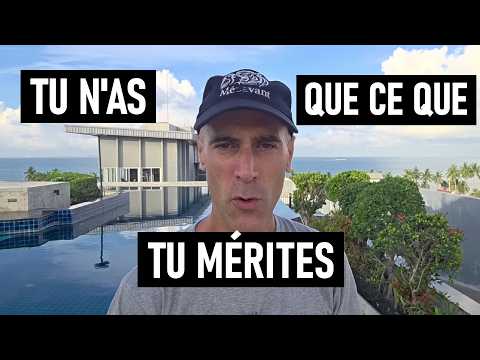
Tu n'as que ce que tu mérites (La vérité brutale)
Audio Summary
AI Summary
The core message of the video is that individuals only get what they deserve in life, no more and no less. This idea is presented as a response to a comment about the Mictao philosophy, which emphasizes personal responsibility and rejects blaming external factors for one's life circumstances. The speaker asserts that if one is poor, rich, unattractive, or bald, they deserve it. Similarly, if one is in an undesirable relationship, struggles with problematic tenants, or faces homelessness due to unpaid rent, these are also deserved outcomes. Even arriving at this specific YouTube channel is attributed to deserving it, as the algorithm sent the video because the viewer deserved to see it.
The speaker argues that there is no "imaginary," "potential," or "hypothetical" version of oneself; only the current reality exists. If someone dreams of a different future, they are merely a dreamer. For example, if one believes they have the potential to be rich but are currently poor, they are, in reality, poor. If one imagines financial freedom but remains at a desk job, they are an "office slave" in reality, despite any internal conviction of being able to leave.
This perspective is not meant to be demoralizing but rather an invitation to transform one's perceived potential into reality. While one can strive to become rich, beautiful, or muscular, these aspirations should be kept private until they are achieved, as currently, one is only what they are. The speaker acknowledges that there are brutal realities beyond one's control that also determine what one deserves.
The Mictao philosophy, described as "men going their own way," involves individuals navigating life under various constraints, such as their capabilities, false beliefs, ideological influences, and past wounds or failures. However, these constraints are not presented as excuses for failure or reasons for victimhood. The speaker emphasizes that the individual is the sole person responsible for their actions and inactions. While external circumstances exist, it is the individual who holds the power to initiate change and impact their own life.
Existence, therefore, is defined by impacting one's life and initiating changes. The individual is the primary cause of their life's consequences, the initiator of their own causality. While external influences and difficulties surround them, individuals choose what to listen to and which influences to prioritize or mute. Although everyone is conditioned and indoctrinated, the individual represents the path and the ultimate destination. The Mictao philosophy is framed as a program of self-correction, independent of group allegiances or norms, and unafraid of marginality.