$900 For THIS!? AMD Ryzen 9 9950X3D2 Review & Gaming Benchmarks
Audio Summary
AI Summary
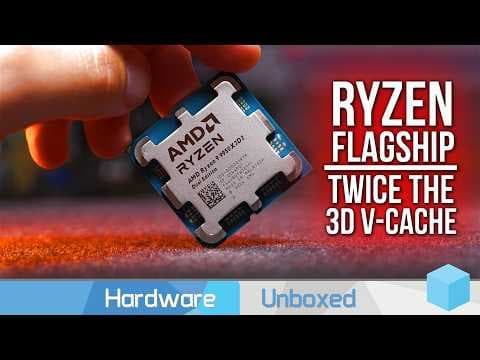
AMD has finally released a processor that enthusiasts have been requesting for years: a dual CCD (Core Complex Die) CPU with AMD's 3D V-Cache technology on both 8-core CCDs. This results in a symmetrical 16-core, 32-thread processor named the Ryzen 9 9950X3D2 dual edition. The review dives into whether this highly anticipated chip lives up to expectations.
The transcript begins with a humorous anecdote about the reviewer not having the official box due to AMD prioritizing a smaller, up-and-coming channel, Gamers Nexus, due to limited supply. This highlights the enthusiast nature of the product and the community's demand for it.
A brief history of AMD's 3D V-Cache processors is provided. The original 5800X3D on the AM4 socket was a groundbreaking gaming CPU, but higher core count models never received the V-Cache treatment. On the AM5 platform, AMD initially released dual CCD models, the 7900X3D and 7950X3D, which featured V-Cache on only one of the two CCDs. This asymmetrical design presented scheduling challenges, often leading to performance regressions in games unless the V-Cache-less CCD was disabled. The asymmetrical approach also had thermal implications, with the V-Cache CCD running at lower clock speeds due to thermal constraints. The idea was to offload non-cache-intensive tasks to the higher-clocked CCD, but this didn't always work as intended.
The subsequent release of the 7800X3D, a single CCD V-Cache part, proved to be a more straightforward and highly effective gaming CPU, reigniting the debate about whether AMD should have pursued symmetrical dual CCD V-Cache designs from the start.
Two years later, with the Zen 5 architecture, AMD released the 9950X3D and 9900X3D, which were still asymmetrical dual CCD designs. However, the second-generation 3D V-Cache design, which stacks the cache below the cores, significantly reduced thermal resistance. This allowed the V-Cache CCD to clock much closer to the non-V-Cache CCD, largely addressing the performance disparity. Despite these improvements, AMD still opted for an asymmetrical design, leaving many to wonder why they didn't implement V-Cache on both CCDs.
This brings us to the Ryzen 9 9950X3D2 dual edition, AMD's first CPU to feature dual 3D V-Cache enabled CCDs, offering a massive 192MB of total L3 cache. However, this comes with a steep price tag of $900 USD, a significant increase from the original 9950X3D's $700 MSRP. The reviewer questions the value proposition, especially considering the competitive landscape, including Intel's Core Ultra 7 270K Plus, which offers comparable productivity performance at a much lower price point.
AMD claims up to 7% improvement in rendering, AI, and simulation performance, and around 3% overall for productivity. However, they also claim that gaming performance remains unchanged from the original 9950X3D, which makes sense as games typically don't benefit from more than eight V-Cache enabled Zen 5 cores, and the latency between CCDs can even hinder gaming performance.
The review then presents benchmark results. In Cinebench, the 9950X3D2 is only 4% faster than the original 9950X3D and a mere 3% faster than the Intel 270K Plus, while costing significantly more. Single-core performance shows a minuscule gain over the original and is slower than the 270K Plus. Productivity benchmarks show mixed results: a valid 7% improvement in Blender rendering, a modest 4% gain in 7-Zip compression, and a 2% uplift in Premiere Pro. Photoshop sees a small 2% boost. Notably, shader compilation time was actually slower on the new dual CCD model.
Gaming benchmarks are largely underwhelming. In most titles, the 9950X3D2 either matches or slightly trails the original 9950X3D, and in some cases, even the 9800X3D. While it generally outperforms the Intel 270K Plus in gaming, the performance gains are not substantial enough to justify the massive price difference. The reviewer highlights that the 9950X3D2 delivered the same gaming performance as the original 9950X3D, with one reviewer noting it was "a frame faster" and calling it "a bloody expensive frame."
Power consumption is another drawback. The TDP is increased to 200W, and testing reveals a significant increase in power draw under load, consuming almost as much power as a 14900K for a marginal performance gain. Gaming power consumption is more reasonable, but still not class-leading.
In terms of value, the 9950X3D2 is deemed the worst value high-end CPU for gaming, with a significantly higher cost per frame compared to other options. For productivity, it offers better value than the specialized 9800X3D but is considerably worse value than the original 9950X3D and especially the Intel 270K Plus. The reviewer emphasizes that the 270K Plus is the best value for productivity builds, even at its current slightly inflated price.
The conclusion is that the Ryzen 9 9950X3D2 dual edition is a "dumb Halo product" that doesn't really need to exist. It offers minimal performance gains over its predecessors, particularly in gaming, and comes with a prohibitive price tag. While it's an "inoffensive product" in that it doesn't disrupt the market or replace existing viable options, it's not a sensible purchase for anyone looking to maximize their investment. The review suggests that for productivity, Intel currently holds the advantage with its value offerings, while AMD remains the go-to for high-end gaming with its X3D processors. The 9950X3D2 is positioned as a niche product for those who want the absolute latest hardware for bragging rights or simply have money to burn.