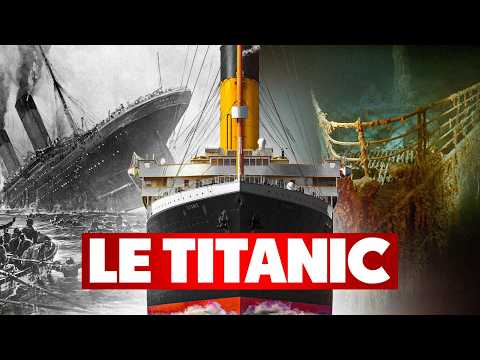
L'histoire tragique du Titanic
Audio Summary
AI Summary
The RMS Titanic, a symbol of human ambition and technological prowess, met its tragic end on April 15, 1912, sinking in the North Atlantic with over 1,500 lives lost. More than a century later, its story continues to captivate, representing not just a maritime disaster but a profound reflection on human hubris, technological advancement, and the unforgiving power of nature.
The late 19th and early 20th centuries were an era of unprecedented optimism in the Western world, dubbed "La Belle Époque." Cities were electrified, railways spanned continents, and innovations like the telegraph and the nascent automobile promised a future where humanity had mastered its environment. This technological fervor extended to maritime travel, a crucial link between Europe and America. The Atlantic crossing, once a perilous journey of weeks, had been revolutionized by steamships, reducing travel time to days. This made the ocean a vital business artery, carrying millions of European immigrants dreaming of a new life in America.
In this competitive landscape, two British companies, Cunard Line and White Star Line, were locked in a fierce commercial battle. Cunard, with government backing, launched the revolutionary Lusitania and Mauretania in 1906. These ships, massive for their time and capable of 26 knots, were designed for speed, aiming to win the coveted "Blue Riband" for the fastest Atlantic crossing. They succeeded, setting new speed records and dominating the transatlantic trade.
White Star Line found itself outpaced. The company had faced its own share of tragedies, notably the sinking of the Atlantic in 1873, which killed 535 people due to a series of human errors and cost-cutting measures regarding coal. This disaster had deeply impacted White Star Line, forcing them to sell off ships to survive. By 1907, with Cunard's new giants dominating, White Star Line needed a decisive response.
A pivotal dinner in London in the summer of 1907 between Joseph Bruce Ismay, managing director of White Star Line, and Lord William James Pirrie, chairman of Harland and Wolff shipyards, marked a turning point. Recognizing they couldn't compete with Cunard on speed, they devised a new strategy: to build ships of unparalleled size, luxury, and comfort. The plan was to create "floating hotels" so magnificent that wealthy passengers would choose opulence over a few hours saved in travel time. This led to the conception of the Olympic-class liners: the Olympic, the Titanic, and the Gigantic (later renamed Britannic). Their names, referencing Greek mythology, signaled their intended grandeur.
The design of these colossal vessels was entrusted to a team led by Alexander Montgomery Carstairs, responsible for interiors and safety, and Thomas Andrews, the chief naval architect. Andrews, a meticulous craftsman, knew every detail of the ships he designed. The specifications were staggering: 269 meters long, 28 meters wide, weighing 46,000 tons, and featuring ten decks. They were designed to carry over 3,300 people, a testament to human engineering.
Construction began in 1909 at the Harland and Wolff shipyards in Belfast, which underwent a massive overhaul to accommodate the giants. Over 15,000 workers toiled under dangerous conditions, with safety measures virtually non-existent. The construction was not without cost; hundreds were injured, and eight lives were lost. The sheer scale of the project, involving 3 million rivets for the Titanic alone, was a marvel. A notable detail was the use of iron rivets in the hull's curved sections, which were less durable than the steel rivets used elsewhere, a potential vulnerability.
The Titanic was designed with a revolutionary safety feature: 16 watertight compartments separated by 15 bulkheads. This system was intended to keep the ship afloat even if up to four compartments were flooded. This innovative design, coupled with the ship's immense size, fueled the press's narrative of its "practically unsinkable" nature, though White Star Line never officially claimed it was entirely unsinkable.
Beyond its engineering, the Titanic was envisioned as a floating palace. Its interiors were meticulously designed to offer unparalleled luxury across three classes. Even third-class accommodations were a significant improvement over contemporary standards, with proper beds and dining facilities. Second class offered comfort comparable to first class on other ships, while first class was the epitome of opulence, featuring grand suites, a lavish dining room, smoking rooms, a gymnasium, and a swimming pool.
The Titanic's maiden voyage began on April 10, 1912, from Southampton, England, with stops in Cherbourg, France, and Queenstown (now Cobh), Ireland, before heading to New York. On board were 2,208 people, a mix of the world's wealthiest individuals, families seeking a new life, and the ship's crew. Captain Edward Smith, a respected and experienced commander nicknamed "the millionaires' captain," was at the helm.
Despite the initial excitement and the ship's apparent perfection, several warning signs were present. An incident upon departure from Southampton saw the displacement of water from the Titanic nearly cause a collision with the SS New York. More critically, numerous ice warnings were received via radio on April 14, the day of the disaster. However, radio operator Jack Phillips, prioritizing passenger messages for revenue, failed to relay all of them to the bridge, and the SS Californian, nearby and aware of the ice field, had its radio switched off.
At approximately 11:40 PM on April 14, 1912, in a calm, moonless night, the lookouts spotted an iceberg directly ahead. First Officer William Murdoch ordered evasive action, turning the ship to port and attempting to reverse engines. However, the Titanic's size and the configuration of its propellers, which made it less responsive to the rudder, meant the maneuver was too slow. The ship scraped along the iceberg's starboard side, breaching six of its forward watertight compartments below the waterline.
Thomas Andrews, the ship's architect, quickly assessed the damage and delivered the grim prognosis to Captain Smith: the ship was doomed, with only an estimated hour to an hour and a half before sinking. The watertight compartments, designed to withstand damage to four, could not cope with six.
As the ship began to list forward, Captain Smith ordered distress signals to be sent and the lifeboats to be prepared. The evacuation was hampered by a lack of preparedness; there had been no drills, and most passengers and crew were unfamiliar with the lifeboat procedures. Compounding the tragedy was the insufficient number of lifeboats, legally compliant but far from enough for all on board. The "women and children first" protocol was interpreted differently by officers, leading to some lifeboats being launched significantly under capacity.
The class divide also played a tragic role. Passengers in third class, located in the lower decks, faced greater difficulty reaching the lifeboats due to locked gates and language barriers. While many in first and second class were rescued, a disproportionate number of third-class passengers perished.
The Titanic sank at 2:20 AM on April 15, 1912, breaking in two as it went down. Of the estimated 2,208 people on board, only 712 survived, largely due to the arrival of the RMS Carpathia, which had raced to the scene. The frigid waters of the North Atlantic claimed the lives of over 1,500 individuals, succumbing to hypothermia within minutes.
The aftermath of the sinking was marked by recovery efforts, official inquiries in both the US and Britain, and immense public grief. The inquiries highlighted negligence, excessive speed, insufficient lifeboats, and communication failures. The disaster led to significant reforms in maritime safety, including mandatory lifeboat drills, 24-hour radio watch, and the establishment of the International Ice Patrol.
The White Star Line faced financial repercussions and legal battles, ultimately merging with Cunard Line years later. Joseph Bruce Ismay, the company's director, survived but faced public condemnation for his actions. The Titanic's legacy, however, transcended financial and legal consequences. Its story, embodying themes of human ambition, technological hubris, social inequality, courage, and sacrifice, has been immortalized in countless books, films, and documentaries, ensuring its place in collective memory as a timeless symbol of tragedy and a stark reminder of humanity's vulnerability against the forces of nature. The discovery of the wreck in 1985 further fueled fascination, revealing the ship's broken state and the immense scale of the disaster, while also sparking debates about the preservation of underwater heritage. The enduring power of the Titanic lies in its ability to resonate with universal human experiences, making it a story that continues to captivate and instruct generations.