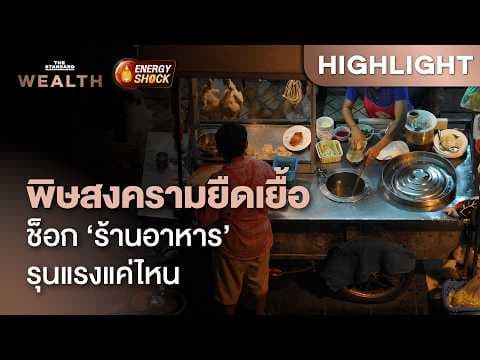
สงครามตะวันออกกลาง สะเทือนธุรกิจร้านอาหารไทย แรงแค่ไหน | THE STANDARD WEALTH
Audio Summary
AI Summary
The ongoing Middle East conflict, now in its seventh week, has significantly impacted various sectors, particularly the restaurant industry in Thailand. Thaniwan Kulmongkol, from the Thai Restaurant Association, highlighted the immediate and shocking effects of the war on supply chains and operational costs.
One of the initial impacts was the sudden disappearance of certain ingredients from the market, even for basic items like boxed meals. This scarcity was unexpected, leading to a scramble for supplies. Beyond availability, the rising oil prices have directly translated into increased transportation costs across the board. While Bangkok might see a minor one-baht increase in product prices, provincial areas experience a two-baht hike, making a 40-50 baht boxed meal now cost 3 baht more to produce. This increase is particularly alarming for business owners.
The price of essential goods is also climbing steadily. For instance, rice prices have surged by 6 baht per kilo in Chiang Rai, from 30 baht to 36 baht, a trend observed even in malls. This makes it challenging for smaller vendors, who are most vulnerable to these price fluctuations, to stay afloat. Eggs, once a stable indicator, are now seeing significant price increases, with a tray potentially reaching 200 baht. Similarly, chicken, previously a cheap protein source at 50-60 baht, now costs over a hundred baht. These increases are not necessarily benefiting farmers, raising questions about where the additional costs are accumulating within the supply chain.
The discussion also touched upon the rising costs of other items, such as plastic, which is linked to petrochemicals, and even vegetables. While some vegetables are inexpensive at the source, their prices inflate by the time they reach consumers, again pointing to transportation costs and supply chain inefficiencies.
The Thai Restaurant Association has been actively communicating these issues through media channels, advocating for the most vulnerable groups: street food vendors. The Department of Internal Affairs estimates over 80,000 street food vendors nationwide, who are crucial in feeding the common people. The Ministry of Commerce has offered some support through government-subsidized stores, distributing essential items like pork, beef, chicken, and rice at controlled prices. This initiative could benefit millions and is an idea the association wishes to promote.
Entrepreneurs, especially small and micro-SMEs, face a dilemma: absorb the rising costs and shrink profits, or raise prices and risk losing customers. Consumers have numerous options, and any price increase could easily drive them to competitors. Therefore, many businesses are hesitant to raise prices, opting instead to reduce quantities or run promotions to maintain sales figures. The association advises against being the first to raise prices to avoid creating mass hysteria and further shrinking the already diminished purchasing power.
The association, initially focused on medium to large-sized businesses, has become a voice for small enterprises since the COVID-19 pandemic. While larger businesses can absorb a 2-3% profit shrink, smaller ones cannot. Many big brands have committed to freezing prices for several months, but the core issue remains the financial strain on consumers. The goal is to support small businesses, as they are the most fragile. For instance, a small pork satay vendor cannot afford a 10-baht increase in pork prices without either reducing portion sizes or increasing the price, both of which are difficult decisions.
Customers, too, are expressing their preferences. Many would rather see a reduction in quantity than an increase in price. The association is actively listening to these concerns and trying to ensure government support to navigate the economic situation. They believe that maintaining current prices, even through promotions, is crucial, especially with upcoming events like Songkran, which could further reveal selling pressures.
The employment aspect is another critical concern. With over 1 million restaurants in Thailand, including 500,000 small businesses employing 3-5 people each, and larger ones employing dozens or hundreds, business closures would lead to significant job losses. The association urges the government to consider their situation, perhaps through tax reductions or reduced social security contributions, to help businesses cover their operational costs and preserve employment. The current situation demands adaptation, but the ultimate goal is to prevent widespread closures and the resulting economic ripple effects.