The Science of Gardening, with EpicGardening
Audio Summary
AI Summary
Here's a summary of the YouTube video transcript, focusing on key insights and main conclusions:
**The Future of Growing Food: Key Insights and Innovations**
The discussion explores various aspects of growing food, from home gardening to advanced agricultural techniques and the challenges of cultivating food in extreme environments like the moon.
**1. Home Farming and Sustainability**
* **Growing Popularity:** Home farming, or homesteading, has seen a recent surge in popularity.
* **Location Flexibility:** Plants can be grown in diverse locations, not just large fields. Even small urban lots, or "a third of an acre," can produce hundreds of pounds of produce annually, sufficient for a couple.
* **Diverse Home Garden:** A significant home garden can include numerous fruit trees (e.g., 30, with half being citrus in a suitable climate like San Diego) and many annual crops (e.g., 40-50 different types depending on the season).
* **Self-Sufficiency Efforts:** Beyond plants, a self-sufficient setup can integrate chickens, rainwater capture, and gray water conversion.
* **Gray Water Systems:** Gray water (from showers, laundry) can be repurposed for irrigation, especially for thirsty plants like fruit trees. However, it requires using specific, eco-friendly detergents. Sink water, considered "black water," is generally not suitable.
* **Rainwater Harvesting:** Collecting rainwater from roofs can yield substantial amounts (e.g., 600 gallons per inch of rain on a 1,000 sq ft roof). This water needs filtration and can be stored in cisterns or rain barrels.
* **Financial vs. Security Investment:** While solar panels can be a good financial investment, rainwater collection systems are more about security and sustainability than immediate cost savings due to the low cost of municipal water.
* **Learning in Public:** Sharing the learning process of gardening, especially for beginners, fosters a strong bond with viewers and demonstrates that gardening is achievable, even if starting small.
* **Gardening as a Relaxing Endeavor:** Gardening is described as a highly relaxing and rewarding activity, offering a break from digital life.
**2. Modern Growing Techniques: Hydroponics and Aeroponics**
* **Beyond Soil:** Plants don't strictly need soil; they need what the soil provides: oxygen, water, and nutrients.
* **Hydroponics (Water-Based):**
* Involves growing plants with roots submerged in oxygenated, nutrient-rich water.
* Seeds start in a growing medium (e.g., rockwool), and roots extend into the water.
* Roots require oxygen to respire; otherwise, they drown.
* Synthetic nutrients must be added to the water.
* Hydroponically grown plants tend to grow faster and have similar macronutrient profiles, though flavor can be flatter.
* This method allows for precise control over nutrients, potentially enabling flavor manipulation and even patenting specific flavor profiles.
* **Aeroponics (Air-Based):**
* Roots are suspended in air and periodically misted with nutrient-rich water.
* The primary advantage is that roots are mostly exposed to air, maximizing oxygenation.
* Most commonly, only the roots are nebulized, though foliar feeding (misting leaves) can also occur.
* This method is more management-intensive than traditional soil gardening.
**3. Light and Plant Growth**
* **Varied Light Needs:** Different plants have different light requirements. Some, like eggplants, thrive in abundant sun, while others, like spinach, can be damaged by too much direct sunlight.
* **Evolutionary Adaptation:** Plants evolve to specific light conditions. A plant adapted to low light in a forest canopy will struggle in full sun, as excessive light can produce compounds that damage its photosynthetic ability.
* **LED Grow Lights and Spectrum:**
* Early LED grow lights focused on blue (for vegetative growth) and red (for flowering) light, as these were thought to be the primary wavelengths plants use.
* However, plants use a broader spectrum, including far-red light (beyond 700 nanometers, invisible to humans) and green light.
* While plants reflect green light (making them appear green), they still absorb a significant amount (70-80%). Green light penetrates deeper into the plant canopy, reaching lower leaves.
* Modern LED lights aim to provide a fuller spectrum to better mimic natural sunlight.
* **"Mood Lighting" for Plants:** Understanding specific light needs allows for creating optimal "light baths" for plants, a more managed approach than relying solely on natural sunlight.
**4. Growing Food in Space and Extreme Environments**
* **Lunar Challenges:**
* The lunar surface is regolith (powderized rock) lacking the microbes, fungi, and bacteria essential for soil.
* No atmosphere means no oxygen or protection from micrometeorites.
* A lunar day lasts a month, with 14 days of continuous darkness, which most plants (evolved for a 24-hour cycle) cannot tolerate without supplemental light.
* **Solutions for Space:**
* Hydroponics or aeroponics in pressurized chambers with artificial light would be necessary.
* Genetically modified plants could be developed to withstand extreme conditions.
* **Carbon Dioxide and Oxygen Cycle:** Human exhaled CO2 could theoretically be used by plants in a closed system, which then produce oxygen. The exact amount of plant life needed per person for daily oxygen intake is a complex calculation.
* **Aquaponics: A Closed-Loop System:**
* Combines aquaculture (raising fish) with hydroponics.
* Fish excrete ammonia, which is converted by bacteria into nitrites and nitrates, serving as nitrogen-rich fertilizer for plants.
* This creates a sustainable cycle where fish feed plants, and both plants and fish can be consumed.
* The main challenge for space is the fish's disorientation in zero-G, as they align themselves vertically based on gravity. Rotating the spaceship could simulate gravity.
**5. The "30-Day Survival Challenge" and Self-Sufficiency Limitations**
* **Experiment Setup:** A personal challenge to survive for 30 days solely on food grown, fished, or foraged from a 15x30 ft urban garden plot (plus a friend's terrace).
* **Calorie Focus:** The primary goal was to obtain enough calories (estimated 78,000 for the month) rather than a balanced macronutrient profile.
* **Key Crops:** Potatoes and beans were chosen for their high-calorie yield in a short timeframe (90 days lead time).
* **Protein and Fat Deficiency:** Growing sufficient protein and fat quickly from plants is difficult (e.g., nuts, avocados take too long). Fishing (specifically for grunion, a fish that beaches itself in large numbers) was included to address fat needs.
* **Outcomes:** The experiment resulted in a 13-pound weight loss, with 9 pounds being muscle.
* **Conclusion:** Complete self-sufficiency on a small property is extremely challenging and potentially a "fool's errand." A community-based approach (e.g., "I grow this, you grow that") is more realistic and sustainable.
**6. Sustainability and Industrial Agriculture**
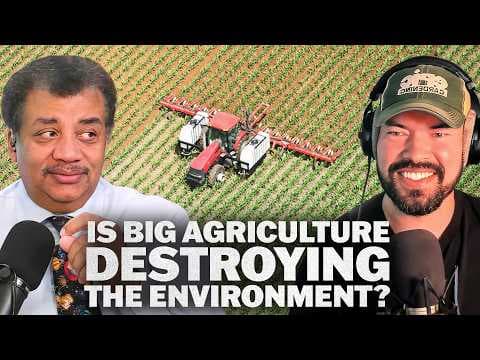
* **The Paradox of Modern Farming:** Industrial agriculture ("big aggra farming") feeds the world with high efficiency, producing more food on less land with fewer farmers. However, this comes at an environmental cost.
* **Topsoil Degradation:**
* Topsoil (the top 3-6 inches) is crucial because it contains the "soil food web" – microbes, fungi, bacteria, and insects that break down organic matter into plant-usable nutrients.
* Industrial farming practices, like tilling, strip away topsoil much faster than it can regenerate.
* This effectively turns fertile soil into "dirt" (soil without life), necessitating the addition of synthetic fertilizers (nitrogen, phosphorus, potassium).
* This approach is akin to growing hydroponically in the soil, relying on external inputs rather than natural processes.
* **Downstream Problems of Industrial Agriculture:**
* **Loss of Biodiversity:** Monocultures (e.g., vast almond orchards) eliminate other flora, displacing native pollinators like bees, leading to a need for managed bee pollination industries.
* **Chemical Runoff:** Synthetic fertilizers and pesticides run off into water systems, contaminating groundwater, rivers, and oceans.
* **Disrupting Natural Cycles:** Continuously adding synthetic inputs and creating new industries to solve problems (e.g., water filtration) ultimately reinvents what nature already did efficiently.
* **Regenerative Agriculture:**
* Focuses on practices that return as much or more to the land as is taken out.
* Examples:
* **Cover Cropping:** Planting crops (e.g., barley, rye, oats, legumes) specifically to generate biomass that is then cut and left in place to enrich the soil. Legumes are particularly beneficial as they perform nitrogen fixation, converting atmospheric nitrogen into a usable form for the soil.
* **Animal Integration:** Running chickens through fields to eat insects and provide nitrogen-rich droppings; using pigs to till and fertilize (though this can be complex).
* These methods aim to work with natural ecosystems rather than against them, regenerating soil health and reducing reliance on external inputs.
**7. The Impact of Home Gardening**
* **Historical Precedent:** Victory Gardens during WWII produced 15-20% of the nation's produce, demonstrating the potential impact of widespread home gardening.
* **Cultural Shift:** While home gardening might not solve the topsoil crisis directly, it could significantly change the culture's attitude toward sustainability and food systems, leading to broader beneficial environmental decisions.
* **Personal Transformation:** Engaging in gardening can profoundly change an individual's life and habits, fostering a deeper connection to nature and environmental awareness.
**8. Unanswered Scientific Questions: Flavor and Beyond**
* **Flavor Manipulation:** A key scientific question is how to impact food flavor at a deeper level. Understanding the chemistry of flavor (e.g., what specific compounds influence acidity or flavonoids in a tomato) could allow home gardeners or industrial producers to precisely control flavor profiles.
* **Lab-Grown Meat Flavor:** In the context of lab-synthesized meat, the challenge is that much of the flavor is released during the animal's death. Developing flavor cocktails to infuse into lab-grown meat (e.g., proprietary burger flavors) is a frontier.
* **Chirality and Flavor:** The example of mint and caraway (mirror-image molecules producing different flavors) highlights the complex chemical basis of taste, suggesting a "flavor wheel" could be developed.
The discussion concludes by emphasizing the importance of individual and community-level efforts in fostering a more sustainable and conscious approach to food production.