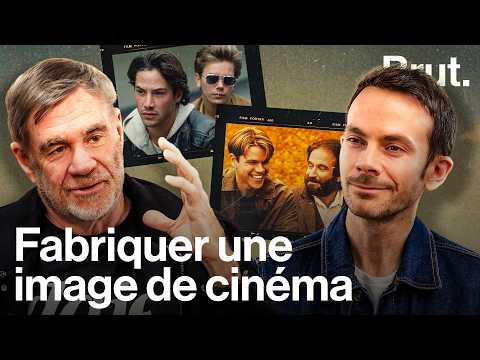
Gus Van Sant : l’interview très (très) technique (MTV, IA, My Own Private Idaho…)
AI Summary
The discussion begins by acknowledging the prevalence of vertical smartphone viewing and its potential impact on how people perceive the world, contrasting it with traditional cinemascope or wide photography. While wide shots might seem less suitable for smartphone screens, the speaker suggests holding the phone sideways as a potential workaround. The speaker personally prefers watching movies on a computer rather than a phone, finding it more convenient for streaming services like Criterion.
When creating a film, the creative process can start with an image or a scene. Often, the most inspiring images conceived in film school might not make it into the final cut but serve as a foundational inspiration. A powerful image is defined as a combination of lighting, subject, motion (if it's a moving image), composition, and the story it conveys. The shower scene from Alfred Hitchcock's "Psycho" is cited as an example, noted for its intense shock and violence condensed into a minute and a half, and for the significant amount of time Hitchcock dedicated to its filming.
The conversation then shifts to the evolving nature of cinematic images in comparison to the multitude of images encountered daily. The stylistic treatment of cinema images underwent a significant change with Oliver Stone's "JFK," which adopted an MTV-like style of mixing various film formats (8mm, 16mm, 35mm) and shooting techniques (handheld, tripod). This approach, initially inspired by documentarians from the 60s, led to shorter shots and a blending of styles. The speaker recalls MTV's early days as a "blender" of different visual aesthetics, appropriating and reanimating famous images from early cinema, a trend they initially thought wouldn't be successful but ultimately became dominant in music video culture. The speaker also did some videos during this era, highlighting the critical importance of music videos to artists and executives, almost on par with the record itself.
Regarding the choice between film and digital for a recent movie, the decision to go digital was primarily driven by financial and time constraints. While film offers certain aesthetic qualities, the processing delays and screening requirements made digital a more practical choice for a quick schedule. Digital filmmaking offers advantages like faster turnaround, the ability to edit while shooting, and immediate feedback on the captured footage.
The impact of artificial intelligence on the perception of images is also discussed. The speaker notes that with AI, almost anything can be created, which might lessen the impressiveness of special effects as they become less about cinematic trickery and more about AI manipulation. The aesthetic of contemporary images (2020s) is still developing, and its unique style might only become apparent with historical distance, perhaps in 30 years.
The film incorporates actual 1977 TV footage, which was intentionally made to look like the movie itself. The director of photography and art director meticulously reproduced the lighting and colors, and the characters were carefully cast to achieve an authentic resemblance to the original footage.
The speaker expresses an interest in various film formats, styles, and grain structures across different decades (70s, 80s, 2000s). While appreciating the value in both grainy phone shots and fine-grain 8x10 black and white negatives, they look forward to a future where fine-grain moving images comparable to an 8x10 camera are possible with advanced digital chip technology.
Reflecting on proud moments in their filmography, the speaker highlights the time-lapses in "My Own Private Idaho." These were initially shot as a showreel for pre-selling the film but were later integrated into the movie to represent a character's narcoleptic states. The cinematographer, Eric Edwards, specialized in stop-motion photography, enabling the creation of beautiful and well-executed time-lapse sequences despite initial concerns from the producer about their cost and purpose.
For their first movie, "Malanoche," the choice of black and white was made to achieve a more dynamic image that could be controlled primarily with light, given budget limitations for color painting. The influences included film noir and David Lynch's "Eraserhead," which also featured sparse lighting. The speaker acknowledges that financial constraints often necessitate compromises in filmmaking, but these limitations can also inspire unique creative solutions, sometimes leading to a process of "subtracting equipment" rather than adding it.
Finally, the speaker addresses the advent of AI-generated images. While not having personally worked with AI, they find it both scary and intriguing. They are not entirely against AI but are wary of the potential for radical changes it might bring to the industry.