เปิดยุทธศาสตร์ Rebalancing พาไทยพ้น ‘Sick man of Asia’ | THE STANDARD WEALTH
Audio Summary
AI Summary
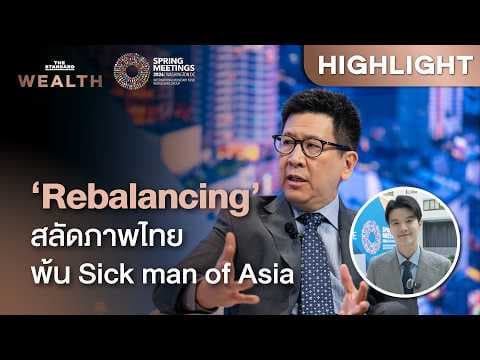
Thailand's Minister of Finance, Ekniti Nitithanprapha, recently presented a vision for the country at the IMF and World Bank 2026 Spring Meeting in Washington D.C., aiming to shed Thailand's image as the "sick man of Asia" and position it for future growth. The Minister participated in two key forums: a debate on the global economy and Governor Talk, both of which saw significant interest from attendees.
The core of Thailand's proposed strategy is a "rebalancing strategy" within a "4T framework" for fiscal balance, designed to move the economy towards clean energy and smart infrastructure, while also addressing public debt. Ekniti highlighted Thailand's current reliance on exports, which account for 70% of its GDP, making it vulnerable to external shocks. The new strategy aims to shift the economy's momentum from external demand to domestic demand, specifically by increasing the proportion of investment from 22% to 30% of GDP within 3-4 years.
The 4T framework outlines four key areas:
1. **Target:** Shifting away from blanket subsidies to targeted support for specific groups, such as low-income earners or the transportation sector, using market prices as a guide.
2. **Transition:** Accelerating the transition to clean energy to reduce reliance on imported oil, which currently accounts for approximately 10% of GDP. This includes incentives for households to install solar panels, with plans to facilitate selling excess electricity back to the grid through smart grid investments.
3. **Technology:** Utilizing AI and digital technology to upgrade infrastructure and build a comprehensive economy. This also involves reskilling and upskilling the workforce to address the skills gap and an aging society, with projects like "Skip Bridge" and BOI investment conditions requiring foreign companies to contribute to Thai workforce development.
4. **Together:** Emphasizing public-private partnerships (PPP) as the main engine for future development, acknowledging the government's limited budget.
A significant highlight of the clean energy transition is the promotion of "direct power purchase agreements" (PPAs) and energy storage systems to support renewable energy at the household level, such as solar cells. The main obstacle to implementing these initiatives is not technology, but rather existing regulations and the "R-tap" framework, which the Minister is actively pushing to reform.
Regarding fiscal discipline, Thailand's public debt currently stands at approximately 66% of GDP. While this includes debt from state-owned enterprises and a 1997 financial recovery fund, Ekniti acknowledged the need to assess the possibility of raising the debt ceiling. The Ministry of Finance is considering raising the ceiling from 70% to 80% of GDP to accommodate investment and economic support measures during periods of uncertainty. This decision, however, requires careful consideration to balance supporting growth with maintaining fiscal confidence and ensuring that any adjustments to the debt ceiling are part of a well-defined fiscal framework, not an open-ended spending policy.
The Minister's mission in Washington D.C. also included meetings with credit rating agencies, finance ministers from various countries, US trade representatives, and large companies considering investments in Thailand. These engagements are crucial for attracting investment and unlocking Thailand's economic potential, especially as Thailand is set to host the IMF and World Bank's Annual Meetings in October.
The discussions with credit rating agencies like Boies Fit Rating and S&P Global Rating focused on clarifying Thailand's fiscal policy adjustments to ensure investor confidence. The current public debt of 12.5 trillion baht (66% of GDP) leaves limited room for further borrowing under the 70% ceiling, especially with existing commitments like the oil fund. The Ministry of Finance views raising the debt ceiling not just as a means to borrow more, but as a way to build policy resilience against prolonged economic risks.
The concept of Direct PPAs was further elaborated, explaining that it would allow private companies to purchase electricity directly from renewable energy producers, bypassing intermediate systems and the state-owned power grid. This is seen as a breakthrough that would require adapting existing laws and regulations, pricing, and infrastructure usage to benefit Thailand and align with global changes. Despite potential resistance, the Minister expressed a commitment to move forward with Direct PPAs to benefit the country.