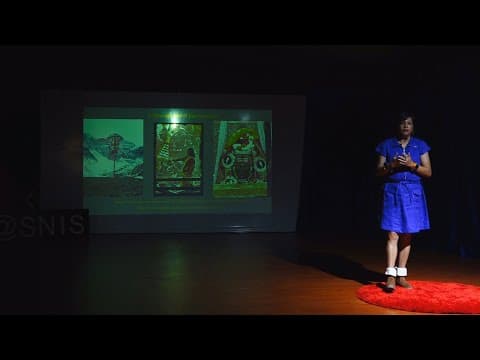
The Strange Logic of Connections | Liane Ghosh | TEDxSNIS Youth
Audio Summary
AI Summary
The speaker begins by discussing different origin stories of the world. From an Indian perspective, there are three main theories: the Big Bang 13.8 billion years ago, the Christian belief of God creating the world in seven days, and the cyclical creation by Brahma, sustained by Vishnu, and destroyed by Shiva. The common premise across these theories is that a single entity or event created the world, which the speaker believes is the source of all connections.
The audience is then prompted to consider their own origin stories and why they are in their current place, questioning whether it's a cosmic connection, something written in their history or astrology, or a result of their unique actions. The speaker encourages self-reflection on one's purpose and presence.
The speaker then shares their personal origin story, having been born about 100-150 kilometers from the current location, into a family of educators. From a young age, they had a strong desire to pursue multiple interests simultaneously, including learning about stars, running, swimming, playing basketball, and excelling academically. This drive continues today, as the speaker holds three jobs, loving each one and unable to choose between them.
To illustrate the concept of connections, the speaker recounts a series of seemingly unrelated experiences. Towards the end of last year, during a trek in Dharma Valley to Panchichula base camp, someone suggested visiting a nearby mountain called Adikail. Despite the itinerary changes, the speaker went and felt a cosmic connection to the incredible, solitary peak against a blue sky.
A few months later, for a job with a travel company, the speaker visited Varanasi. While there, they toured a temple where they learned about Shiva lingas and the 12 Jyotirlingas of Shiva, which originate from different places but are represented as a single pillar. This was noted but not deeply pondered at the time.
Fast forward to March of the current year, during an eight-day camp in Indore, the speaker met a person who wanted to visit a temple in Ujjain. Despite not knowing the person well, curiosity led the speaker to accompany them on a 2.5-hour car journey. Upon arrival, the speaker realized this was another Jyotirlinga of Shiva. This experience was mesmerizing, especially for the speaker, who identifies as neither religious nor Hindu. This series of events prompted the speaker to consider that connections form a web, and things happen for a reason, suggesting cosmic connections.
The speaker then categorizes connections into two types: temporary and permanent. Temporary connections involve people who enter one's life for a "reason" or a "season." These individuals may be present for a short period, serving a purpose such as teaching, sharing, leaving a message, or providing a cosmic link that could be helpful later, or even receiving help from the individual. Despite their transient nature, these connections are deemed powerful.
Permanent connections, referred to as "lighthouse connections," are with people who stay in one's life, even if they periodically fade in and out. These connections are described as meaningful and sacred, deserving to be cherished throughout life. The speaker acknowledges that one can never know if a connection will be temporary or permanent upon meeting someone, but emphasizes that all connections require nurturing.
Finally, the speaker presents a riddle: "Why is a fire engine red?" The convoluted answer involves a chain of associations: 12 people on a fire engine, 12 feet in a ruler, Queen Elizabeth as a ruler and a ship, ships sailing in the sea, fish swimming in the sea, fish having fins, fins coming from Finland, Finland being in Eurasia, Russia also being in Eurasia, and the Russian flag being red. This bizarre explanation serves to illustrate that connections can sometimes be unexpected and strange, requiring individuals to discern which "dots" or "bizarre connections" are meaningful and will endure through life.