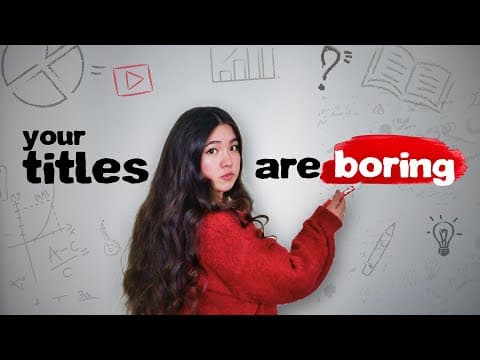
give me 8 minutes, I'll make your titles 81% better
AI Summary
YouTube video titles are crucial for success, often determining a video's performance despite creators spending days on content and hours on thumbnails, only to treat titles as an afterthought. A single title change can dramatically impact a video's reach. There are five common mistakes YouTubers make with their titles, and understanding how to fix them can significantly improve click-through rates.
The first major mistake is not giving people a reason to click, which stems from a lack of curiosity generation. If a title doesn't pique interest, people won't click. For example, instead of a generic title like "I tried Filipino food," a more effective title like "I flew 7,292 miles to eat here" creates an open loop by making viewers ask questions such as "Why did you fly so far?" or "Was it worth it?" Our brains are compelled to close these loops, driving clicks. To create stronger loops, various techniques can be employed, which can be displayed on screen.
The second mistake is not utilizing proven title formats. There's no need to invent new ways to generate curiosity; even top YouTubers model successful formats. They draw inspiration from titles that have already garnered millions of views, either for themselves or others. This involves identifying "outliers"—videos that have significantly outperformed a channel's average view count. These outliers can be found by scrolling through video libraries or by using tools like Spotter Studio, which also sponsored this video. Once an outlier is identified, its title can be broken down into its core structure. For instance, a title like "I took bold action for [time frame], this is what happened" can be adapted to various content, such as "I woke up at 4 am every day for a month, this is what happened." The key is to find what works, take its structure, and apply it creatively to one's own content.
The third mistake is using uninspired or boring words. Even a single word can differentiate between a title that gets clicks and one that's ignored. Comparing "How to edit and film YouTube videos" with "How to edit and film cinematic videos like a pro" illustrates this. The latter, with just a few "power words," instantly conveys higher value and quality. Power words are specific terms that make a title more intriguing without altering its core meaning, falling into categories like emotional, authority, urgency, and exclusivity. Critically, each niche has its own effective power words. In finance, terms like "broke" or "passive income" are common, while in fitness, "shredded" or "fat burning" frequently appear. Identifying these involves analyzing top-performing videos in a niche for recurring patterns. Tools like Spotter Studio's "power up" feature can also generate niche-specific power words using data from millions of views. Spotter Studio also offers features like "rephrase," "shorten," and "explode" to aid in title ideation and refinement, which can be tried for free for 14 days via a link in the description.
The fourth mistake is being too wordy. Titles compete for attention, and a lengthy, difficult-to-process title will be overlooked in favor of shorter, clearer ones. Ideally, titles should be under 55 characters for faster intake speed. If a title is longer, effective word order is vital. Viewers skim, rather than read word-for-word. It's crucial to frontload the most important words so that the core message is clear even if only the first half is seen, especially since YouTube may cut off longer titles on some devices.
Finally, the fifth mistake is sticking with an underperforming title. Sometimes, despite best efforts, a title just doesn't resonate, and it's essential to be willing to change it—a practice common among big creators. To determine if a title needs changing, monitor the click-through rate (CTR) and impressions. If both are lower than average within the first 24 hours, the title or thumbnail isn't connecting with the audience. Changing the title is often easier than changing the thumbnail. If CTR and impressions are average, it's best to wait until after the typical window when videos gain traction for that specific channel, which could be days or even a week or more. YouTube Studio can help identify this pattern by checking the "typical in this period" view range. While changes may not show immediate results, sometimes all a video needs to succeed is the right title.
Realizing one is making these mistakes is a positive step, demonstrating a commitment to improvement. YouTube is a challenging platform, and continuous learning is necessary. Instead of making all changes at once, focus on one micro-adjustment at a time, and over time, significant progress will be evident.