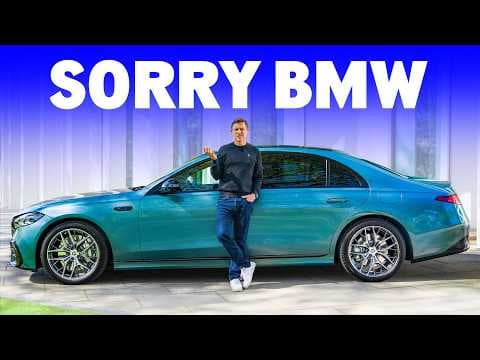
Mercedes’ new S-Class just DESTROYED BMW
Audio Summary
AI Summary
The new Mercedes S-Class, presented as a mid-life facelift with extensive changes, aims to be the most luxurious saloon in its class, though the reviewer expresses reservations. The front of the car is entirely new, featuring updated lights with distinctive three-pointed star daytime running lights, which are well-received. However, the new grille, particularly on the AMG line model with its blacked-out elements, is criticized for appearing plasticky rather than luxurious. While chrome accents are available and improve the look, the reviewer finds the overall grille design lacking in premium feel. The prominent three-pointed star emblem is highlighted as the sole element that truly conveys luxury at the front.
Moving to the side profile, changes are less pronounced. New alloy wheel designs are present, and a camera unit for upgraded sensors has been added. The AMG line's blacked-out window trim is deemed less suitable for the S-Class than chrome. A recurring point of dissatisfaction is the door handles, which are described as lacking the luxurious feel expected, with a springy action likened to a "bad handshake."
The rear of the car sees more significant updates, with all non-metal components being new. This includes a new strip, updated taillight design incorporating the three-pointed star motif, and revised rear bumpers. The reviewer prefers the rear to the front, though notes the exaggerated exhaust surrounds, while acknowledging the presence of functional exhausts. The side profile is considered the car's best angle, with the front being a notable detractor.
Inside, the most striking change is the new dashboard design, dubbed the "super screen." This integrates a main infotainment display with a separate screen for the passenger, both standard features that significantly enhance the interior over the previous model. The digital driver's display is clear and offers intuitive menu navigation. The reviewer finds this layout superior to the BMW 7 Series. A new steering wheel includes physical controls for volume and cruise control, but the touch-sensitive buttons for the driver display menus are found to be fiddly.
Material quality in the cabin has been updated, with a wider selection of trims, colors, and a vegan option. The center console is redesigned, featuring a 50-watt ventilated wireless phone charger, cup holders, storage compartments, and USB-C ports. Glove boxes are noted as shallow, and door bins as reasonable in size. Seat materials have been updated, but the seat structure remains the same and feels firm compared to the BMW 7 Series. The reviewer also perceives the material quality in the S-Class as cheaper than its competitor, citing specific plastic elements that feel less premium and hollow.
Despite these criticisms, the S-Class's new infotainment system is praised for its sharp graphics, bright colors, and logical menu layout, making car functions and driver aids easily accessible and controllable, including the ability to disable annoying systems. The app-based interface for in-car functions is user-friendly, with bright, well-organized menus that prevent users from getting lost, unlike BMW's system. Ambient lighting with a wide array of colors is also a feature. The lack of physical climate controls and the reliance on the screen are noted as a drawback, although vent direction controls remain physical and are appreciated. A slight lag in the infotainment system's responsiveness is identified as a minor issue.
Rear cabin changes are minimal, including the center console design and air vents. Optional larger rear infotainment screens are available but have an old-fashioned bezel. The reviewer experiences the top-tier, first-class style rear seating, which offers extensive adjustability but requires a manual hold for certain functions. Storage and USB ports are plentiful, but the permanent presence of the wireless charging pad, even when not in use, is seen as a waste of space. Rear door bins are a decent size, and seatback pockets are a nice touch. While the rear seats are comfortable, they are not perceived as plush as those in the 7 Series. Operating the rear touchscreen can be challenging, but a new remote control system, acting like a mouse, offers a convenient solution for controlling various functions, including seat massage and ambient lighting, though it also exhibits some lag. Sunblinds can be controlled remotely, and a fridge option is available, though not present in the test car.
The boot space is generous in the non-plug-in hybrid, but significantly reduced in the plug-in hybrid model due to battery placement. Demonstrations highlight the difficulty of fitting into the plug-in hybrid's boot compared to the non-hybrid version.
Five "annoying" aspects of the new S-Class are detailed: the angled glass screens requiring an awkward posture for optimal viewing, the absence of electrically closing rear doors, the unavailability of a short-wheelbase version in the UK, a dividing beam in the glass sunroof, and occasional technical glitches such as door handles and rear blinds malfunctioning.
Conversely, five "cool" features are presented. These include work tables in the rear that are springy, a reflective and potentially distracting large screen, and an impressive augmented reality head-up display requiring a large dash cutout. However, a new HD camera for Teams meetings is a notable addition, allowing for video conferencing from both front and rear seats. Heated front seat belts, a feature the reviewer questions the necessity of, are also included. The S-Class boasts an advanced air filtration system that can purify the cabin air in 90 seconds. The car is equipped with numerous airbags and an extensive array of exterior cameras and sensors enabling advanced autonomous driving and parking capabilities, including a highly efficient parking search function that identifies spaces ahead of the vehicle.
On the road, the hybrid model offers strong acceleration thanks to its electric motor. Engine options include diesel, petrol, two plug-in hybrids, and a V8 petrol in the US. The car is capable of electric-only driving, offering a smooth and quiet experience, enhanced by the excellent air suspension. The reviewer praises the sophisticated navigation system with augmented reality and head-up display integration. The plug-in hybrid's electric range is sufficient for commutes, and the engine's engagement is smooth and unobtrusive. The chassis and suspension remain unchanged from the pre-facelift model, which is considered already excellent, providing a "magic carpet" like ride. The S-Class is noted for its relaxing and wafty feel on fast roads, and its ability to maintain comfort even on long journeys. Adaptive cruise control with lane-keeping assist is functional, though the reviewer notes a brief, unexpected braking event. The car handles well for its size, with responsive steering. An innovative cloud-based system shares road condition data between vehicles to proactively adjust suspension. The cabin's soundproofing creates a sense of isolation from the outside world. The car's automatic braking system is highlighted for its effectiveness in managing traffic flow, providing smooth deceleration.
The car's price point is discussed, with the entry-level model costing over £100,000, rising to around £140,000 for higher trims and engine options. The reviewer concludes by stating that while the S-Class excels in its driving dynamics and technology, it is let down by certain aspects of material quality and exterior design, suggesting that engineers may have delivered on the brief but accountants have compromised on luxury. This contrasts with the BMW 7 Series. Despite its driving prowess, the S-Class is perceived as lacking in some areas for buyers seeking ultimate top-tier luxury.