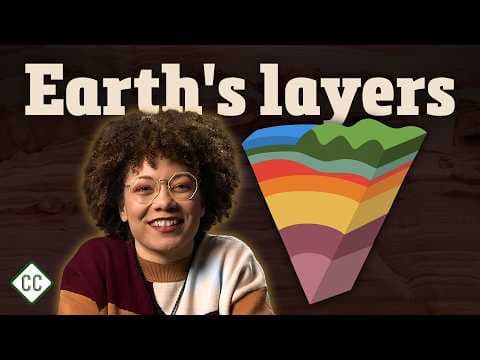
Earth's Crust and Mantle Explained: Crash Course Geology #3
Audio Summary
AI Summary
Humans have long wondered about the Earth's interior, with early theories ranging from a hollow shell containing a smaller sphere to a planet with sentient squishy guts. However, these imaginative ideas were incorrect. The deepest hole ever dug, the Kola Superdeep Borehole in Russia, reaches 12.2 km, but this only scratches the surface, barely penetrating the Earth's top layer. This highlights how little we truly know about what lies beneath us.
Our planet's outer rocky shell, the crust, is the layer we are most familiar with, as it is where we live. Despite this, it accounts for only 1.4% of Earth's total volume, and we have never journeyed beyond it. There have been attempts, such as Project Mohole in the late 1950s, an ambitious plan by the American Miscellaneous Society to drill through the Earth's crust. Named after the Mohorovičić discontinuity, the boundary between the crust and mantle, the project aimed to achieve something unprecedented. In 1961, the team aboard the ship Cuss I, with journalist John Steinbeck observing, began their efforts. They faced the challenge of not only drilling through kilometers of rock but also doing so at the bottom of the ocean where the crust is thinnest.
Starting small, they drilled a few hundred feet off the coast of Mexico, successfully dredging up cores of volcanic rock and sediment previously unknown. This initial success garnered praise from President John F. Kennedy. However, the project soon faced internal disagreements and bureaucracy regarding the next steps—whether to continue with small tests or pursue the ambitious "crust or bust" goal. Ultimately, funding ran out, and Project Mohole faded away, never achieving its main objective of drilling through the Earth's crust. To this day, no one has accomplished this feat.
The Earth's crust is composed of solid rocky slabs, primarily oxygen and silicon, along with elements like aluminum, iron, and calcium. These slabs, known as tectonic plates, interact over time, forming continents, mountains, and oceanic trenches. The crust is thickest under mountains, reaching depths of about 70 km, while oceanic crust is much thinner, typically 5 to 10 km thick.
Beyond the crust lies the mantle, Earth's dense middle layer, which makes up roughly 84% of the planet's volume and extends to a depth of about 2900 km. The uppermost 100 km, encompassing the crust and the top part of the mantle, is called the lithosphere—a solid, rocky, and relatively cool region. Below this, we enter the asthenosphere, where increasing heat and pressure cause the iron and magnesium-rich rocks of the mantle to become more pliable, with a taffy-like texture.
The upper mantle, extending about 410 km down, is characterized by a greenish-black color due to the mineral olivine. As one descends into the mantle transition zone, an area of increasing temperature and pressure, the chemical composition shifts, and minerals rearrange their atomic structures, changing color to black, red, and blue. At the base of this zone, around 660 km down, a subterranean mountain range with jagged crags, some potentially taller than Everest, exists.
Further down is the lower mantle, stretching from 660 km to about 2700 km below the surface. Due to high pressure, rocks here flow less than in the upper mantle. This vast region accounts for about half of Earth's total volume and contains mysterious, continent-sized blobs, nicknamed Tuzo and Jason by scientists, whose origin is still unknown.
Finally, we arrive at the core, Earth's extremely hot and dense center, which will be discussed in a future episode. Despite the inability to drill past the crust, geologists have devised methods to study Earth's deep interior. They analyze volcanic eruptions that bring melted mantle rock to the surface and study iron meteorites, ancient space rocks believed to have formed the cores of other worlds, to understand the Earth's core composition. In 2014, a 4.5-billion-year-old meteorite allowed geologists to observe bridgmanite, the most abundant mineral inside Earth, thought to make up much of the super-hot lower mantle.
Seismology, the study of seismic waves from earthquakes, also provides crucial insights. By measuring these waves, geologists can essentially "x-ray" the Earth, piecing together the properties of its layers. While Project Mohole and the Kola Superdeep Borehole did not achieve their ultimate goals, they pioneered techniques that have led to significant discoveries about Earth's climate millions of years ago and the formation of landscapes by tectonic plates.
Recent research continues to push the boundaries of our knowledge. In 2023, a team aboard the Joye's Resolution drilled 850 meters below the ocean surface, retrieving mantle chunks from an underwater mountain where the crust is thin. They observed how these olivine-rich rocks reacted with ocean water to produce hydrogen, a key ingredient for organic compounds, potentially offering clues to the origin of life billions of years ago.
Even though we know less about our planet's interior than about the solar system, geologists are constantly refining methods to study Earth's depths, building on early drilling techniques. There is still much to discover about the world beneath our feet and its profound influence on our lives.