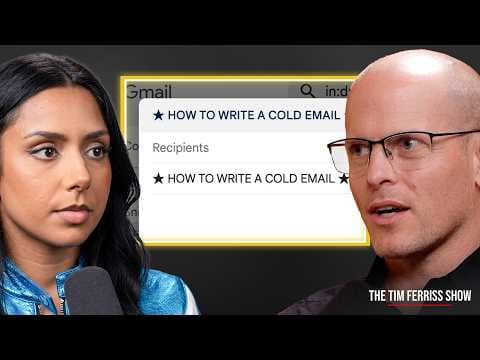
Tim Ferriss’s Cold Email Playbook (Step by Step)
Audio Summary
AI Summary
When reaching out to high-profile individuals, establishing credibility upfront is crucial. A key strategy for the subject line of an email is to mention a mutual connection, especially if they recommended the outreach. For instance, an email to Tom Cruise could be titled "For Tom Cruise via mutual connection: Tim Ferriss." This prioritizes the recognizable name, which is vital as subject lines are often truncated on mobile devices. The "via" phrasing is preferred over "referral from X" because it implies a connection without requiring the recipient to immediately vet the referrer.
However, it's paramount to genuinely know any mutual connections mentioned. The person receiving the email is likely to text these individuals for verification. Misrepresenting the depth of a relationship can lead to immediate disqualification.
Regarding salutations and tone, politeness is always the safest approach. Using "Mr." or "Ms." is recommended over informal greetings like "Hey Tim" or "Yo Ferris." Such casualness can be perceived as a lack of awareness or respect, especially by busy individuals who receive numerous emails. An overly familiar tone from a stranger can feel intrusive and unprofessional, posing a reputational risk for the sender if they are to be connected with others or work alongside the recipient. Many busy people have more opportunities than they can consider, so the primary goal of an initial email is to avoid any missteps that could lead to disqualification.
Another important tip, especially relevant in certain social environments, is to respect personal space and boundaries. Avoid unsolicited physical contact, such as hugging, unless explicitly invited. The person desiring the most distance often dictates the interaction.
For the first line of the email, following the subject line, a credibility indicator is essential. This could be something like "For interview (1 billion+ downloads)" for a podcast, or, for those without such metrics, examples of their work that demonstrate effort and quality, even if not widely recognized yet. In early career stages, volunteering for organizations with strong name recognition can provide a valuable "via" connection. For example, volunteering for "Tai, the Indus Entrepreneur" allowed for emails to tech professionals to be sent "For so-and-so via Tai," leveraging the organization's reputation. These volunteer efforts, though unpaid, can lead to significant long-term opportunities and connections, embodying a "long-term greedy" approach rather than seeking immediate monetary gain.
The email should also clearly state who the sender is within the text, rather than forcing the recipient to click links or attachments to figure it out. Busy individuals don't have time for "scavenger hunts." A brief line or two explaining the sender's identity is sufficient. Hyperlinks should be embedded within descriptive text, for example, "and I've done this thing," rather than simply "click here." This is crucial for several reasons: it saves the recipient time and reduces the risk of phishing attacks. Well-known individuals often receive numerous fraudulent emails with dangerous links designed to steal information or facilitate social engineering scams, such as fake podcast invitations that attempt to gain screen access to hijack social media accounts.
Finally, the email must contain a clear and concise "ask." Vague requests like "would love to discuss something vague, let's hop on the phone to discuss how's next Tuesday at 2 p.m." are unlikely to receive a response. Such an approach suggests a lack of consideration for the recipient's time. The ask should be specific and value-conscious.
In the closing, provide a direct contact number (a burner or Google Voice number can be used) and explicitly invite communication, e.g., "Feel free to text me anytime" or "I promise it will not take more than 10 minutes." If a time limit is promised, it must be strictly adhered to. Including a line like, "If you've read this far, I really appreciate it. And if you're too busy to get back to me, I totally understand," can significantly increase response rates by demonstrating a lack of entitlement.
A cold email serves as an audition. A vague, presumptuous email signals a lack of awareness and business savvy. If no response is received, a single follow-up is permissible, but only after at least a week. Repeated "bumping this up" emails are generally ineffective and irritating. If an email doesn't get a response, it's often a sign that the email itself, not the recipient's interest, is the problem, and it's best to move on.