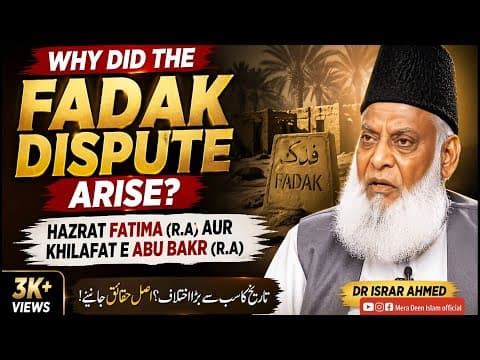
Why Did the Fadak Dispute Arise? |Hazrat Fatima R.A & Khilafat e Abu Bakr R.A | Dr Israr Ahmed Bayan
Audio Summary
AI Summary
The provided transcript is a fragmented and at times unintelligible collection of words and phrases, making a coherent and comprehensive summary challenging. However, I will do my best to extract the discernible themes and points, relying solely on the text provided.
A recurring theme appears to be a discussion of religious figures and their roles, particularly within an Islamic context. Mentions of "the Prophet," "Allah," and various companions like "Abu Talib," "Abu Bakr," and "Uthman" suggest a focus on Islamic history and teachings. There's a sense of seeking divine guidance, with phrases like "asking exaltio" and references to "Allah's protection."
The transcript touches upon the concept of divine will and human action. There are instances where the actions of individuals are questioned, such as "What was the person's fault?" and a discussion about whether certain actions were permissible or divinely sanctioned. The idea of God's knowledge and foresight is also present, with statements like "Allah, his súperиков knew."
A significant portion of the transcript seems to revolve around the Quran. There are mentions of "translations reported by the wither Linked we hear and the anyine This is between wide and secure Wrestling Since the podcast,uting the Quranunn a groundsien The Quranunn a-tube it I said That is your Axis Or what It is written because it is made I seen him Again He said till破 in ripped 2000 happen to sin probably." This indicates a focus on understanding, interpreting, and potentially disseminating the Quran. The importance of "the Quran" as a source of guidance and law is implied.
There are also discussions that appear to be historical narratives or biographical accounts. References to "Quraysh کے سرداروں کی پہلی سفارت" (the first embassy of the leaders of Quraysh) and their offer to the Prophet suggest a specific historical event being recounted. The mention of "Abud halib ka bi'intqal kubi" and "Ibn Avf khadija ka bi'intqal kubi" might refer to the passing of significant figures. The narrative seems to involve attempts to dissuade or influence the Prophet, with offers of wealth, leadership, and marriage.
The concept of struggle and perseverance is also evident. Phrases like "very difficult time" and mentions of "fighting" and "struggle" suggest challenges faced by the early Muslims. The transcript also alludes to the importance of faith and belief, with phrases like "if i can only believe that when i will marry you" and "may nor be y retin if i can only believe."
There are also fragmented discussions about specific events or situations. The mention of "Tabaif ka shahr" and a potential divine intervention involving mountains suggests a narrative of divine protection or a test of faith. The idea of repentance and seeking forgiveness appears in phrases like "don't come out? You are sitting under Without you We can make our armor It is not Once that is When I minute I am using it."
The transcript also touches upon the notion of leadership and responsibility. The role of "Abu Bakr" in consolidating the Islamic state and dealing with "counter-Revolutionary Movements" like false prophets and those who refused to pay Zakat (charity) is highlighted. This suggests a focus on the establishment and protection of the nascent Islamic community.
There are also instances that seem to be prayers or supplications, such as "ربِ اَدْخِلْنِي مُدْخَلَ صِدْقٍ وَأَخْرِجْنِي مُقْرَجَ صِدْقٍ وَيَعَلِّمِ اللَّدُنكَ سُلْطَانًا النَّسِيرًا" (Lord, cause me to enter a good entrance and to exit a good exit, and grant me from Yourself a supporting authority).
The transcript contains a mix of languages and dialects, making it difficult to ascertain the exact context of some phrases. However, the overarching themes revolve around faith, divine guidance, historical accounts of early Islam, the importance of the Quran, and the challenges faced by believers. The fragmented nature of the text prevents a more detailed or nuanced summary. The recurring mention of "Prophet," "Allah," and "Quran" strongly indicates a religious discourse, likely within the context of Islamic teachings and history. The mention of specific companions and historical events points towards a narrative or explanatory style, aiming to convey lessons from the past. The emphasis on divine will and human accountability suggests a theological discussion.