Je pensais que la Bourse allait s’effondrer… et j’ai tout perdu ?!
Audio Summary
AI Summary
The speaker questions the absence of economists and market pessimists who predicted a collapse and urged selling, contrasting their predictions with actual market performance. He recounts a personal experience from April 9th, when his Alpha Zen system indicated a strong buy signal for 20 titles, despite widespread bearish sentiment from respected figures like a hedge fund manager whose LinkedIn post advocating selling was liked by commodity star Pierre Endurant. This presented a dilemma: follow his system or be swayed by influential bearish opinions.
The speaker emphasizes the importance of sticking to one's method over external "noise," even from highly respected investors like George Soros, Paul Tudor Jones, or Warren Buffett. He explains that while Buffett's value investing style might find the market too expensive, his own momentum-based approach focuses on exceptionally performing stocks, irrespective of broader economic or valuation concerns. This conviction led his portfolio to achieve an "insane" 16.41% performance in one month, with significant gains in individual stocks like Intel (80%), DOCN (74%), SNDK (68%), STX (55%), and MU (55%).
He challenges the notion that economic fundamentals justify the recent market surge, pointing to risks like inflation, global recession, and supply chain issues (e.g., 20% of oil tied up). Instead, he argues that the surge is driven by supply and demand, which technical analysis effectively captures. The speaker asserts that technical analysis (TA) is superior to fundamental analysis (F) because, from a logical and rational perspective, the market shouldn't have risen. He criticizes economists and financial experts who advised against buying, yet his momentum strategy yielded significant gains for his students, with some achieving 26% returns year-to-date.
He dismisses the common belief that individual investors have no chance against professionals, citing Peter Lynch's view that individuals possess the means to beat professionals. The key differentiator, according to the speaker, is mindset and psychological strength. He recalls advising arrogant polytechnicians and centralians who, despite their intelligence, trembled during market downturns, highlighting the power of psychology over perceived complexity. He contrasts this with Pierre Endurant, who, after a strong start to the year (32% performance in three months), suffered a 50% loss in April, bringing his year-to-date performance down by 37%. This example, reportedly from Bloomberg, underscores that even seasoned professionals are not immune to losses.
The speaker expresses frustration with those who claim market success is impossible for individuals, viewing such statements as "arrogance" and "blah blah." He positions Alpha Zen as a public demonstration against these falsehoods, proving that anyone with the right method and courage can beat the markets. He admits he doesn't understand why indices are rising so sharply but doesn't care, as his method keeps him "in it" and profiting. He criticizes those who try to explain market movements after the fact, stressing the importance of entering positions *before* everyone else, not when explanations become abundant.
He defends his scientific, back-tested, and research-backed methodology against those who dismiss technical analysis as simplistic, challenging them to prove their own superior results. The difficulty, he explains, isn't in the simplicity of the method but in people's tendency to complicate things, delay action, and succumb to skepticism. He notes that people often wake up to a trend only when it's well underway, by which point early entrants are already preparing to exit and await the next cycle.
The speaker reiterates that listening too much to analysts and economists leads to being a "sheep" and never achieving success. He emphasizes a science-based method combined with the correct mindset. While acknowledging potential fundamental reasons for market movements (e.g., end of war anticipation, short squeeze), he dismisses them as "intellectual masturbation," focusing instead on tangible results. He challenges critics to demonstrate their own 16% monthly or 26% year-to-date returns before offering opinions.
He strongly condemns criticism of technical analysis as "for 5-year-olds," arguing that his simple, black-and-white approach of buying or selling based on clear signals has yielded superior results compared to theoretical, verbose analyses. He quotes Peter Lynch, who suggested that listening to an economist for 13 minutes annually means wasting 11 minutes. The speaker explicitly states he doesn't know if the market will continue to rise, collapse, or stagnate, and he refuses to take a definitive stance, as his method dictates action based on signals, not predictions.
He criticizes those who offer opinions without having taken action or achieved results, contrasting them with practitioners who "ride the trend" without endless philosophizing. He stresses that the stock market is about winning or losing, entering and exiting well, and that technical analysis's directness (buy, sell, join) is its strength.
Briefly touching on specific assets, he notes Bitcoin is becoming interesting but remains below key moving averages. Gold is recovering but also below averages, needing to break above 4900 to become truly interesting. Bonds are "so-so," and energy, particularly oil, is correcting after an explosion in prices. Silver appears more promising than gold with a nice consolidation but lacks momentum and remains below moving averages.
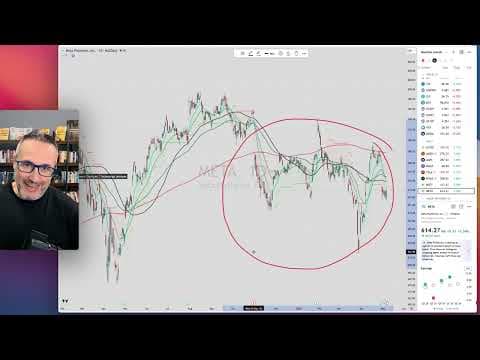
He confirms positions in "Magnificent Seven" stocks like Google and others, acknowledging they can't be everywhere. Amazon is not a current holding. Apple is improving, while Meta and Microsoft are not favored due to being below the 200-day moving average. Tesla is building nicely below its 200-day moving average, and Nvidia is performing well. The NASDAQ has broken its resistance, and the index of magnificent stocks is starting to catch up, poised for an explosion if it breaks its current level.
The speaker concludes by reiterating his frustration with arrogant but incompetent individuals who bash technical analysis while offering no tangible results. He emphasizes his transparency with Alpha Zen students, showing a real portfolio with real money and all statements, including wins and losses, to teach the process. He offers a promotion for Alpha Zen, providing 6 months free with the purchase of certain programs.