6 Things Ancient Coins Taught Us
Audio Summary
AI Summary
Money, in the form of coins, has been a continuous presence in the West since the 7th century BCE. These ancient coins, though no longer viable for modern transactions, offer a wealth of information to archaeologists and historians, revealing insights into the past.
The most immediate lesson from ancient coins concerns their nature as stamped metal, agreed upon as valuable. While today coins are instinctively linked with money, money itself is anything exchanged for goods and services, encompassing items like shells, beads, and even cigarettes. The exact origin of coin usage is unknown, but the oldest discovered coins, minted around 600 BCE in modern-day Turkey, were made of electrum, a natural gold and silver alloy. Their value was inherent, and the official state seal stamped on them served as a guarantee of legitimacy and a promise that the issuer would back the coin's value, essentially offering credit or an IOU. This metal-money concept quickly spread across the eastern Mediterranean.
Archaeologists can infer surprising details about ancient economies from coins. For example, a Roman silver coin from the 1st century CE, found in the UK, has a hole punched through it. Approximately 60% of Roman coins from the Anglo-Saxon period found outside Kent exhibit similar alterations. Historians suggest that after the Roman army's departure, Roman money became worthless in these areas. People then repurposed the shiny coins as decoration, indicating a shift away from using them as currency. Economic trouble is also visible in Roman coins, such as a denarius from 87 BCE. During a period of war and debt, the Roman mint deliberately added 5-10% copper to what was supposed to be pure silver, devaluing the coins and demonstrating early signs of inflation.
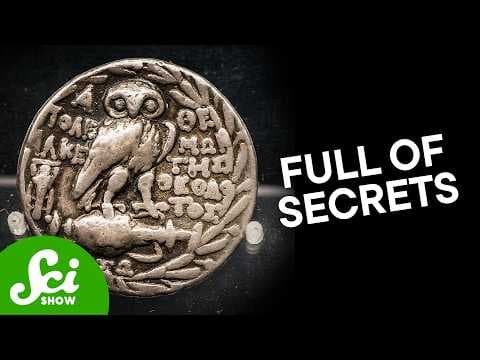
Coins also provide information about available metals, metallurgical advancement, and metal origins. An analysis of ancient Athenian silver tetradrachms revealed that the silver used was mined as far away as Spain, France, Romania, and Turkey, rather than from closer northern Greek mines as previously assumed. Early Athens, therefore, relied on imported silver to build its influence before gaining control of local mines and producing its iconic owl coins. Conversely, coins can indicate the absence of certain metals. A Spanish real from the late 18th/early 19th century, found in Jamestown, illustrates this. Early European colonizers in North America found a land rich in resources but lacking precious metals for mining. Consequently, the fledgling United States initially used foreign currency, only establishing the U.S. Dollar as sole legal tender in 1857.
Beyond economics, coins are potent sources of information about politics and propaganda. Powerful individuals, typically the issuers, chose images reflecting their priorities or fears. Early coins featured gods, but the Persian commander Tissaphernes, around 400 BCE, was the first actual person to appear on currency. These portraits offer insights into the appearance and ambitions of historical figures. Julius Caesar, in 44 BCE, was the first living Roman to place his head on a coin, a significant power play given the taboo. His inscription "Dictator for Life" further asserted his authority, though his assassination shortly after minting this coin proved his victory lap premature. This set a precedent for Roman emperors and later monarchs, providing archaeologists with a clear timeline of rulers. Shifting values are evident in French coins during the French Revolution. Coins from 1789 depicted King Louis XVI with "King By the Grace of God," while 1792 coins, after his imprisonment, changed to "The Nation, Law, and the King." Following his execution, the head of state was removed until Napoleon seized power.
Coins are invaluable for dating archaeological sites. Just as a 1987 penny in a jacket indicates it was worn after that year, ancient coins help date past sites. A recent discovery of 4th-century CE coins in tunnels near an ancient Galilean village suggests the tunnels were used during the third Jewish revolt, well after the previously known first and second uprisings against the Romans. Coin dating can be more precise than carbon dating for relatively younger sites, as it can narrow down activity to specific decades. For example, a French coin minted between 1632 and 1634 found at an Inuit site in Quebec helped date its activity to the 1630s, a period too recent for carbon dating to be as precise. However, coin dating isn't foolproof; the Maria Theresa Thaler, continuously minted with the 1780 date, complicates precise dating beyond that year.
Coins are also excellent indicators of ancient trade routes. The presence of 1st-century CE Roman coins in northwestern China confirms a network of trade routes, likely the Silk Road, connecting Rome and China to facilitate the exchange of goods like Chinese silk. Similarly, Islamic coins found at a 9th-century Viking burial site in Sweden demonstrate unexpected trade connections. A recent study of 250 silver coins from Southeast Asia revealed a previously unknown 1st-millennium trade network. Shared religious motifs and the discovery of two coins from Bangladesh and Myanmar, likely made by the same person or with the same die, highlight the extensive reach of this network.
Finally, coins offer insights into religion. Medieval Islamic coins, unlike their Christian counterparts, typically featured calligraphy instead of images. This trend began in 696 CE under Caliph Abd al Malik, who minted coins without symbolic images. One theory suggests this was to distinguish the Islamic Empire and its values from the Christian Byzantine Empire, which often depicted emperors alongside Christian images. The text-only Islamic coins, written in Arabic, showcased Arabic as a unifying language and indicated literacy among users, while still asserting the Caliph's authority by proclaiming him "God's Deputy."
From political messages to decorative purposes, coins have served diverse functions throughout history. These artifacts provide invaluable insights into the people who created them, offering a window into past economies, politics, and cultures. Modern coins, though less precious in material, will similarly inform future historians about our values and society.