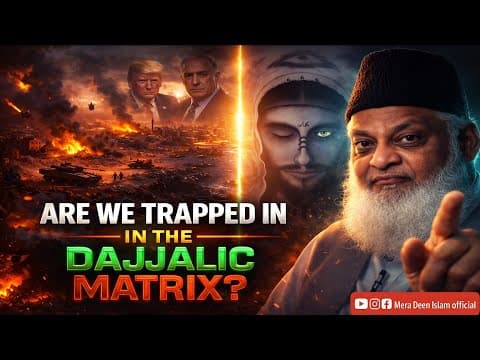
ARE WE TRAPPED IN THE DAJJAL MATRIX? | DR ISRAR AHMED BAYAN
Audio Summary
AI Summary
The video discusses various interpretations of religious and political systems, with a significant focus on Islam and its perceived place in the modern world. It begins by referencing symbols like "Ordo Siklorum" and "1776," associating them with the "Order of Illuminati" and questioning their significance. The speaker then shifts to a critique of what they term "naked capitalism" and its perceived negative consequences, such as poverty and wealth disparity. This system, they argue, is a significant "deception" and is linked to the banking system and other financial structures.
A central theme is the concept of "usury" (interest) and its prohibition in Islam. The speaker contrasts this with the prevailing global financial system, suggesting that removing interest, gambling, and feudalism would align with Islamic economic principles, promoting investment and fair competition. They advocate for a system of universal welfare, emphasizing the role of Zakat (charity) and the responsibility of the Caliphate to ensure basic necessities for all citizens.
The video touches upon historical figures and events, mentioning the Prophet Muhammad and his companions, and drawing parallels to contemporary political leaders. There's a critique of leaders who, according to the speaker, have not truly upheld Islamic values despite claiming to do so. The concept of "Islamic governance" is presented as a solution, but the path to achieving it is debated. The speaker emphasizes that collective governance ("Ijtimai Khilafat") cannot be achieved without individual commitment and sacrifice. They quote scripture, suggesting that aspirations alone are insufficient and that significant effort and sacrifice are required to bring about change.
The discussion then moves to social issues, where the speaker calls for the eradication of indecency, obscenity, and the promotion of modesty and hijab. They argue that societal ills stem from the absence of these principles and the prevalence of prohibited practices like alcohol and drugs. The implementation of Sharia law is presented as a means to create a virtuous society.
A significant portion of the video is dedicated to the idea of "Khilafat" (Caliphate) as a form of collective leadership for Muslims. The speaker interprets verses from the Quran, suggesting that every Muslim is a Caliph in their own right, responsible for upholding divine principles. This individual responsibility, when collectively applied, is what leads to the establishment of a true Caliphate. They criticize those who remain solely focused on religious scholarship without engaging in the practical application of Islamic governance in the modern era, especially in a post-colonial context where Muslims are now in positions of power.
The speaker also addresses the role of political parties and their perceived obstruction of Islam's establishment in the country. They express disappointment with parties that have participated in elections, suggesting that they have played a detrimental role. The video calls for a re-evaluation of priorities, urging Muslims to actively work towards the dominance of God's religion through sacrifice and dedication.
The concept of "Al-Jama'ah" (community or congregation) is highlighted as essential for the existence of Islam. The speaker quotes a hadith emphasizing that there is no Islam without community, no community without leadership, no leadership without obedience, and no obedience without hearing. This underscores the importance of unity and collective action under a just leadership.
The video concludes by reiterating the need for divine guidance and the establishment of a system that reflects Islamic values, emphasizing that true change requires not just prayer but also concerted effort and sacrifice. The speaker calls for the eradication of exploitative economic practices, the promotion of ethical conduct, and the enforcement of divine laws to create a just and prosperous society. The ultimate goal is the re-establishment of a system where the well-being of all citizens is paramount, mirroring the ideals of early Islamic governance.