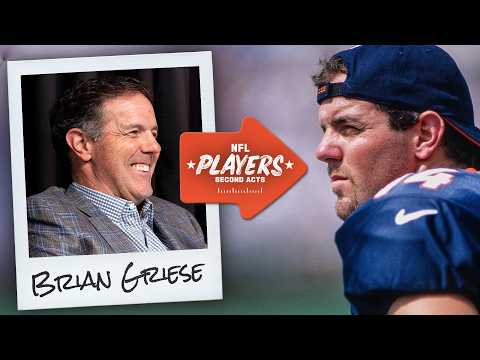
Brian Griese on Replacing John Elway, Coaching Brock Purdy, Helping Grieving Children
Audio Summary
AI Summary
Brian Greasy, a former Pro Bowl quarterback, 11-year veteran, and Michigan standout, joins the NFL Players Second Acts podcast to discuss his journey from the gridiron to coaching and philanthropy. He reflects on his early life, including the profound impact of losing his mother, Judy, to breast cancer when he was 12. This loss, he explains, led him to build walls around himself and struggle with unresolved grief and trauma throughout his high school and college years.
Greasy recounts how, during his NFL career, he realized the importance of using his platform to help others. This led to the co-founding of Judy's House in 2002 with his wife. Judy's House is a program dedicated to supporting bereaved children and families through difficult times. He shares a powerful memory of participating in a grief support group with 10-year-olds, which was the first time he truly began to process his own grief and make meaning of his mother's passing. He emphasizes that making meaning of loss is a crucial part of the grieving process.
Transitioning to his NFL career, Greasy discusses his time as a rookie with the Denver Broncos, learning under John Elway. He describes the pressure of stepping into such shoes and the challenging transition to becoming a starter, especially after Elway's retirement. He highlights the baptism by fire he experienced in his first game against Dan Marino, a childhood idol, where he suffered significant injuries.
A key lesson learned from his early NFL struggles, Greasy explains, was the importance of not trying to win the game all the time. He learned to differentiate between moments for aggression and moments for finding completions and protecting the ball. He emphasizes the need for conviction and trusting preparation, rather than playing with hesitancy or doubt, which he considers a "death sentence" for a quarterback.
After his playing career, Greasy moved into broadcasting but found himself drawn back to the game through coaching. He initially hesitated, not wanting to be away from his family, but found immense fulfillment in mentoring young players. He speaks about the "intoxicating" nature of molding and guiding college-aged athletes, helping them build values and navigate the challenges of the NFL. He shares positive experiences coaching Brock Purdy and Sam Darnold, noting the intrinsic confidence both players possessed despite their different paths.
Greasy expresses frustration with how some first-round draft pick quarterbacks are immediately thrown into starting roles without adequate development, often due to a lack of structure and stability within their franchises. He believes this can lead to players being unfairly labeled when they struggle.
He then discusses his decision to step away from coaching after the 2024 season, despite loving the mentorship and camaraderie. The primary reason was the significant time away from his family. He also felt a desire to reinvest in relationships and create space to address societal issues and model proactive engagement for his children. This led him to pursue his passion for environmental policy, a field he majored in during college. He announces he will be a fellow at Stanford in the fall, focusing on geothermal and renewable energy, with a particular interest in the intersection of sports and sustainability.
Returning to his personal journey, Greasy elaborates on Judy's House, describing his mother as a compassionate, kind, humble, and selfless nurse. He details the emotional toll of her five-year battle with cancer and his own feelings of anger, unfairness, and guilt at such a young age. He emphasizes that the grief and trauma he experienced significantly impacted his relationships and personality, leading him to become an "island."
He highlights the collaborative effort with his wife, a clinical psychologist, in developing the curriculum for Judy's House, which utilizes the "cognitive behavioral triangle" (thoughts, feelings, and behaviors) to help children process their grief. He shares that the program has served over 16,000 individuals and that the next step is to expand its reach through technology and training.
Greasy reflects on his father's resilience as a survivor, having lost his own father at a young age before losing his wife. He also acknowledges the mentorship of his college coach, Lloyd Carr, who suspended him for a year due to poor decisions stemming from unresolved grief. This experience, while difficult, ultimately taught him discipline and led to a pivotal moment in his senior year where he played a significant role in a victory against rival Ohio State. He also credits Gary Kubiak, his first NFL coach, for his principled leadership.
In his "Mount Rushmore" of influential figures, Greasy names his mother and father separately, recognizing their distinct influences. He includes Lloyd Carr for his guidance and Gary Kubiak for his character and coaching. He also touches on the rumor about radiation at the 49ers facility, humorously noting that his teammate Kyle Juszczyk, a Harvard graduate, might have theories.
The conversation concludes with Greasy expressing gratitude for the opportunity to share his story and the impact of Judy's House, emphasizing that making meaning out of tragedy and giving back is a powerful force. He reiterates the importance of tending to relationships and the profound impact that grief has on children, with one in 11 kids in the U.S. experiencing the death of a parent before age 18. He stresses that Judy's House aims to provide a strength-based model to help these children and families navigate life's challenges.