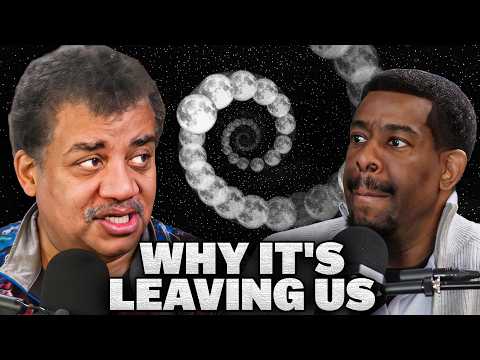
Why the Moon is Spiraling Away From Us
Audio Summary
AI Summary
The moon has been continuously spiraling away from Earth since its formation billions of years ago. This phenomenon is a direct consequence of tidal forces exerted by both celestial bodies on each other. Tidal force occurs because the gravitational pull on the side of an object closer to another body is stronger than the pull on the farther side, creating a stretching effect. Over time, these tidal forces lead to tidal locking, where an orbiting body rotates at the same rate it orbits, resulting in one side always facing the primary object.
Earth has tidally locked the moon, which is why we always see the same lunar face. This process also applies in reverse: the moon exerts tidal forces on Earth, attempting to slow its rotation. The most visible manifestation of Earth's tidal forces is the tidal bulge in its oceans. This bulge, a stretching of the Earth's fluid oceans, is not perfectly aligned with the moon's position. Because Earth rotates faster than the moon orbits, the planet's rotation drags the tidal bulge ahead of the moon's current location in the sky.
This misalignment creates a gravitational tug-of-war. The tidal bulge, being ahead of the moon, exerts a gravitational pull that actually accelerates the moon in its orbit. As the moon speeds up, it moves into a higher orbit, causing it to drift further away from Earth. Simultaneously, this interaction creates tidal friction on Earth. The oceans sloshing against the Earth's surface due to the rotating tidal bulge acts like a brake, slowing down Earth's rotation.
The Bay of Fundy in Canada is highlighted as a location with particularly significant tidal friction. Its unique geography channels vast amounts of water, leading to extreme tidal variations of up to 50 feet. This intense water movement generates substantial friction, contributing significantly to the slowing of Earth's rotation. This friction effectively acts as a brake pad on our planet's spin.
The concept of angular momentum is crucial here. As Earth's rotation slows down, it loses angular momentum. This lost momentum is transferred to the moon, causing it to gain orbital speed and move into a higher orbit, thus spiraling away from Earth. This entire process is a delicate balance: Earth's faster rotation drags the tidal bulge ahead, which then pulls the moon into a higher orbit while simultaneously braking Earth's spin.
This process is not static. As Earth continues to slow, the tidal bulge will become less pronounced and less ahead of the moon. Eventually, Earth's rotation will synchronize with the moon's orbital period, leading to a state of double tidal lock. At this point, Earth will always present the same face to the moon, and there will be no more tidal friction, and consequently, no more tides as we experience them.
Scientists can measure the moon's recession rate, which is currently about an inch to an inch and a half per year. This measurement is made possible by retroreflectors left on the moon by the Apollo 11 mission. These corner reflectors bounce laser beams sent from Earth directly back, allowing for precise distance calculations. Over time, these measurements have confirmed the moon's steady outward spiral.
This ongoing drift has implications for the future of solar eclipses. Currently, the moon appears to be the same size as the sun in our sky, a remarkable cosmic coincidence where the sun is 400 times larger than the moon but also 400 times farther away. This perfect alignment allows for total solar eclipses, where the moon can completely obscure the sun, revealing its corona. However, as the moon recedes, it will eventually become too small to cover the sun entirely. The last total solar eclipse is predicted to occur in about 1.2 billion years. In the distant past, the moon was much closer and larger in the sky, and total solar eclipses would have been more like a complete blackout, obscuring the sun entirely without revealing its outer atmosphere.
The slowing of Earth's rotation due to tidal friction means that our days are gradually getting longer. To account for this, we have implemented leap seconds, adding an extra second to the atomic clock time on June 30th or December 31st to keep our civil time synchronized with astronomical time. Since the early 1970s, when atomic clocks allowed for precise measurement of Earth's rotation, approximately 25-26 leap seconds have been added. This phenomenon highlights the dynamic and interconnected nature of the Earth-moon system, a cosmic dance governed by fundamental physics.