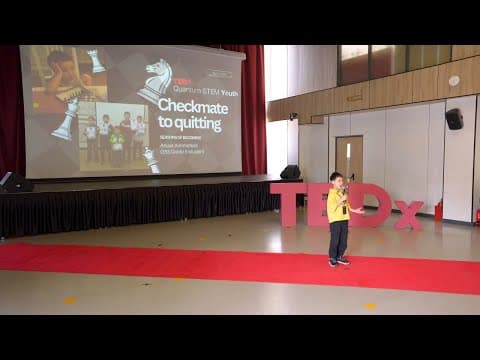
Why Pawns Don’t Move Back | Anuar Akhmetkali | TEDxQuantum STEM Youth
Audio Summary
AI Summary
The speaker, Anoir, recounts quitting chess, a common experience of abandoning something and claiming not to care. He started chess at 3 years and 10 months, drawn by the pieces' appearance. His dad taught him, sparking a curiosity for the game. At five, he entered his first tournament, earning the fourth category and being labeled "talented," which he enjoyed.
He continued playing, experiencing pride in wins and a heavy feeling in losses. He reached the third category, but then quit. There was no external pressure; he simply decided he was "done." The reasons were subtle: losing felt worse than winning felt good, other kids improved faster, and he was no longer the "little genius." He realized that when people are called talented young, they can mistake talent for identity, making losses feel like a loss of self. Quitting seemed easier than confronting his perceived lack of specialness. He quit for two years.
At nine, he returned to chess, but with a different mindset. This time, he played by choice, not for fun or talent, but to improve. He learned that discipline is powerful, training consistently, even when unmotivated. This led to faster improvement and reaching the second category. He realized that in a bad position, one can resign or look for the next move, a lesson applicable to life. Quitting chess initially felt like ending the game, but it was just resigning too early. He believes champions are those who come back, embracing the humbling process of being a student again. He now plays almost daily, not fearing loss, but seeing it as guidance for the next move.
His message: if you've quit something, ask if it was truly wrong for you or just stopped being easy. Resigning too soon is sad. In life, there's almost always another move; you just have to find it. Quitting doesn't have to be the final move, but part of the game.