Berlin in Ruins: Life After the Fall of Nazi Germany UNCENSORED
Audio Summary
AI Summary
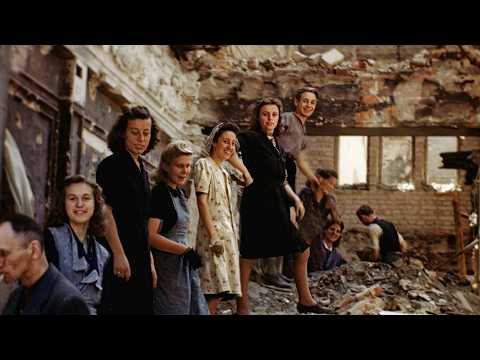
In early July 1945, Berlin, the former heart of Nazi Germany, was a city in ruins. Two months after the war's end, Allied forces, including a Hollywood film crew led by George Stevens, began documenting the devastated capital. Stevens' crew ventured into the Soviet sector, filming landmarks like the destroyed Hotel Adlon and the collapsing Unter den Linden boulevard. Allied reporters were only then permitted entry to record the aftermath of twelve years of Nazi rule and six years of war. The city was a landscape of rubble, with bicycles a luxury and cleanup efforts underway, though the future remained uncertain ahead of the upcoming Potsdam Conference.
Meanwhile, on June 24, 1945, Moscow celebrated its victory with a grand Red Army parade in Red Square. Joseph Stalin, having demanded immense sacrifices from his people during the "Great Patriotic War" which resulted in 27 million Soviet casualties, stood at the height of his power, consolidating the Soviet Union's superpower status. Nazi symbols were dramatically cast at the feet of Stalin, symbolizing the defeat of the regime.
A July 1945 aerial survey revealed the scale of Berlin's destruction: 50,000 tons of explosives had been dropped, leaving 48,000 buildings destroyed and thousands more severely damaged. British Air Marshal Arthur Tedder described Berlin as "completely destroyed," a "city of rubble" that could serve as a monument to Prussian militarism, and believed it could never be rebuilt. The New York Times expressed hope that Berlin's obliteration might signal a renewal of German civilization, with some visitors viewing the city as an "unlovable parvenu." Journalist William Shirer recounted the shock of seeing a once-powerful nation reduced to rubble, with its former arrogant conquerors now facing their downfall.
Despite the devastation, Berliners, particularly women, showed resilience and a fervent desire to rebuild. Journalist Ruth Andreas Friedrich noted in her diary on July 7, 1945, a "frenzy of expectation" and a yearning to work with "a thousand hands and a thousand brains." Amidst rumors about the presence of Allied forces, the immediate focus was on survival. Rubble women worked tirelessly to clear debris, a monumental task given that most men were dead or imprisoned.
Captain Carter of Special Film Project 186 was also documenting the damage, focusing on sites significant to Hitler's rise and fall. He filmed the ruins of the Kaiserhof Hotel, where Hitler had lived and planned his ascent to power, and the Berlin Sports Palace, the venue for his early speeches and Joseph Goebbels' "total war" address. The Reich Chancellery, where Goebbels committed suicide, was also heavily damaged. The fate of Hitler himself remained a subject of speculation, with German propaganda falsely claiming he died fighting. In reality, he had committed suicide in his bunker on April 30, his body subsequently burned and buried in a bomb crater, identified by Soviet agents shortly after. Stalin, however, kept this information from his Western allies.
American cameramen also documented Albert Speer's monumental architecture, which had symbolized Germany's perceived invincibility, now bearing the marks of the Red Army's victory. Soviet posters plastered across Berlin quoted Stalin, proclaiming the Red Army's lack of racial hatred, a message met with cynicism by many Germans given the widespread looting and rape in the immediate post-surrender period. Ruth Andreas Friedrich lamented that politicians failed to grasp that winning people over required offering them a better future, not adding to their misery.
The Victory Column, nicknamed "Gold-Else," stood as a symbol of hope in the British sector. George Stevens filmed the Reich Chancellery, once a place of celebration for Hitler's victories, now a symbol of a defeated regime. He also gained permission to film inside, documenting the remnants of Nazi grandeur. The fate of Goebbels and his wife Magda, who committed suicide there, was also recorded.
Stevens' crew visited sites from Germany's imperial past, encountering Red Army soldiers who had brought in Paul Markgraf, the former police chief of Berlin under the Nazis, to head the new police force. This move, along with the Soviets readmitting the Communist Party on June 11, 1945, fueled Western Allied suspicion that the police were an extension of Soviet influence. However, most Berliners remained focused on daily survival, the emerging East-West political conflict largely secondary to their struggle for food and shelter.
Rubble women continued their arduous work, earning a meager wage and a better ration card, their efforts crucial for rebuilding housing. Ruth Andreas Friedrich reflected on the perceived lack of independent thinkers in Germany, contrasting the "10% leaders" with the "90% led." The city was also a transit point for hundreds of thousands of refugees from the East, many forced to move on due to overcrowding. Water scarcity was a major issue, with contaminated groundwater posing health risks. Even those in better circumstances sought work, barter goods, or housing, as many undamaged homes had been requisitioned by occupying forces.
The war had left many homeless, forced to evacuate with little notice, a situation familiar to those bombed out during the conflict. Family life often took place in front of the damaged facades of their homes. Street trees, once a symbol of the city's greenery, were being cut down for winter fuel. Despite cleared streets, traffic was minimal, with most vehicles confiscated. Public transport, including trams and the S-Bahn, was slowly resuming service.
George Stevens visited the Reichssportfeld, site of the 1936 Olympics, where Jesse Owens' success had embarrassed Hitler. The stadium was now used by British soldiers, with swimming off-limits to Germans. At Wannsee, occupation soldiers and their companions, disregarding fraternization bans, enjoyed recreational facilities, including a golf course at the 2nd US Armoured Division's beach club.
In the Soviet sector, German policemen, some with Nazi pasts, served the new masters. On July 12, 1945, British Desert Rats marched through Berlin, an event filmed by Special Film Project 186, symbolizing the joint victory. However, Berliners sensed a growing divide among the Allied powers. Ruth Andreas Friedrich noted that the Allies "don't seem to love each other" and that any hint of difficulties with the Soviets was met with coldness. Joint appearances, like Field Marshal Montgomery presenting Marshal Zhukov with an order of merit, aimed to mask these underlying tensions.
George Stevens also documented the lead-up to the Potsdam Conference, where the "Big Three"—Stalin, Truman (having succeeded Roosevelt), and Churchill—would discuss Germany's future. Truman, despite concerns about Soviet control in Eastern Europe, still hoped for continued cooperation with the Soviet Union. Stevens filmed a Red Army unit marching through the Tiergarten, while Truman expressed his belief in continued friendship with the Soviets, despite ongoing incidents.
On July 14, 1945, Captain Carter filmed at Pariser Platz, reflecting on Germany's uncertain future and the potential for Soviet expansion. The conference would address the rebuilding and re-education of Germany, with differing views on its economic future, ranging from Henry Morgenthau's idea of an agrarian Germany to Henry Stimson's belief in an economically strong nation. Ruth Andreas Friedrich hoped for a positive outcome, believing Germany was "ripe for redemption."
The Potsdam Conference began on July 16, 1945, with Truman arriving at Gatow airfield. The conference venue was Cecilienhof Palace in Potsdam, within the Soviet zone. Truman met with Churchill, who, despite having lost recent elections, was impressed by Truman's resolve. Truman, in turn, found Churchill's effusive praise somewhat tiresome. Stevens' crew filmed Berliners procuring food in the countryside en route to Potsdam, with Ruth Andreas Friedrich hoping for news of order and justice from the conference.
Potsdam, though damaged, was chosen for its security within the Soviet sector. The decisions made there would profoundly shape Germany's future. Media from across Europe gathered, and Stevens' team obtained necessary accreditation. The conference's first topic was the Pacific War, with Stalin signaling his intention to declare war on Japan. Discussions then turned to post-war European borders, reparations, and the administration of occupied Germany.
Truman, having received news of a successful atomic bomb test, was in high spirits. The conference agreed that Germany would not be partitioned, but would cede territories to the East. Disarmament, demilitarization, reparations, and war crimes trials were also on the agenda. Ruth Andreas Friedrich expressed optimism, seeing the Potsdam Agreement as a path to peace and common construction. The final communique conveyed renewed confidence in establishing a just and lasting peace.
However, Truman remained less confident, deeply shocked by the destruction in Berlin. He reflected on the destructive potential of machines outpacing morality. Special Film Project 186 concluded its work with aerial footage of destroyed Berlin, amassing about 80 hours of material that would remain largely unedited for decades due to lack of funding. The victors left Potsdam with agreements that would define Germany's fate for decades, but the underlying tensions of a new era, the Cold War, were already evident.