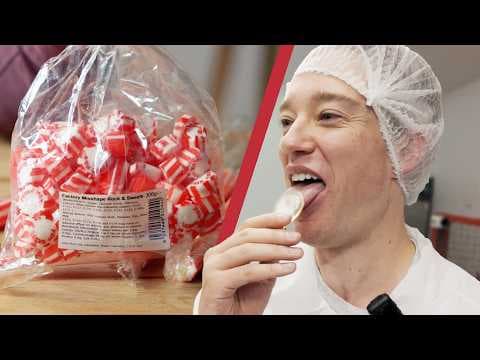
If you found candy with my name in it, here's why.
Audio Summary
AI Summary
In the East Riding of Yorkshire, near Bridlington, the John Bull Rock Factory specializes in a traditional English candy called "rock." This isn't "rock candy" known in America, but rather a brittle confection, similar to a candy cane, typically featuring letters running through its length, often the name of a seaside town.
The process begins early, with Albert and Charles preparing a large batch. Thirty kilos of sugar, about 19 liters of glucose, and a small amount of water are boiled in a cauldron. The water's purpose is solely to prevent sticking and aid mixing; it boils off quickly, leaving a concentrated sugar syrup. The temperature reaches 135 Celsius (275 Fahrenheit), a dangerously hot molten sugar that adheres to skin and causes severe burns.
After boiling, the mixture is poured onto a specialized table divided into sections. Here, coloring is added. For this demonstration, raspberry-flavored white rock and red striped rock were chosen. The sugar cools rapidly, becoming a pliable goo within minutes. It must be continuously worked to prevent it from setting like glass. A small, cooled piece of the plain sugar reveals its glass-like, non-sticky, and sharp properties.
The history of rock candy is debated. While plain rock existed at fairgrounds, Ben Bullock, an ex-miner turned confectioner, is often credited with popularizing modern rock with embedded words. In the 1880s, inspired by a trip to Blackpool, he created the first batch with the phrase "Whoa Emma," a popular music hall song. Though the song is now largely forgotten (its lyrics about an alcoholic wife), Bullock's innovation, particularly his "Blackpool" rock, became a hit, coinciding with the rise of Victorian seaside holidays. New railways made coastal trips accessible to the working class, who sought cheap, edible souvenirs.
However, earlier references, such as in Henry Mayhew’s "London Labour and the London Poor," suggest that "short sentences into his sticks" were introduced decades prior. Thus, Bullock likely commercialized and popularized rock rather than inventing it.
After the initial coloring, the sugar-goop is cooled further on the table, with cold water circulating underneath. Workers dust their hands with cornstarch to prevent sticking. The mixture, initially yellow, is then loaded into a pulling machine. This machine folds air into the proto-candy, transforming its structure and turning it a pale white, a crucial step for seaside rock. Raspberry flavor is incorporated into the white rock.
The next stage involves creating the letters. This highly skilled process, described as "wizardry," is performed by an expert who knows the "recipe" or construction for every letter. The candy remains warm and pliable, allowing for manipulation. Parts needing to stay separate are dusted; those needing to stick are wiped with water. For this demonstration, the letters "T," "O," and "M" were crafted. The "O" is made by rolling color around a white center, and the "M" by constructing one half and folding it over.
Surprisingly, instead of just "Tom," the expert continued to construct "Tom Scott," the full name. The red stripes are cut, placed together, and adhere with a little water. This forms a very large stick of rock, a minimum batch size of 45-50 kilos.
The presenter attempted to make his own "Tom" rock, highlighting the difficulty and skill required. It takes about six months to a year of on-the-job training to reach professional standards. The stretching process evens out any irregularities in the letters.
The colossal 45-kilo lump of rock with the presenter's name is then processed by a single-purpose machine that rotates and steadily squeezes it, akin to "spaghettification." During rolling, a slight twist is added for visual appeal, and fans rapidly cool it to set. This meticulous temperature management is key to the skill involved.
Ultimately, about a hundred meters of rock with "Tom Scott" embedded throughout were produced. The rock is then chopped and bagged. While the presenter found having his name in rock "incredibly vain" and couldn't take 45 kilos with him, the batch wasn't wasted. This "warm-up batch" is processed by "the Chipper," mixed with other test batches, errors, or mistaken orders, and sold in bulk at a steep discount as "broken rock." So, some consumers might unknowingly have bought candy with "Tom Scott" in it.