เคลียร์ตรงกับเบอร์หนึ่ง AOT ทำไมต้องขึ้นค่า PSC เป็น 1,120 บาท | THE STANDARD WEALTH
Audio Summary
AI Summary
The Airports of Thailand Public Company Limited (AOT) has increased the Passenger Service Charge (PSC) for international travel at six airports from 730 baht to 1,120 baht, effective June 20th. This adjustment, the first in 19 years, is deemed essential for the efficient, safe, and sustainable management of the airports.
Ms. Pavina Jariyathitipong, Managing Director of AOT, explained the rationale behind this increase. For nearly two decades, the 700 baht PSC remained unchanged, while airport operating costs have consistently risen due to inflation, the addition of new amenities, and the need to maintain high service standards and global competitiveness. Airports, like other industries, must continuously develop and improve. A significant portion of these rising costs is attributed to security measures, which are a critical aspect of airport services worldwide, adhering to ICAO standards for thorough inspections and passenger verification processes. Recent incidents, such as the severe turbulence on a Singapore Airlines flight, highlight the necessity of robust safety preparations and support systems, all of which contribute to operational expenses.
AOT’s review revealed an imbalance between aeronautical service costs and revenue. The income generated from aeronautical services covers only 60-70% of related expenses, necessitating subsidies from non-aeronautical revenue sources like concessions and sales. However, the non-aeronautical revenue has also become imbalanced, with a significant increase in the operator's contractual share, leading to issues such as expensive food at airports and financial difficulties for some concessionaires. The PSC adjustment aims to re-establish a balance, ensuring the financial sustainability of airport services and enabling future investments.
According to ICAO Document 9082, passenger service charges should reflect the "full cost" of services. AOT has benchmarked its costs and charges against other airports globally, confirming the necessity of this adjustment for efficient airport management and future sustainability. This sustainability includes the ability to invest in infrastructure, attract airlines, and bring more passengers to Thailand, thereby generating income for the country.
The increased revenue from the PSC will primarily be used to mitigate losses from the aeronautical sector. While AOT continues to make various investments, the goal is to manage these costs prudently to avoid significant future impacts on PSC values. AOT plans to develop all six airports under its management to meet international standards. Even airports with lower flight volumes, such as Chiang Rai, will receive investment to ensure they meet ICAO regulations, a shift from the previous approach of developing only profitable airports. Approximately 80% of the increased PSC, largely collected at Suvarnabhumi Airport, will be reinvested as a "subseries investment" into infrastructure, modern facilities, and improved safety across all AOT-managed airports and regional terminals.
Beyond infrastructure, a key focus is enhancing the "Level of Service" for passengers, encompassing everything from parking systems and ground transportation to check-in processes, security screenings, and amenities catering to diverse passenger needs, such as kids' rooms or quiet workspaces. The ultimate goal is to improve the global ranking of Thailand's airports.
While acknowledging that PSC adjustments can affect passenger destination choices due to increased ticket prices, research indicates that the PSC constitutes a very small proportion (less than 10%, often around 5%) of the total fare. Global studies suggest that such increases have minimal impact on travel decisions but are crucial for the development of the aerospace industry. Thailand's strong tourism appeal and reputation as a destination are expected to outweigh the minor price adjustment. Suvarnabhumi Airport, for instance, has already improved its Skytrax ranking from 39 to 36, and among airports serving over 40 million passengers, it ranks 4th globally, demonstrating significant development.
Comparing with Singapore, which frequently adjusts its PSC, sometimes even collecting payments 10 years in advance for future terminal investments (like Terminals 5 and 6), AOT's approach differs. AOT is currently maintaining its existing cost structure and managing investments to minimize future PSC impacts.
AOT’s profit drivers are solely from non-aeronautical revenue, which includes concessions, ground handling, duty-free sales, and fines. However, relying heavily on fine revenue is not sustainable for a business. The COVID-19 pandemic highlighted this vulnerability, as AOT immediately incurred losses when non-aeronautical revenue disappeared, while aeronautical costs remained. In the past, non-aeronautical profits were used to compensate for aeronautical losses. However, increased investment needs necessitate a re-evaluation of this balance. Aeronautical revenue is used exclusively for airport management and investment, not for bonuses or other expenditures.
AOT is also adjusting various non-aeronautical contracts. Previously, compensation was fixed at a 10% annual increase for 10 years, then tripled, making it unsustainable for many business owners. AOT has around 2,000 such contracts, indicating a widespread issue.
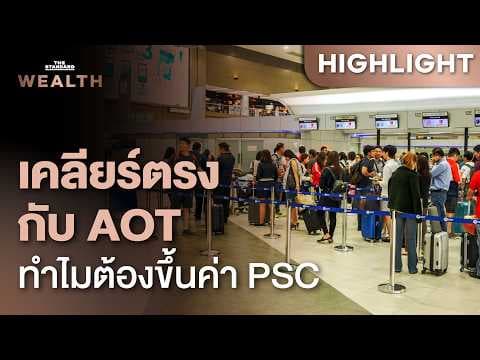
The investments funded by the PSC increase will go into visible facilities and infrastructure, including roads, technological advancements, and expanding existing structures. For example, Suvarnabhumi Airport, designed for 45 million passengers, handled 62 million last year, leading to overcrowding in areas like check-in and baggage claim. Technology helps speed up processes, but physical expansion, like the recently opened SAT-1 terminal and the B3 expansion, is also crucial. Future capital will also be directed to other regional airports, such as Chiang Mai and Phuket, which are already at capacity.
The aim is to enhance infrastructure and technology to raise airport standards, aligning them with global counterparts, maintaining Thailand's appeal as a passenger destination, and creating room for future growth. The interview concluded with an emphasis on the 19-year gap since the last adjustment and the need for sustainable development through balanced revenue management, particularly in the aeronautical sector. Passengers can expect new amenities and faster processes, such as biometric passport checks, as a result of these investments. The small percentage increase in ticket price is deemed a necessary cost for the long-term development and competitiveness of Thailand's airports.