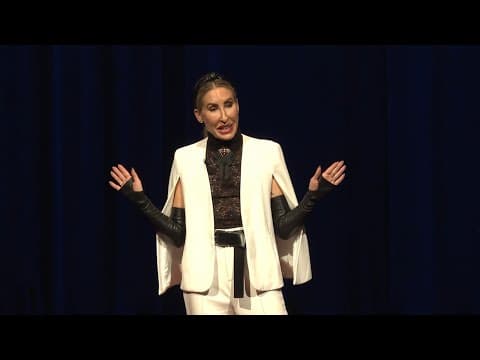
Beauty From Within: Choosing to Go Flat After Mastectomy | Erica Deligne | TEDxMarshallU
Audio Summary
AI Summary
The speaker, Erikica Deline, a fashion stylist and creative consultant, shares her personal journey of redefining beauty, femininity, and confidence, emphasizing freedom from societal pressures and the power of informed bodily choices. Her relationship with her reflection has historically been fraught, with her self-worth tied to external perceptions influenced by good or bad lighting.
In 2021, at age 38, Deline was diagnosed with stage one invasive ductal carcinoma. The initial urgency of appointments and scans shifted to discussions about rebuilding her body. She was presented with options for lump sum with radiation, single mastectomy, or double mastectomy with implant reconstruction. As she was only a candidate for implant reconstruction, the surgeons implied it was the standard choice for maintaining symmetry. Initially considering it an "upgrade," Deline decided to proceed with implants.
However, a gut feeling led her to research breast implant illness. She discovered patient communities where women shared experiences of chronic fatigue, brain fog, autoimmune symptoms, hair loss, and joint pain that emerged after receiving implants. Crucially, many reported significant improvement or complete resolution of these symptoms after explant surgery. This pattern prompted Deline to question why implants, which could make healthy women sick, were offered to immunocompromised cancer patients.
Her research revealed that breast implants were never thoroughly tested long-term before widespread use, with initial testing on a dog for only a few weeks in 1962. They were grandfathered into the Medical Device Amendment in 1976, allowing them to remain on the market while safety data was collected. By the 1990s, thousands of women reported illness, leading the FDA to temporarily ban silicone implants for cosmetic use, though they remained available for reconstruction. Following legislation mandating insurance coverage for reconstruction, implants returned to the market with FDA approval in the early 2000s. Despite over 20 years of patient tracking and FDA warnings about the systemic risks of breast implant illness, including a rare immune system cancer, many surgeons still fail to inform patients about these dangers.
Deline also learned about the complexities and potential complications of reconstructive surgery, which often involves multiple procedures, revisions, and potential long-term infections. A JAMA surgery study indicated a 33% complication rate for reconstruction, meaning one in three women experience complications. This led her to fear that reconstruction might not lead back to her baseline health.
She then discovered the "fierce flat forward" community, where women shared stories of exhaustion and trauma from undergoing numerous surgeries to maintain reconstructed breasts. Deline realized that for many, reconstruction prolonged their suffering rather than restoring peace. This realization prompted her to stand naked before the mirror, covering her breasts, and ask herself what mattered more: her health or having breasts.
One morning, a quiet inner voice told her, "If you go flat, you will be fine." This brought her immediate peace and eliminated her fear and anxiety. She understood that true beauty comes from inner peace, not from external additions to the body. Deline chose to go flat, not out of bravery, but from a place of inner peace.
What surprised her most was that neither surgeon had presented going flat or aesthetic flat closure as an option. She had to bring it up herself. Since then, she has heard from hundreds of women globally who were also not informed about this option, with some even being denied their request to go flat. Studies indicate that 25% of women experience "flat denial," where surgeons advise against going flat or even leave extra skin. In the UK, women face significant gatekeeping, with some requiring psychosocial evaluations to have a healthy breast removed for symmetry. Only 32% of UK patients are informed about the option of going fully flat. In Italy, reconstruction is considered integral to cancer treatment, often covered by public healthcare, with immediate reconstruction believed to be essential for women's psychological well-being. However, Italian women who refuse reconstruction may face resistance and be referred for psychological counseling.
Deline argues that this is not about choice but about control, rooted in the patriarchal belief that women are incomplete without breasts. She views this as a patriarchal beauty standard disguised as medicine. While going flat has perceived cons often stemming from social discomfort, its pros include faster recovery, fewer surgeries, fewer complications, no foreign objects, and greater long-term peace. Surveys show high satisfaction rates among women who go flat.
Going flat challenges the cultural notion that a woman's worth is tied to her breasts and redefines beauty by questioning if a woman's worth is diminished with their absence. Deline asserts that a woman's worth is not gone. It challenges the idea that women need to be "restored" to be acceptable and reminds us that our bodies are not public property. By choosing flat with intention, she stopped performing "normal" and started redefining it, finding that peace looks better than perfection.
She acknowledges her continued love for fashion but emphasizes that beauty shifted from something she chased to something she honored, seeing it in her demeanor, the strength of her choices, and the peace she cultivated. With breast cancer being the leading global cancer, Deline stresses that women facing mastectomy have options and deserve unbiased conversations about their health, values, and peace, not societal expectations. She concludes by inviting listeners to imagine a world where beauty is seen from within, where worth isn't measured externally, and where health and longevity are prioritized over perceived perfection. She encourages everyone to listen to their inner voice, recognizing their inherent enoughness, and find confidence, freedom, and wholeness in choosing from their spirit.