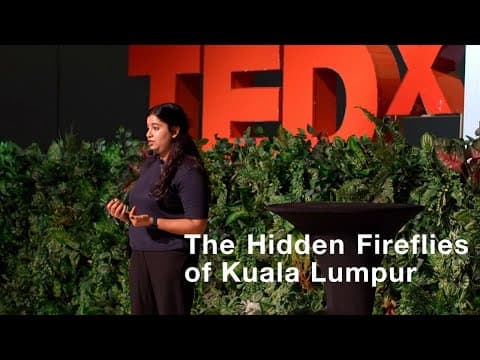
Magical Mysteries At Bukit Kiara - The Hidden Firelies In Kuala Lumpur | Harleen Rai Kaur | TEDxKL
Audio Summary
AI Summary
This video highlights the remarkable biodiversity of Bukit Kiara in Kuala Lumpur, focusing on the discovery and conservation of nine species of fireflies, including the world's largest. Harleen from Friends of Bukit Kiara takes viewers on a journey through the history and ecological significance of this urban forest.
Bukit Kiara, located less than a kilometer from the large mall Wanutama, was formerly a 1,500-acre rubber estate. In 1976, the federal government acquired the land for public use. A master plan in 1982 envisioned a 650-acre arboretum and national mausoleum to the north, and an international golf course to the south. However, by 1987, a significant portion of the land intended for public use fell into private hands. The remaining 400 acres is what is now known as Bukit Kiara. In 2007, the Federal Cabinet agreed to preserve this area as a large-scale public park. The National Landscape Department was appointed administrator in 2010, and partial gazettement as a federal park occurred in 2020, with the remaining land to be gazetted in 2027. Bukit Kiara is notable for being the first federal park in Malaysia.
Since its acquisition, the land has been left to regenerate. While rubber trees are not native, replanting efforts by FRIM in the 1990s and the National Landscape Department from 2010 onwards, which involved planting 36,000 native trees, have accelerated the regeneration process. This has resulted in a secondary forest teeming with biodiversity.
The presence of nine species of fireflies is a significant discovery. One species, *Lemprygera*, is the world's largest firefly, with larvae reaching up to 12 centimeters. Fireflies were first discovered in Bukit Kiara in 2017 by a member of Friends of Bukit Kiara, who initially thought of mangroves when fireflies were mentioned. This discovery led to outreach to the Malaysian Nature Society and confirmation of their presence. The subsequent "Firefly Walk" attracted 300 people, highlighting the public interest and potential for conservation advocacy.
This led to the "Magical Mysteries of Bukit Kiara" citizen science project, funded for a year. Scientists from FRIM and the Urban Biodiversity Initiative helped design a simple experimental procedure, enabling citizen participation. Through this project, seven species of fireflies were identified by 2022. In 2023, during Earth Day celebrations, a diurnal firefly – active during the day – was discovered. This added a new dimension, as fireflies are typically associated with nocturnal activity. Globally, fireflies are categorized into congregating (found in mangroves), solitary, and diurnal types. Bukit Kiara now hosts solitary and diurnal species.
A collaboration with Monash University, led by firefly specialist and taxonomist Dr. Wan Farida, further advanced research. Students from the university conducted research, leading to significant discoveries. One student, Jack, identified a specimen labeled *Colophotia* that did not match its characteristics. After extensive research and comparison with specimens in other institutions, Dr. Wan identified it as *Pteroptix gombakia*, the Gombak bentwing firefly. This species had not been seen for 100 years, with the last sighting in the 1920s. Previously, only two specimens existed, one at the University of Malaya and another in London. The discovery of *Pteroptix gombakia* in Bukit Kiara raises questions about its behavior, as the genus *Pteroptix* is usually associated with mangrove and estuarine fireflies, suggesting potential shifts in their habitat or behavior.
The video also touches on the biology of fireflies, explaining that their light emission is an enzyme reaction involving luciferase. Adult fireflies are herbivores, while their larvae are carnivores, feeding on snails abundantly found in Bukit Kiara.
Despite the ecological richness, Bukit Kiara faces threats from potential development. While it is designated as a federal park, it lacks a proper buffer zone. Surrounding forested areas are privately owned, including land belonging to the KLGCC Golf Club. Data collected from firefly surveys indicates that the "Magic Carpet" trail is highly biodiverse in terms of firefly numbers and is located near these neighboring private lands. The development of a water reservoir on a nearby parcel of land has already shown a trend of decreasing firefly numbers in the vicinity, serving as a warning of potential impacts from larger developments near Bukit Kiara's borders.
Fireflies are presented as biological indicators, with their presence or absence reflecting the health of an environment. The abundance of nine species signifies a healthy forest ecosystem in Bukit Kiara, emphasizing the urgent need for its protection for future generations. The presentation concludes with a quote from Dr. Jane Goodall, "Only if we understand, can we care? Only if we care, will we help? Only if we help, will we be saved?" and a Malay proverb, "tak kenal maka tak cinta" (if you don't know, you can't love), encouraging people to explore nature and fall in love with it, thereby fostering a desire to protect it.