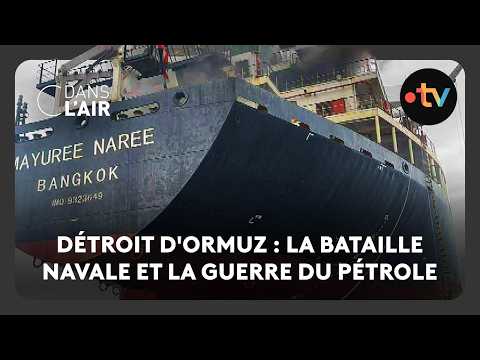
Détroit d'Ormuz : la bataille navale et la guerre du pétrole - C dans l’air - 11.03.2026
Audio Summary
AI Summary
Tensions are escalating in the Strait of Hormuz, with three ships targeted and Iran warning that any American, Israeli, or allied vessel will be considered a legitimate target. Washington has advised civilians to evacuate ports in the strait, a strategic zone where Iran's Revolutionary Guards possess agile means to disrupt traffic. The global shockwave from fuel prices has led 32 countries, including France, to release an unprecedented 400 million barrels of oil to curb price hikes. Iran has also designated banks and business centers as new targets, causing major corporations in Dubai to begin evacuating.
Experts discuss the unfolding situation, noting a declaration from D. Trump stating the U.S. will strike within the hour, vowing Iran "will not recover." This suggests a highly planned military operation, with B-52, B-1, and B-2 bombers deployed together for the first time, aiming for widespread strikes rather than targeted ones, potentially due to low reserves of sophisticated equipment. The lack of attacks on key sites like Bandar Abbas or Kharg Island, which handles Iranian oil exports, is attributed to military caution. Events are accelerating, driven by Trump's decision to hasten the war process.
Despite Trump's claims of having "practically nothing left to strike" in Iran, experts warn against hasty conclusions. Iran's decentralized, "mosaic" defense system remains resilient, and there are reports of mines being laid north of the Strait of Hormuz. Iran is not yielding, and its ability to strike civilian infrastructure, coupled with Israeli counter-strikes on Iranian civilian facilities, indicates an escalating conflict with no clear end.
The Strait of Hormuz is a critical flashpoint, with Iran threatening to target ports if its own are attacked. Washington's call for civilian evacuation underscores the gravity. Iran's naval capabilities include mine-laying boats and speedboats carrying mines, which could quickly block the strait. To counter this, heavy bombers would be needed to neutralize anti-aircraft defenses and destroy launch points for these small vessels and short-range missiles or drones. However, the rugged, cave-filled Iranian coast makes locating these points difficult. Europeans emphasize the need for the U.S. to clear the area before any escort operations for tankers can be organized.
The conflict has entered a "second phase" of urgency, driven by Trump and Israeli pressure. Iran's parliamentary speaker, usually a hardliner, expressed concern that continued war would prevent oil production and sales, highlighting oil as a crucial weapon. While the U.S. has avoided striking oil facilities to prevent a complete collapse of Iran, the question remains whether they will adopt Israel's more aggressive stance.
American military strategy may involve using advanced capabilities to clear the Strait of Hormuz. However, the objectives of various actors are not entirely coherent. Israelis seek regime collapse, Americans aim for disarmament, and China has offered mediation for free navigation. The U.S. is not directly dependent on Iranian oil, which primarily goes to China and India. The current operation appears to be a response to exasperation and an unplanned escalation, initially targeting Bandar Abbas. Military occupation or heavy bombardment of Kharg Island to control oil exports is a possibility. A key unknown remains the whereabouts of 10-11 Iranian submarines, which could inflict significant damage even in the narrow strait. This complex situation, intertwined with oil prices, is challenging for Trump, who favors simple solutions.
The oil price volatility is a major factor, with the Strait of Hormuz acting as Iran's "mass deterrent." Recent attacks on three civilian ships in the strait, including a burning Thai vessel, are suspected to be Iranian. A U.S. State Department tweet about escorting tankers was quickly retracted, highlighting the risks. The U.S. Navy has even removed its four minehunters from the region, sending them back for destruction, raising concerns about its demining capabilities.
The conflict's economic impact is global. Qatar has issued a general alert due to attacks on energy installations by both sides, which it deems a dangerous precedent. France has announced the deployment of two frigates to ensure maritime freedom in the Red Sea and Strait of Hormuz when conditions allow.
Iran is engaging in a war of attrition, having followed through on threats to attack U.S. bases in Gulf countries and close the Strait of Hormuz. They believe Trump cannot sustain a prolonged war and seek a formal agreement rather than a temporary ceasefire. Iran’s ability to disrupt traffic in the Strait of Hormuz is its powerful deterrent. Gulf countries, particularly the UAE, Qatar, and Bahrain, are suffering economically and are pressuring Trump to end the conflict. Some Saudi officials are reconsidering normalization with Israel due to the war's costs.
While Iran claims to have laid mines, intelligence services have not confirmed their use in the narrowest part of the strait. However, Iran has demonstrated capabilities like marine drones, posing a new threat to military and civilian fleets. Laying mines in the strait is seen as an "atomic bomb" move, which the U.S. is ill-equipped to counter, lacking sufficient mine-clearing vessels. An escort operation like the one during the Iran-Iraq war in 1987, which required 30 U.S. ships to protect three tankers weekly, would be far more challenging today with drones and submarines. The current U.S. deployment of only 12 ships is insufficient for such a task, implying a two-and-a-half-year timeline to clear all stranded vessels.
Iran's strategy is asymmetric, relying on nuisance tactics. They possess thousands of mines and small boats hidden in underground caches. The precision of some strikes on Gulf countries, targeting satellite communication zones and a CIA office, suggests foreign support, possibly from Russia. Iran's regime, unlike Iraq's, is a complex system, making its collapse unlikely in the short term.
Targeting tankers above the waterline is a warning shot, as war-related damages are uninsurable without massive government subsidies. The freezing of shipping due to fear is a key Iranian tactic: "You have the watches, we have the time."
The U.S. does not need the Strait of Hormuz for its own energy supplies, as it is a major producer and exporter. However, rising global oil and gas prices affect American consumers, especially with less fuel-efficient vehicles. Trump's urgency stems from domestic pressure to lower prices, as a 50% rise in diesel prices severely impacts American motorists.
Globally, 32 countries, including France, have released strategic oil reserves to stabilize markets. European nations are implementing emergency measures like price caps and tax cuts. The economic shock is widespread, with restricted traffic in Myanmar, a 20% rise in Vietnamese gasoline prices, and strategic stock releases in Japan and South Korea.
Iran explicitly intends to disrupt the global economy if the conflict continues. Petro-monarchies, dependent on U.S. security, feel betrayed by the war and are reviewing their security doctrines. Some are furious at the U.S., particularly Saudi Arabia, which now rejects normalization with Israel. The U.S. criticizes these allies for not joining the operation, despite their vast, often unused, armaments.
Iran's new threat targets banks, particularly in Dubai, a major financial hub and money-laundering center where Iranians have significant assets. This signifies a shift to economic warfare. The region is expected to be profoundly altered, with Abraham Accords and the U.S. security umbrella potentially collapsing. Attacks on desalination plants, vital for 90% of these countries' water, would be catastrophic.
Iran's resilience stems from its "mosaic defense" system and preparations, including anticipating attacks and developing missile farms hidden underground. They have also accelerated their nuclear program, potentially signaling a withdrawal from the non-proliferation treaty as a "life insurance."
While the U.S. has inflicted significant damage, hitting 5,000 targets in days, the goal is to weaken Iran, not necessarily to collapse the regime. France's President Macron believes Iran's military capabilities are not reduced to zero. The war has overshadowed French municipal elections, with parties grappling with divisions and electoral challenges. The conflict has boosted Macron's approval ratings. Trump also benefits among his Republican base, who see it as settling old scores.
Military options like special forces operations on Kharg Island or Bandar Abbas are possible but would not fully resolve the issue, as hidden drones and other assets would remain. A comprehensive solution would likely require China's involvement. The U.S. has ample bomb reserves but faces challenges with interceptor missile stocks. Iran has strategically increased oil exports recently, but a prolonged closure of the Strait would also harm its economy. The Gulf monarchies, with their vulnerable infrastructure, could retaliate by freezing Iranian funds, which would severely impact Iran.
The war's economic fallout is global, as a disruption in the Strait of Hormuz impacts global oil prices, even for countries not directly sourcing from the Middle East. The Iranian regime is unlikely to fall soon but will emerge significantly weakened, potentially leading to a transition away from the Islamic Republic as known since 1979.