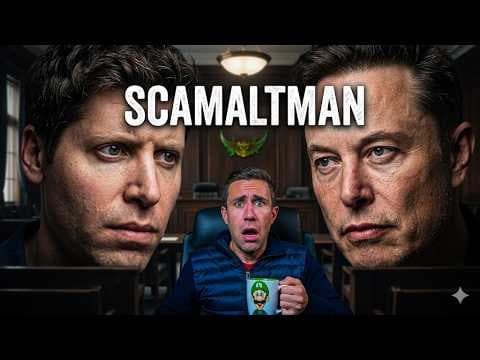
INSANE FINDINGS: Elon Musk vs OpenAI Lawsuit
Audio Summary
AI Summary
The trial between Elon Musk and OpenAI leadership, Sam Altman and Greg Brockman, is ongoing, with live testimony concluding on Wednesday, May 13th, and closing arguments scheduled for May 14th. Jury deliberations will commence on Monday, May 18th, with an advisory verdict to be delivered to the judge, who will make the final determination on equitable remedies.
Elon Musk dropped his fraud claims before the trial, focusing instead on OpenAI's alleged breach of charitable trust and constructive fraud. Musk contends that he donated money with the directive to establish a nonprofit, and that Altman and Brockman violated this trust by converting OpenAI to a for-profit model. He seeks $134 to $150 billion in restitution and the removal of Altman and Brockman.
However, the case is complex. The judge has ruled that discussions of existential AI risks are off-limits, and an April 25th text message from Musk to Greg Brockman, which suggested Altman and Brockman would be “the most hated men in America” if they persisted, was also excluded. This message, sent shortly before the trial, could be interpreted as an attempt to extort a settlement.
A key piece of evidence presented by the defense is documentation from 2017-2018 showing Elon Musk's repeated attempts to merge OpenAI into Tesla. He even offered Sam Altman a board seat at Tesla during this period, a fact that contradicts Musk's current narrative of being deceived into a nonprofit structure. This suggests Musk himself was open to a for-profit model for OpenAI, especially considering Tesla's financial struggles at the time, where such a merger could have boosted stock value.
Further complicating Musk's case is the stark contrast in evidence preservation. Greg Brockman has provided detailed digital diaries dating back to 2017, while Musk’s communications are characterized by auto-delete features on platforms like Signal. This difference in documentation raises questions about transparency.
Brockman's diaries reveal insights into the motivations of both parties. An August 21st, 2017 entry shows Brockman contemplating the financial requirements to reach $1 billion. More damningly, a November 6th entry, written just before a strategy meeting with Musk, states, "We cannot say we are committed to the idea of a nonprofit. But if in three months later, we are doing a for-profit company, then it was a lie. The true answer is we want him out." This suggests a deliberate plan by Altman and Brockman to transition to a for-profit model and remove Musk from the picture.
The narrative presented is one of a tug-of-war: Musk initially wanting to steer OpenAI towards a Tesla-integrated for-profit entity, while Altman and Brockman envisioned a path to billionaire status through a controlled for-profit company, seeking to oust Musk. Testimony also suggests that Musk's leadership style was detrimental to morale, and his departure was met with a boost in company spirit.
The defense also highlights Brockman's significant financial stake in OpenAI, estimated at $30 billion, and his investments in related companies like Cerebrus, CoreWeave, and Helion Energy. Allegations have also surfaced regarding Brockman's failure to make a promised donation to a nonprofit, while simultaneously accusing Musk of wanting to control OpenAI for-profit to fund his ambitious Mars city project.
Sam Altman, in his testimony, rejected the notion of stealing from charity. He argued that the capped-profit subsidiary was a necessary measure to offset computational costs, rather than a premeditated scheme. However, this contradicts Brockman’s diary entries. Altman also expressed discomfort with Musk's alleged insistence on total control and his desire for AGI controls to pass to his children upon his death. Altman further criticized Musk's leadership capabilities, suggesting he doesn't understand how to run a research lab effectively.
Former chief scientist Ilya Sutskever testified that Altman had a pattern of lying and that his reinstatement was necessary to prevent the company's collapse after Microsoft threatened to absorb OpenAI. Satya Nadella, CEO of Microsoft, described the board's termination of Altman as "amateur city" and emphasized Microsoft's desire for OpenAI to remain an independent profit-maker.
Elon Musk's former partner and mother of some of his children, Siobhan Zilla, testified that the corporate structure of OpenAI was extensively debated between 2017 and 2018 and confirmed Musk's offer of a Tesla board seat contingent on merging OpenAI into Tesla. This testimony supports the idea that Musk was open to a for-profit structure.
Ultimately, the case appears to be less about whether converting from a nonprofit to a for-profit was morally right, and more about whether Elon Musk was lied to. The speaker speculates that the trial may conclude with no financial penalties, each party bearing their own legal fees, and the judge acknowledging that both sides ultimately desired a for-profit outcome.