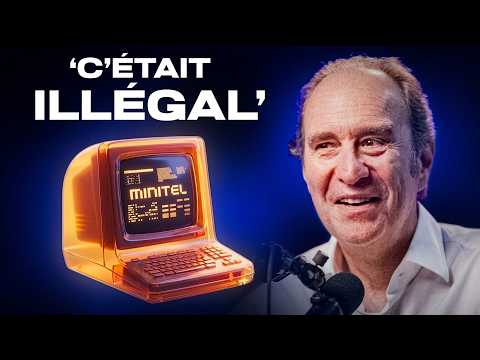
Comment Xavier Niel avait bâti un empire clandestin, avant Internet
AI Summary
Xavier Niel, the prominent French entrepreneur, shares the story of how he became a millionaire at age 24, not through the Internet, but via the Minitel. This forgotten French network was a precursor to the modern digital economy, featuring a free terminal in every home, an integrated payment system, and a revenue-sharing model that functioned like an App Store forty years before the term existed. Based strictly on Niel’s account, this summary explores the technical innovations, bold business maneuvers, and the "pirate" mindset that built his empire.
### The Minitel Revolution and Technical Disruptions
The Minitel was born from a period of intense French innovation, alongside the Concorde and the TGV. The government decided to digitize the country by distributing small terminals—a keyboard, a screen, and a connection—to every household for free. This created a closed network using the X25 protocol. To monetize it, the state established a "kiosk" system: users paid through their telephone bills, and the service providers received a portion of that revenue.
At the time, major media outlets dominated the Minitel because obtaining a service code required a "press commission number." However, the technical execution by large IT firms was inefficient and expensive. They used million-franc "mini-computers" that could only handle one task per user, making the infrastructure bulky and slow.
Niel, still a student, saw an opportunity for disruption. He realized he could replace these massive machines with standard PCs. By using a specific hardware card and writing software that managed hundreds of users within a single task—retaining a "state" for each user rather than launching a new process—he achieved massive scalability. While competitors spent millions, Niel spent only 20,000 francs on a setup that could host thousands of users. This efficiency allowed him to offer media partners a much higher revenue share (initially 50%, eventually 80%), effectively pricing his competitors out of the market.
### The Rise of "Minitel Rose" and the "Free" Brand
While the Minitel hosted weather and train schedules, the real drivers of traffic were astrology, games, and "Minitel Rose"—erotic chat and dating services. Niel notes that modern platforms like Tinder or Meetic are simply evolutions of these early Minitel concepts. For Niel, these services were incredibly lucrative because they relied on interactivity and long connection times.
The origin of the brand name "Free" is tied to this era. Niel managed a Minitel dating service called "3615 FREE" for the newspaper *Nice-Matin*. When the paper was bought by the Hachette group, Niel wanted to reclaim full ownership of the brand. He called the new director and described the service as a scandalous, sex-heavy platform and threatened to launch a massive advertising campaign featuring "nude girls" in Nice. Panicked by the potential reputational damage, the director handed over the "Free" brand for nothing, allowing Niel to secure the name for his future telecommunications empire.
### The Pirate Mindset and Legal Battles
Niel describes himself as coming from the "underground" world of hacking. In his youth, he and a small group of friends used the X25 network to bypass security, hack into international machines, and host "pirate" sites to share software or hacking tutorials. This culture was deeply linked to the Parisian catacombs, where hackers and tech enthusiasts mingled.
This lifestyle eventually led to legal trouble. Niel was arrested by the DST (French intelligence) for hacking phone numbers, including those belonging to the Élysée Palace. Rather than just punishing him, the authorities used him to help establish the first unit dedicated to fighting computer crime.
Another major legal hurdle involved "scrapping" before the term was common. To create a reverse directory (3617 ANU), Niel needed France Télécom’s subscriber database, which they refused to sell. Niel’s solution was to build "farms" of hundreds of Minitels connected to PCs. These machines would constantly query the official directory for free (taking advantage of a three-minute free window) to extract and update a private database of 25 million French citizens. France Télécom sued, and Niel was hit with a 100-million franc judgment. However, this battle eventually forced a change in the law, making such databases accessible to the public for technical costs, a standard that exists to this day.
### From Minitel to Internet and AI
Niel’s transition to the Internet was driven by chance rather than certainty. He met another hacker who wanted to launch an ISP, and Niel agreed to try it, though he initially doubted it would succeed. Within two years, the heads of France’s largest companies were visiting his office to see demonstrations of the web. He applied the same philosophy to Free that he had to Minitel: extreme efficiency, in-house design of all hardware and software, and a refusal to outsource.
Today, Niel’s focus has shifted to Artificial Intelligence. He co-founded Kyutai, a non-profit AI research lab, with an investment of 300 million euros alongside partners like Rodolphe Saadé and Eric Schmidt. The goal is to keep French talent in France and provide an open-source alternative to US and Chinese dominance.
The lab's first major breakthrough is "Moshi," a voice-to-voice AI. While other models convert voice to text and back again—a slow process—Moshi works directly with audio tokens. This allows for "full duplex" communication, meaning the AI can talk and listen simultaneously with no perceptible lag, mimicking human conversation. Niel takes pride in the fact that a small team of eight "geniuses" in Paris produced a model that garnered global attention, proving that efficiency and talent can still disrupt markets dominated by giants.