Why the Colorado River Doesn’t Reach the Ocean
Audio Summary
AI Summary
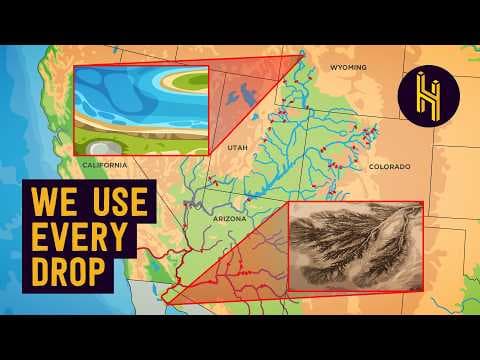
The Colorado River, a seemingly exceptional waterway, presents a paradox by not flowing into any larger body of water, instead petering out into nothingness. This unique behavior stems from the arid region it traverses, encompassing states like Colorado, Utah, Arizona, Nevada, California, and parts of Mexico, along with tribal lands. Despite its origin at a high elevation, the river's waters are heavily diverted to sustain life and agriculture in these dry environments.
The journey begins in Colorado, where the city of Fort Collins, surprisingly located on the opposite side of the Continental Divide from the river's western drainage, taps into its flow. This diversion is facilitated by tunnels, allowing water to be moved from the wetter western slopes to drier areas. The river then continues through Colorado, Utah, and Arizona, where cities like Grand Junction utilize a portion of its water for irrigation, enabling the growth of crops like melons.
As the Colorado River enters the more arid regions, its flow is significantly impacted by human consumption. Las Vegas, for instance, draws water from Lake Mead, created by the Hoover Dam. While Vegas is noted for its water efficiency, returning treated indoor water for reuse, the downstream diversions are substantial. Lake Havasu sees 8% of the water diverted to Southern California cities like Los Angeles and San Diego. Further downstream, Phoenix and Tucson rely heavily on an 11% diversion to a vast canal, underscoring its critical role in supporting these rapidly growing urban centers.
The river's flow is further diminished by agricultural demands. The Imperial Valley in California receives 20% of the river's flow, making it a vital agricultural hub, particularly for winter produce. By the time the Colorado River reaches the US-Mexico border, only about 10% of its original flow remains. This remaining water is allocated to Mexico under a 1922 international agreement, which, along with promises to Native American tribes, has led to an over-allocation of the river's resources. The agreed-upon 16 million acre-feet of annual flow is often more than the river can provide, exacerbated by climate change and reduced snowpack, leading to ongoing renegotiations and disputes.
The consequence of these numerous diversions is that the Colorado River, for most of the year, does not reach the ocean. The water that does pool beneath the final dam is minor, stagnant, and derived from leakage and runoff, eventually drying up. This depletion has had a significant impact on the Colorado River Delta's ecology. Historically a vibrant habitat for birds and fish, the delta's ecosystem suffered greatly from the lack of freshwater.
However, an experiment in 2014 demonstrated the ecosystem's resilience. When water was released downstream, the delta showed signs of recovery, with insects, birds, and plants returning. Unfortunately, this ecological restoration was short-lived as funding ran out and water diversions resumed, prioritizing other uses, such as irrigating golf courses.
Given this reality, the speaker suggests referring to the Colorado River as the "Colorado water feature" rather than a true river, highlighting its altered state. The video then transitions to a sponsorship message from Storyblocks, a provider of stock media assets, emphasizing their value for content creators and offering a discount on annual plans.