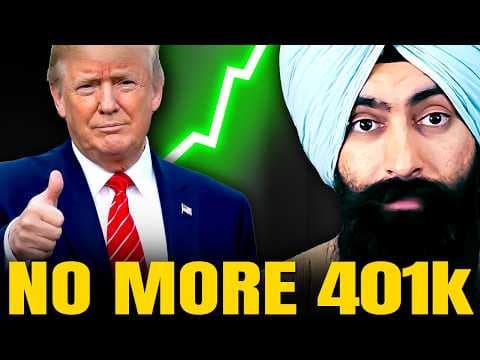
Trump's 2026 Plan To Reset The 401k
Audio Summary
AI Summary
President Trump has signed an executive order to create a new retirement savings vehicle for Americans, called the Trump IRA, which aims to address several perceived problems with the traditional 401k. The Trump administration identifies three main issues with the 401k: high fees, limited access, and lack of portability.
The average 401k in the U.S. is criticized for charging high fees, which divert wealth from individuals to money managers on Wall Street. Many Americans also lack access to a 401k through their employers, preventing them from building wealth through this mechanism. Additionally, 401ks are not easily transferable between jobs, making it difficult for individuals to move their retirement savings when changing employment. The Trump IRA is designed to reset how Americans approach retirement by addressing these shortcomings and potentially impacting the economy, stock market, and investment opportunities.
To understand the Trump IRA, it's essential to first grasp the concept of a 401k. A 401k is a tax-deferred retirement account where individuals contribute money, which then grows tax-free until retirement. There are two main types: a traditional 401k, where contributions are pre-tax and withdrawals are taxed in retirement, and a Roth 401k, where contributions are post-tax, and qualified withdrawals are tax-free. The key requirement for a 401k is that it must be offered by an employer.
The Trump IRA aims to be universally accessible, unlike the 401k. The Trump administration estimates that approximately 56 million American workers do not have access to a 401k. The Trump IRA would be available to any worker in the United States, regardless of their employer's offerings.
Regarding fees, the average 401k fee was 1.26% in 2025, according to Kiplinger. The Trump IRA, however, proposes a fee cap of 0.15%, significantly lower than the average 401k. This reduction in fees is intended to ensure more of an individual's wealth remains in their pocket.
Portability is another major advantage of the Trump IRA. Unlike 401ks, which are tied to an employer and can be difficult to transfer when changing jobs, the Trump IRA is associated with the U.S. government. This means individuals can maintain their Trump IRA regardless of their employment status.
Minimum investment requirements are also addressed. While 401ks often have minimum monthly contributions (e.g., $50-$100), the Trump IRA would allow individuals to start investing with as little as $5, making it more accessible to those with limited funds.
Perhaps one of the most significant differences lies in contributions. Many employers offer a matching contribution to their employees' 401ks, effectively providing free money. The Trump IRA, being government-sponsored, would not have employer matches. Instead, the government would provide a matching contribution of up to $1,000 annually, subject to income qualifications. This means the government would be injecting money directly into individuals' retirement accounts and, consequently, into the U.S. stock market. This $1,000 contribution is not a one-time offer but a potential annual contribution for qualifying individuals.
To qualify for the full $1,000 government contribution, a single person must earn under $20,500 per year, or married tax filers must earn under $41,000 per year. The government's contribution is a 50% match, meaning an individual must contribute at least $2,000 annually to receive the full $1,000 government match. For those earning between $20,500 and $35,500 (single) or $41,000 and $71,000 (married), a partial government match may still be available. Individuals earning above these thresholds would not qualify for any free money from the government.
The impact of fees is a crucial aspect of investing. Regardless of whether one uses a 401k, IRA, or Trump IRA, all investment funds (mutual funds, ETFs, index funds) have fees, known as expense ratios. For example, investing $500 per month for 30 years with an 8% annual return and an average 401k fee of 1.26% would result in approximately $540,000 at retirement, with $139,000 going to fees. In contrast, with a 0.15% fee, the retirement sum would be around $660,000, with only about $19,000 paid in fees over 30 years. This highlights the substantial long-term impact of even small differences in fees. Investors are encouraged to examine their expense ratios and ensure that higher fees are justified by better returns.
The funding mechanism for the government's contributions to the Trump IRA raises economic concerns. The U.S. government's finances currently show a significant deficit. In 2026, the government is estimated to generate $5 trillion in taxes but spend approximately $7 trillion, resulting in a $2 trillion gap covered by debt. If the government starts funding Trump IRAs, its expenses will increase further. The two primary ways to fund this would be raising taxes or increasing debt. Given recent tax cuts, raising taxes appears unlikely. Therefore, increased debt is the more probable path.
The government borrows money from individuals, foreign countries, and the Federal Reserve Bank. The Federal Reserve Bank, despite its name, is not a traditional bank and does not hold cash reserves. Its unique power is to print money. If the Federal Reserve prints money to lend to the government to fund Trump IRAs, it could lead to inflation. Money printing does not create wealth; it increases the supply of dollars, which decreases the value of each dollar and causes prices to rise. Thus, the Trump IRA, if funded through money printing, could contribute to inflation.
This situation also creates investment opportunities. The stock market, like any other asset, is priced based on supply and demand. More buyers than sellers drive prices up. The Trump IRA aims to increase access to the stock market for more individuals and directly inject government-printed money into the market. It is estimated that the Trump IRA could lead to an additional $32 billion to $68 billion entering the stock market. This influx of capital, combined with increased participation, could boost the stock market.
For investors, this signals an opportunity to "own where the money is moving." Historical trends show that initiatives like 401ks, IRAs, and free brokerage accounts have injected more money into the stock market. The Trump IRA is seen as a new way to bring regular people and government funds into the market, potentially keeping it afloat.
While this influx of money could boost the stock market, it doesn't eliminate market volatility, crashes, or recessions. In fact, injecting "free money" into the market can increase volatility, leading to bigger swings up and down. However, market downturns also present significant buying opportunities for savvy investors to acquire good investments at lower prices.
Investors can participate in the stock market through various funds. For broad market exposure, funds like VTI (Vanguard Total Stock Market ETF) cover the entire U.S. stock market. For exposure to the largest companies, SPY (SPDR S&P 500 ETF Trust) tracks the S&P 500. These funds allow investors to gain exposure to the American economy and stock market.
The Trump IRA is scheduled to begin in early 2027. It is expected to achieve two main outcomes: increase buyers in the stock market by expanding access, and potentially create more inflation due to the government's need to fund contributions through increased debt and money printing. While increased investment benefits investors by making asset prices more valuable, the inflationary impact could hurt the average person's salary and savings. Understanding these economic dynamics is crucial for individuals to navigate and potentially thrive within the system.