What comes after Donald Trump? | America, Actually
Audio Summary
AI Summary
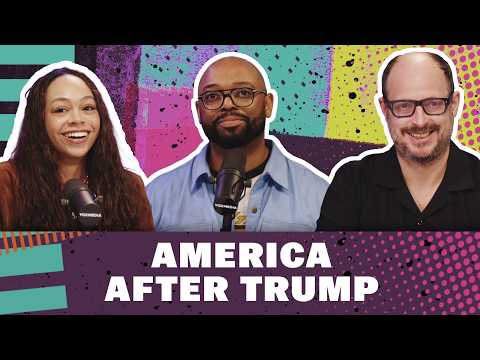
This episode of "America Actually" explores the future of US politics beyond Donald Trump, aiming to be a safe space for political discussion. Host Stedman Herndon is joined by culture writer Hunter Harris and statistician Nate Silver to discuss who and what will shape the post-Trump era.
The initial premise of a "Trump-free" political discussion is debated. While Trump has dominated political discourse, some argue he is more a symptom than a cause of underlying societal issues. The Republican Party, for example, built a coalition that was perhaps always unstable, and Trump capitalized on existing populist, xenophobic, and racist sentiments. Hunter Harris suggests that Trump represents the only true "monoculture" remaining, driven by a reactive, drama-queen persona more concerned with media attention than setting an agenda. This leads to the idea that a post-Trump-focused show can exist because he isn't truly driving policy, but rather reacting to events.
The discussion then shifts to individuals likely to shape the future. Obvious presidential candidates like Gavin Newsom, J.D. Vance, Kamala Harris, and AOC are acknowledged, but the focus moves to less conventional figures. Nate Silver highlights Zoran Mamdani, the mayor of New York, as a rising political figure. Mamdani is seen as fresh, pragmatic, and popular, demonstrating a "proof of concept" for a leftist politician who can also be seen as reasonable and moderate. This contrasts with figures like Kamala Harris, who struggles to appeal to both centrists and liberals. On the Republican side, J.D. Vance's appeal is questioned, especially given his narrow win in Ohio. The growing split within the GOP over issues like the Iran war, with figures like Tucker Carlson openly opposing some stances, suggests a potential shift away from Trump's monolithic influence.
Hunter Harris agrees on Mamdani's importance, noting the Democratic Party's slowness to adapt to culture compared to the right, which is less concerned with "politeness." The right's candidness and casual approach, exemplified by Trump and Vance, appeal to some voters, while the left is perceived as "wonkier." Mamdani, however, manages to be relatable and casual online without resorting to ineffective "clapback" viral moments. His ability to impress Trump, a difficult feat, further underscores his unique political talent. The hosts consider whether Mamdani's success is due to his articulation of public sentiment or simply his youth and charisma; it's concluded to be a combination of both, particularly his focus on affordability over ideological battles.
The conversation moves to demographic shifts. While the idea that a "blacker and browner" America inevitably leads to a liberal direction has been challenged, demographic changes continue to reshape politics and culture. Generational divides within Black, Hispanic, and Asian American communities are highlighted as particularly important, with "40" serving as a rough dividing line for formative political experiences. Nate Silver, at 48, recalls the end of the Cold War and 9/11 as defining moments, fostering a degree of conservatism. Hunter Harris, 31, identifies Obama's and Trump's presidencies as her formative experiences. The "post-racial America" optimism following Obama's election was shattered by Trump's rise, leading to widespread anxiety and a lack of stability.
The lessons learned from the 2016-2024 political arc are then discussed. Hunter Harris believes the biggest lesson is that "if you simply just keep talking, if you stay on stage, you can get through anything." This contrasts sharply with the Obama era, where scandals had a longer shelf life. Trump's presidency normalized a rapid turnover of "insane moments," driven by both internet speed and his own behavior. This has eroded the "nice guy finish first" mindset, introducing a "reality TV sensibility" to politics where an "idyllic life" is no longer a prerequisite for a presidential candidate.
The discussion transitions into a "game" where the hosts categorize questions about the country into three buckets: America's role in the world (foreign policy), affordability and domestic issues (kitchen table), and societal/cultural issues (culture).
Under "Society and Culture," Nate Silver asks how a leftist politician can "harness and capitalize the manosphere." This points to the growing influence of independent media ecosystems and influencers, and the challenge of reaching young men, particularly given the misogynistic undertones of some online communities. Hunter Harris connects this to a broader "loneliness crisis," exacerbated by the pandemic, where people engage with the world digitally rather than physically. Nate Silver also questions whether cultural "vibe shifts" are happening so rapidly they don't even last a single presidency, noting the significant difference between the 2020 and 2024 elections. This suggests that rising trends might not be sustainable, and derivative attempts to replicate success often fall flat. The issue of media consolidation and changing trust is also raised, with people increasingly relying on individual recommendations rather than top-down expert opinions. Hunter Harris suggests the "anti-elite moment" might be a trend rather than solely driven by facts, noting Trump's hypocrisy on issues like the Epstein files. She hopes for a pendulum swing back towards valuing intelligence and learnedness, despite the current state of media literacy.
For "Kitchen Table" issues, the discussion focuses on healthcare costs as a major driver of financial strain. The rising cost of everything, even a McDonald's McChicken, is attributed partly to algorithmic models that induce spending and the increasing sophistication of businesses in extracting profit. The aging population and housing costs are also cited as significant factors. Nate Silver raises the crucial question of what happens when white-collar workers fear AI will take their jobs. He emphasizes the rapid advancement of AI, which is becoming increasingly capable of performing tasks traditionally done by accountants or lawyers, potentially fundamentally altering future economies and political races. Hunter Harris, however, is not concerned about AI taking her job, believing it lacks her humor and encyclopedic knowledge of pop culture. The issue of entertainment monopolies (like Netflix and Paramount) is also brought up as a concern, not only for consumer choice but also as a labor issue, putting jobs at risk.
Finally, in the "Foreign Policy" bucket, Hunter Harris humorously asks "what will be done about Drake," indicating a lighter moment. More seriously, the changing sentiment around Israel is identified as a significant issue reshaping both parties. While foreign policy issues like Israel-Gaza may not be top concerns for the average swing voter, they are highly important for Democratic primary voters, creating complications for both parties. Public opinion toward Israel has worsened, leading to internal divides within the Democratic Party and unusual coalitions on the Republican side regarding the Iran war. Nate Silver also questions whether America's declining global standing and reputation, along with a potential loss of confidence in the US dollar, will lead to a worsening of all aspects of American politics and a profound sense of national anxiety.
Despite the "doomery" nature of many of these outlooks, the hosts try to end on a hopeful note. Hunter Harris admits to not feeling confident about anything positive, but Nate Silver points to two encouraging trends: increased voter turnout, indicating greater political participation, and early evidence that AI might push people towards expert opinion rather than social media, potentially fostering a return to greater media literacy. Hunter Harris adds that the past era has starkly exposed the brokenness of the political system, empowering voters and increasing their agency and motivation to demand change. The cyclical nature of politics suggests that after 40 years of rising polarization, an inflection point, flattening, or even a reversal might be on the horizon.