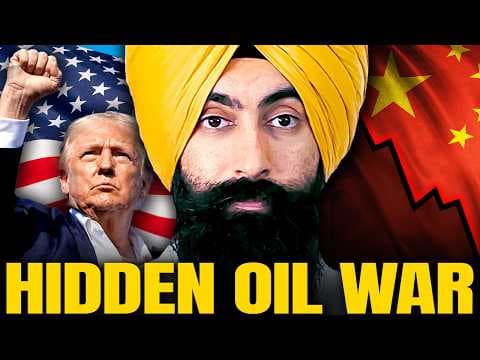
Trump Just Started A War Most Americans Don't See
Audio Summary
AI Summary
The current geopolitical situation in the Middle East, while drawing attention to Iran, has significant implications for global economics, particularly for China and its competition with the United States. The core of this economic dynamic revolves around oil, specifically Iran's oil exports and China's role as the primary buyer.
China is the largest purchaser of Iranian oil, and crucially, it has been acquiring this oil at a substantial discount, below market value. This price advantage for China translates directly into lower production costs for a wide range of goods. Cheaper oil means China can produce energy, plastics, fertilizers, and virtually any manufactured product at a lower cost. This cost advantage is vital because the United States and China are in direct economic competition. The Chinese economy has been experiencing significantly faster growth than the U.S. economy, leading to projections that China's economy could surpass that of the United States within the next decade.
The United States' recent actions, specifically blockading Iranian oil, might seem counterintuitive given high global oil prices. The conventional wisdom is that increasing the supply of oil would lower prices. However, the U.S. strategy is not primarily aimed at hurting Iran, but rather at hindering China's economic competitiveness.
Oil is a fundamental commodity that underpins nearly every sector of the economy, from manufacturing and transportation to the production of plastics and fertilizers. When oil prices surge, as they have due to conflicts in the Middle East, the cost of virtually everything increases. This inflationary pressure is a major concern for the U.S. economy, potentially leading to a recession, stock market downturns, and a general rise in the cost of living, from gasoline to groceries.
A significant factor contributing to the initial rise in oil prices was Iran's blockade of the Strait of Hormuz, a critical chokepoint for global oil transit. Disrupting this passage reduces the global oil supply, inevitably driving prices up. However, the situation has recently shifted, with the United States now implementing its own blockade. The U.S. objective is to prevent Iran from selling its oil to the international market, and by extension, to deny China access to this discounted energy source.
The transcript highlights that approximately 90% of Iran's oil exports are destined for China. By cutting off this supply, the U.S. aims to increase China's energy costs, thereby impeding its ability to produce goods cheaply and compete with American businesses. This move is part of a broader U.S. strategy to counter China's growing economic and geopolitical influence. Concerns about China's rapid economic expansion, its efforts to establish an alternative currency to rival the U.S. dollar, and its potential to become the next global superpower are driving these actions.
The economic disparity between the U.S. and China is stark. China's economy has been growing at roughly 4% annually, compared to the U.S. economy's approximately 2% growth. This differential fuels the projection of China's economy becoming larger than the U.S. economy in the coming years. The U.S. dollar's status as the world's reserve currency is a key pillar of American economic power, enabling the U.S. government to spend beyond its means due to the global trust in the dollar. This trust, established after the U.S. left the gold standard in 1971, allows the Federal Reserve to print money, though it carries the risk of inflation. The U.S. economy heavily relies on government spending, which fuels businesses and creates jobs. A reduction in this spending, which could be a consequence of losing its reserve currency status, would have severe economic repercussions.
China's efforts to strengthen its economic position are evident in its aggressive acquisition of physical gold, a traditional safe-haven asset, especially during times of inflation and currency printing. This move, along with its economic growth and potential to challenge U.S. hegemony, is viewed with concern in the U.S.
The transcript also touches upon other U.S. strategies to counter China, such as the imposition of tariffs. While stated reasons include revenue generation and reshoring manufacturing, a significant underlying goal was to disrupt China's economy by making it more difficult for U.S. companies to operate there, thereby encouraging them to relocate. Similarly, U.S. actions in regions like South America, such as intervening in Venezuela, are seen as indirect ways to undermine China's access to resources like oil.
From an investor's perspective, the key takeaways are:
1. **Inflation:** Higher oil prices contribute to inflation. Inflation benefits asset owners and lenders while diminishing the purchasing power of cash and savings, making savers and the average person poorer.
2. **Market Volatility:** Geopolitical events and economic shifts cause market volatility. While market crashes create buying opportunities, timing the market is extremely difficult and often leads to missed opportunities.
3. **Investment Opportunities:** During inflationary periods, certain assets tend to perform well, including gold and real assets like real estate. In times of conflict, defense and energy stocks often see gains. Nuclear and uranium stocks can also benefit from concerns about energy security.
4. **Financial Education:** Building financial literacy is crucial. The media often sensationalizes events with emotion (fear, greed), but a solid understanding of economic principles allows investors to identify opportunities and make informed decisions.
The transcript concludes by emphasizing the importance of understanding where money is moving in the economy, rather than relying on emotional reactions or the pronouncements of media outlets. It stresses that astute investors seek to identify opportunities by analyzing underlying financial trends and that proactive financial education is the best way to secure one's financial future. The speaker also promotes their free newsletter, "Market Briefs," and an accompanying investing masterclass as resources for investors. Finally, it briefly mentions a future event on May 15th, 2026, concerning a change in the Federal Reserve chairman and a plan to address the U.S. debt crisis, hinting at potential significant economic impacts for the public.